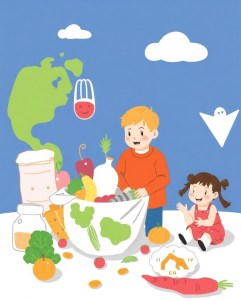
When my class was asked “Would you rather have too much food which only you could eat or eat slightly less than your current portion?” most had chosen having too much food, but that’s not a good thing. We humans used to be nomads as well as hunters and gatherers, so we are able to survive on 1 meal a day (not that we should now, though). It means it’s in our genes to eat by foraging from natural sources and be able to fast for long hours at a time.
All the food that you wouldn’t eat would go to waste and end up in landfills. Now I’ve heard many people say to finish the food on their plate, but why buy excess amounts of food in the first place if you’re not able to finish it? Last year in 2023 alone, 1.05 billion tons of food was wasted, or 10 trillion 5 thousand kilograms. 783 million people starve throughout the world. Ironically, Tunisia, Egypt, and Tanzania, who all produce the most food waste in Africa, also have more than 20% of their population malnourished.
_______________________________________________________________________
Read Also: Study shows universally positive effect of cover crops on soil microbiome
________________________________________________________________________
Having this large amount of food wasted comes with a few side effects. One is an increase in greenhouse gas emissions. Greenhouse gases (GHG) are any gases that can absorb infrared radiation emitted from Earth’s surface and redirect it back to Earth’s surface. In simpler words, these are gases which absorb heat energy and are unable to leave the atmosphere, trapping heat inside. That can cause smog and air pollution, depletion of the ozone layer (which can lead to many humans getting diseases like skin cancer), and global warming, which is when the Earth starts to get significantly hotter, melting ice caps and making sea levels rise. To let all this happen would be as stupid as a sloth!
Food worth 1 trillion US dollars, or 1/3 of the world’s food, is being wasted each year! Wasting this much food has a carbon footprint of 3.3 billion tons, being a main contributor to climate change. Everyone knows water is essential for our livelihood and, more than that, the environment. Food wastage can also pollute water bodies. It can cause decomposition and oxygen depletion, physical blockage, nutrient overload (which is also known as eutrophication), spread of pathogens, or release of harmful substances. Worse, it can happen all at once!
_______________________________________________________________________
Read Also: Innovative Technologies That Can Make Indian Agriculture Resilient to Climate Change
________________________________________________________________________
There is also a difference between food loss and food wastage. Food loss is when something happens during processing, storage, transport, or production, like trees of bananas being destroyed because of a hurricane. Food wastage is when something happens in its consumption phase, when and after it has reached retailers, like some bread expiring. Now the top 3 countries wasting the most food also have the highest populations: China at 91 million tons, India at 68 million tons, and, with a huge gap, the US at 19 million tons. Many people justify this by saying India and China have a much larger population, but I think it’s absolutely absurd to even rationalize food waste so simply. No matter the population, we shouldn’t waste food.
A study in China from 2018 shows that around 12% of every meal was being wasted; in a year, it accumulated enough to be able to sustain 30-50 million individuals. That’s just in China alone! 10% of the world is starving, but still 1/3 of our food is wasted!? This shouldn’t happen any further – not just our population is suffering, but our planet is too. I think that we are way more advanced and clever than we were earlier, so I’m sure if we set our minds to it, we can tackle this world-changing problem.
We can tackle this crisis by:
- Not buying unnecessary groceries
- Buying fruits no matter how funky they look (if they are still good to eat)
- Moving older products to the front of your fridge so you don’t forget about them
- Not visiting buffets very often
- Donating surplus food
I hope we can reduce, if not fully remove, food waste to benefit us and the environment!
Tags: #AirPollution, #earth, #food, #getgreengetgrowing, #globalwarming, #gngagritech, #greenstories, #health, #humans, #ozonelayer, #portion, #waste