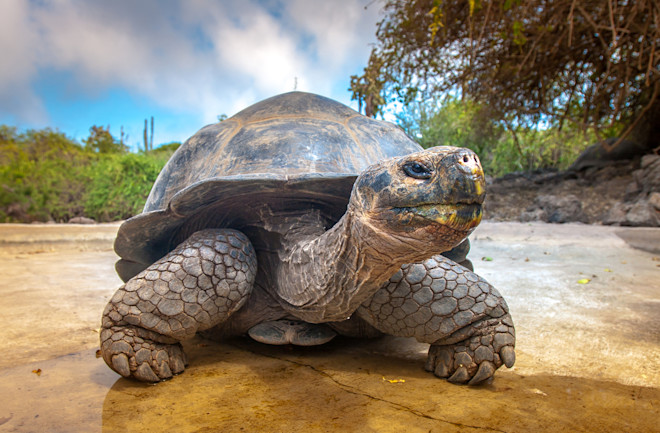
Learn about the unique way turtles create their scales and how it’s revealing an ancient evolutionary link to dinosaurs, crocodiles, and birds.
How Do Turtles Make Their Scales?
Typically, animals create their scales or feathers using placodes. Placodes are special areas of the skin controlled by genetic signals. These very specific genetic signals tell the skin to create the required appendage and what area it should grow in.
The other way an animal can produce scales is through purely mechanical processes like skin folding. As the skin grows at different rates, it will fold and bend in particular patterns and create the scales.
_______________________________________________________________________
Read Also : Implementing Artificial Intelligence in Waste Management
_______________________________________________________________________
Turtles are an anomaly, however, as they use both placodes and mechanical folding to create the scales on their head. On the side of their head, the scales are formed using placode development, similar to birds. But for the top of their head, the scales are formed mechanically, more like a crocodile.
Researchers were able to identify these differences by using 3D light-sheet microscopy and computer modeling. Their findings showed that the diverse and irregular patterns of scales on a turtle’s head were the result of mechanical skin folding.
“This mechanical folding explains the asymmetrical shapes of the scales on the top of the head,” said Rory Cooper, postdoctoral researcher and co-author of the study, in a press release.
Another co-author, Ebrahim Jahanbakhsh, added that the mechanical folding “also accounts for the remarkable variation seen between individuals, and even between the left and right sides of a single individual’s head.”
Turtle Scales and Reptile Evolution
Although it may seem like a small detail, the dual scale-creation processes used by turtles are incredibly significant for the story of reptile evolution. The closest living relatives to tortoises and aquatic turtles are crocodiles and birds. While turtles and crocodiles are now known to share a mechanical process, their other relatives — birds — do not.
_______________________________________________________________________
Read Also : Waste management a grave problem in Dharamsala
_______________________________________________________________________
What this suggests is that a mechanical process for forming head scales was a trait from a shared ancestor of all three animals that was eventually lost in birds. The common ancestor in question? Likely a dinosaur.
“This reveals a new facet of reptile evolutionary history: the ability to generate head scale patterns through mechanical forces is an ancient trait — predating the emergence of modern turtles, crocodiles, and birds, and therefore most likely present in dinosaurs,” said Michel Milinkovitch, professor in the Department of Genetics and Evolution at the University of Geneva, in the press release.
The evolutionary implications are not the only big news to come out of this discovery. By understanding more about how nature creates complex structures and patterns, such as scales, we can replicate these processes in areas like architecture, tissue regeneration, and innovative material design.
NOTE – This article was originally published in discovermagazine and can be viewed here