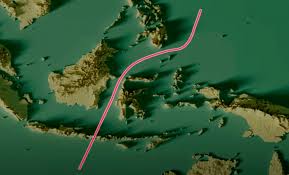
The Wallace Line is an invisible boundary that has baffled scientists for centuries, keeping entire species divided across continents!

Wallace’s Line, an imaginary boundary that separates the unique animal kingdoms of Asia and Australia, has fascinated scientists for over a century. As species on either side of this line evolved in dramatically different environments, it has shaped how animals adapted to their surroundings. Recent research, including a groundbreaking study published in Science in 2023, has provided fresh insights into the geographic and climatic factors that continue to define this invisible boundary, offering clues into the ongoing evolution of life on Earth.
The Origins of Wallace’s Line
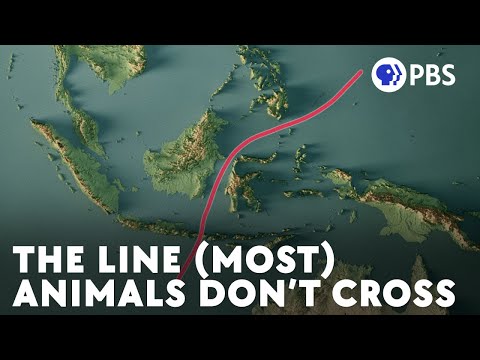
The concept of Wallace’s Line, first identified by naturalist Alfred Russel Wallace in the 19th century, has long intrigued scientists. This line represents a stark division in the types of species that inhabit the islands and lands between Asia and Australia, despite the geographical proximity of the two continents. The boundary is not just a superficial divide, but rather a reflection of millions of years of tectonic and climatic shifts that have shaped biodiversity.
Geological Foundations of Wallace’s Line
About 30 million years ago, the Australian tectonic plate began drifting away from Antarctica, which played a crucial role in the formation of Wallace’s Line. This event created the conditions for the rise of the Antarctic Circumpolar Current (ACC), a major ocean current that encircles Antarctica. This shift not only affected ocean currents but also had a profound influence on global climate patterns. “When Australia drifted away from Antarctica, it opened up this area of deep ocean surrounding Antarctica which is now where the Antarctic Circumpolar Current (ACC) is,” explained Alex Skeels, lead author of the study.
The separation of Australia from Antarctica had a direct impact on the species evolution in both regions. While Asia’s tropical environments facilitated the spread of a diverse range of species, Australia’s evolutionary path diverged due to its increasingly cooler and drier climate. Skeels further explained,
“This dramatically changed Earth’s climate as a whole; it made the climate much cooler.” This cooling had a specific impact on Australian species, however, which were not as affected by the shift. As Skeels points out, “This was not the case for the Australian species. They had evolved in a cooler and increasingly drier climate over time and were, therefore, less successful in gaining a foothold on the tropical islands compared to the creatures migrating from Asia.”\
_______________________________________________________________________
Read Also : Scientists found a ‘geological heartbeat’ that is forming a new ocean and splitting Africa in half
________________________________________________________________________
Wallace’s Line: A Natural Evolutionary Barrier
Wallace’s Line is not just a geographical division but also a biological one. On one side, the Asian continent hosts species like tigers, elephants, and monkeys, while on the other side, Australia is home to unique marsupials, monotremes, and reptiles. This divide has remained remarkably stable over millions of years, even as sea levels fluctuated and the climate shifted.
“This could help us predict which species may be better versed at adapting to new environments, as changes to Earth’s climate continue to impact global biodiversity patterns,” Skeels noted.
These predictions could become increasingly important as the planet faces rapid climate change and shifting ecosystems.
The Role of Climate in Animal Evolution
The differing climates of Asia and Australia played a fundamental role in shaping the evolutionary history of the species on each side of Wallace’s Line. In Asia, species adapted to tropical and humid environments, allowing for greater diversity and mobility. On the other hand, Australia’s drier, cooler conditions forced species to adapt in different ways. The dry environments created fewer opportunities for migration, and as a result, animals on the Australian continent evolved in isolation.
Climate also played a role in the physical adaptations of species. Australian marsupials, such as kangaroos and koalas, developed unique ways of surviving in their harsh environment, while their Asian counterparts developed different traits suited to the tropical climate. The evolution of these species showcases the importance of climatic conditions in shaping not only physical characteristics but behavioral patterns as well.
NOTE – This article was originally published in the Indian Defence Review and can be viewed here