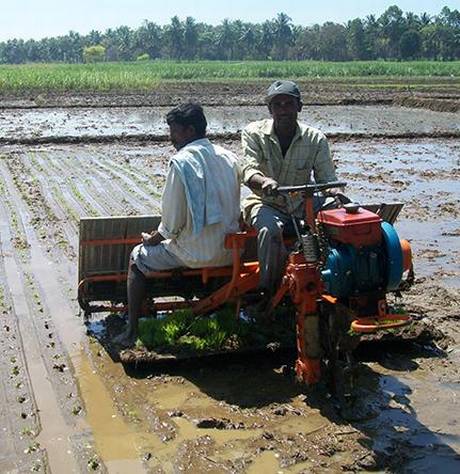
Punjab’s identity presents itself as a synonym for agricultural prosperity & the state helped extensively in achieving food security for Indians during the green revolution.(water crisis) The role of Punjab, Haryana & western UP cannot be denied in any way, shape, or form, but the shadows of that revolution is starting to haunt these areas due to which the whole future of these states seems to be in peril.
Punjab & Haryana were at the forefront of the green revolution which started with the objective to achieve food security in India in the ’60s but after 50+ years, the policies accepted during the movement continue to shape the agriculture sector up to a great extent.
_______________________________________________________________________
Read Also : Shrub encroachment on grasslands can increase groundwater recharge
________________________________________________________________________
During recent years India has witnessed a strong case of water crisis which includes unavailability or inadequate availability of water combined with water pollution. These problems affect all parts of India alike but the case of Punjab comes out a being one of the peculiar cases which we will observe closely in this article.
Punjab, agriculture & water
The word Punjab means the land of five rivers & the area is considered to be one of the most fertile lands in the world. Owing to that, Punjab is one of the frontrunners in the wheat & paddy production sector of India. So why is the future of this state in peril?
Well, the simple answer to this question is, that the land of five rivers is facing an unprecedented water crisis like never before & if not taken seriously, Punjab will be rendered a desert within 25 years, says a draft report of the central groundwater board (north-western region). In the same report, it is mentioned that in 110 out of 138 blocks is the state, the water sources are overexploited. I.e. the water sources are under great stress to meet the demand in stated blocks & require intensive vigilance, monitoring & evaluation.
_______________________________________________________________________
Read Also : The effect of groundwater contamination
________________________________________________________________________
Punjab has water, but due to political obligations & treaties, the water is heavily divided leaving the state in a present condition of water inadequacy. The demand for irrigational water is 4.45m-ham which is certainly more than the available 3.04 m-ham. The difference indicates that the supply cannot match the demand quotas, but the production rate is going up. So, where is the water coming from? The water is not magically appearing from any place but it is the present groundwater that is being exploited at a heavy rate.
Coming to agricultural productivity, the state shares a huge margin in the overall production of the nation which can be seen through the following states:
- The amount of wheat produces in FY 2011-12 in India was 94.88 million metric tons out of which the state of Punjab contributed 17.28 million MT.

- The amount grew to 106.21 million MT in FY 2019-20 out of which Punjab attributed for 18.26 million MT of wheat.
- The amount of paddy (rice) produced during FY 2019-20 in India was 117.47 million MT & 12 million MT was from the state of Punjab.
These figures show consistency in terms of production values but what these figures hide is the consistency of the rate at which the present resources are being exploited. 82% of the state faces a huge decline in groundwater figures, with places like Sangrur & several other districts placed under the dark zone.
Scary stats & figures related to the water crisis
The reality presents us with figures which are scary at first sight, these stated figures are:
- The groundwater level was 2.44 million acre-ft. (MAF) in 1984 which dropped to -11.63 MAF in 2013.

- The amount of water required to produce 1 kg of paddy in Punjab was 5337 liters/kg compared to the national average of 3875 liters/kg in 2013-14
- The primary consumer of groundwater is paddy & water consumption for stated crop went from 16,642 billion liters in 1980-91 to 59,047 billion liters in 2013-14.
- The electricity consumption rose 1652 times from 1970-71 to 2015-16 whereas the gross cultivated area increased only by 1.38 times
- The area under irrigation via tube well increased from 56% in 1970-71 to 71% in 2014-15 whereas irrigation via canal declined from 45% in 1970-71 to 29% in 2014-15. This indicates drying up of canal & over usage of groundwater sources.
- Owing to such exploitation, the average tube wells depth decreased from 49ft. during 1960-70 to 128 ft. in 2013-14 in nearly 15 districts.
- Pre-monsoon depth of groundwater table went from 7 meters to 22 meters in 10 districts from 1996-2016
- The groundwater extraction rate was 165% which indicates that the recharge of groundwater is not adequate.
- Underground water recharging to withdrawal ratio is 21.58 billion cubic meters to 35.78 BCM respectively.
If these figures are not rectified in the coming time, the bread-basket of India will soon run dry.
________________________________________________________________________
Read Also : Sustainable Water Footprints to save humanity from the inevitable Water Crisis.
________________________________________________________________________
The paddy curse & ways out of this water crisis
Historically, paddy was never the staple crop of the region. Out of the total irrigated area, paddy was cultivated on 9.62% of the land in 1970-71 which was comparable to 1939’s figure of 9%, but, it soared up to 72% of net sown area in 2015-16.
The main consumer of groundwater in Punjab is the paddy crop which was heavily introduced in two shifts of the green revolution. The high yielding variety (HYV) seeds made Punjab the overall leader in paddy & wheat production but snatched the practice of crop diversification from the state. As a result, Punjab paid for the produce in kind with its declining groundwater levels.
When 1.5% of India’s total landmass contributes by providing 20% of total wheat & 12 % of total rice produced & that too with consistency, the pressure automatically goes on to its available & precious natural resources. The overstretching of the state’s resources will eventually lead to a brutal breakdown which will seriously hamper India’s food security.
So what are the ways out of this tricky situation?
- Punjab needs to divert from its extensive monogamous approach of rice & wheat cultivation towards diversification of crops.
- Overall reliance upon a single state should be reduced to give it some space in order to diversify its agricultural sector.
- An overhaul of this sector is needed which deals with water situation by making it the priority.
- The use of HYV seeds, which consume more water than necessary should be reduced & eventually removed to reduce stress upon the groundwater sources.
- In order to move away from HYV seeds, government should incentivize the process by providing & raising MSP (Minimum Support Price) cover on different crops & ensuring their procurement.
- Different regions should be studies & crops indigenous or suitable for specific regions should be introduced with proper procurement process & MSP cover to reduce pressure on a single state.
- Overall awareness campaigns should be launched to make the locals aware of the dystopian future if nothing is done to avoid it.
- Water regulatory bodies should be made & interstate co-operation should be increased to divide & conquer the looming threat.
- The need for comprehensive agriculture & water policies is imminent.
These recommended steps need major research & processing that requires the time which will prove crucial for eliminating this threat. The ground reality is, that Punjab along with several other agro-rich states is moving towards desertification & if nothing is done to prevent that, millions of lives will be lost or affected in an adverse manner, which will be irreversible in terms of damage to India.
Reference links:
- https://www.statista.com/statistics/1019575/india-rice-production-volume-in-punjab/#:~:text=In%20financial%20year%202019%2C%20rice,in%20the%20country%20that%20year.
- https://www.tribuneindia.com/news/archive/features/why-punjab-has-a-water-crisis-and-what-now-795509
- https://www.tribuneindia.com/news/archive/punjab/punjab-well-on-way-towards-being-a-desert-state-in-25-yrs-772592#:~:text=CHANDIGARH%3A%20Punjab%20will%20be%20rendered,Central%20Ground%20Water%20Board%20warned.&text=Punjab%20will%20be%20rendered%20a%20desert%20within%2025%20years.
- https://www.researchgate.net/publication/321343757_Water_Crisis_Issues_and_Challenges_in_Punjab
- https://www.businesstoday.in/current/economy-politics/disappearing-groundwater-punjab-haryana-likely-to-face-water-crisis-in-next-15-20-years/story/388932.html
- http://water.columbia.edu/research-themes/water-food-energy-nexus/water-agriculture-livelihood-security-in-india/punjab-india/
- https://indianexpress.com/article/explained/why-punjabs-groundwater-might-run-dry-by-2039-5794435/
- https://www.newindianexpress.com/nation/2020/jan/23/punjab-sounds-alarm-as-water-table-recedes-fast-in-109-administrative-blocks-2093203.html
- https://india.mongabay.com/2019/07/hope-runs-dry-as-groundwater-sources-in-punjab-drop-to-alarming-levels/
image links:
- https://www.springerprofessional.de/en/water-crisis-issues-and-challenges-in-punjab/15259476#:~:text=Punjab%2C%20an%20agricultural%20state%20of,(700%20mm)%20since%201998.&text=Apart%20from%20this%20water%20scarcity,not%20suitable%20for%20drinking%20purpose.
- https://akvosphere.com/indias-water-crisis-explained/
- https://www.statista.com/statistics/1019549/wheat-production-in-punjab-india/#:~:text=In%20financial%20year%202019%2C%20over,wheat%20production%20across%20the%20state.
Tags: #Agricultural Prosperity, #agriculture, #cleanwater, #climatechange, #CropDiversification, #environment, #getgreengetgrowing, #globalwarming, #gngagritech, #greenstories, #HYV Seeds, #india, #nature, #punjab, #rainwaterharvesting, #savewater, #sustainability, #water, #watercrisis, #waterislife, #waterscarcity