An endangered species is one that is highly likely to go extinct in the immediate future, either globally or within a specific political jurisdiction. Habitat depletion, poaching, and invasive species are all potential threats to endangered species. Many species’ global conservation statuses are listed on the International Union for Conservation of Nature (IUCN) Red List, and various other agencies evaluate the status of species within specific areas. Many countries have legislation in place to protect conservation-dependent wildlife, such as hunting bans, land use restrictions, and the creation of protected areas. Extensive conservation programmes, such as captive breeding and habitat preservation, are underway for some endangered species.
“Buy Organic Products Online at best prices at http://www.getgreen.co.in “.
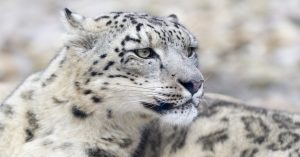
Snow leopard (Panthera uncia)
The snow leopard, despite being called a leopard and resembling a frosted version in the spotted leopards of more equatorial areas, is probably more closely related to the tiger, according to genetic research. Fewer than 6,500 are thought to remain in the wild, but data is difficult to come by due to the species’ preference for remote mountainous terrain and its elusive existence. China and Mongolia have the largest populations, with India and Kyrgyzstan also having major populations. Blue sheep and ibex are natural prey, although it is heavily reliant on domestic animals in some regions. Farmers who depend on the animals are forced to shoot the “problem” leopards. Poaching and overhunting of the species’ natural prey species remain major threats to the species.
Giant panda (Ailuropoda melanoleuca)
Everyone loves a panda, and they may be the cutest species mankind has yet pushed to extinction. We can’t get enough of the bi-colored beasts, from plush toys to CGI abominations skilled in martial arts. While their “aww factor” borders on the cloying, it hasn’t gone unnoticed. Since the late 1980s, China, which is home to the last wild population of less than 2,500 individuals, has implemented more stringent habitat safeguards, and poaching has all but stopped. However, their situation is still precarious. Their range is fragmented, and they face disease, predation, and starvation as vast swaths of the bamboo on which they feed reach the end of their life cycle and die.

Whooping crane (Grus americana)
Just 29 whooping cranes remained in the wild in 1938, the same year a population survey was performed. Just 16 remained three years later. Hunting and the loss of their wetland habitat had decimated the population, and it wasn’t until the late 1960s that concerted attempts to save the remaining birds began. Owing in large part to groundbreaking breeding schemes, there are now over 400 chicks. Despite the failure of a proposal to move whooping crane eggs to the nests of related sandhill cranes for fostering, captive rearing and reintroduction have resulted in the establishment of two wild populations in Florida, one of which has been trained to migrate to Wisconsin. Neither are self-contained. Alberta, Canada, and Texas, United States, are home to the only self-sustaining nation.

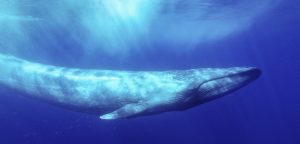
Blue whale (Balaenoptera musculus)
Blue whales, the world’s largest mammals, number less than 25,000. Blue whales, which are divided into many subspecies, can be found in all of the world’s oceans except the Arctic. Whaling in the twentieth century is believed to have depleted the current population by up to 90%. In 1966, commercial hunting of the species was outlawed. In 1998, the United States’ National Marine Fisheries Service outlined a recovery strategy. It required the development of individual specimen photo databases, as well as the collection of genetic and migration data, in order to better understand the species, which is still threatened by ship collisions and entanglement in fishing nets.
Read Also : New coral species discovered on seabed marked for deep-sea mining
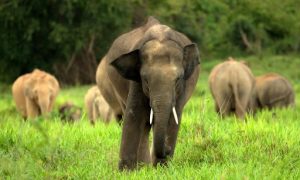
Asian elephant (Elephas maximus)
The total population of Asian elephants, which are found in 13 countries, is estimated to be between 40,000 and 50,000, according to the International Union for Conservation of Nature (IUCN). Some of the lumbering pachyderms habitats are inaccessible due to terrain or political instability, so the number may be much smaller. India accounts for more than half of the world’s population. Conflicts over space and resources arise as a result of the growing human population there—and elsewhere in Asia. Even though Asian elephants have smaller tusks than African elephants, they are still poached for ivory, meat, and skin.
Tiger (Panthera tigris)
The stalking grounds of the six subspecies of tiger, as depicted in William Blake’s “forests of the night,” are ablaze. Slash-and-burn agriculture, as well as deforestation and human encroachment, have greatly reduced the habitat available to these felines, who need vast ranges to sustain the large herbivores that make up the majority of their diets. The most serious challenge to tigers is poaching for trophies and body parts used in Asian “medicine.” There are probably less than 4,000 left in the wild. The eating of endangered animals, such as tigers, whose bones, penises, and other organs are superstitiously believed to have supernatural curative properties, was banned in China in 2014.
Orangutan (Pongo pygmaeus)
The term “orangutan” means “forest human” in Malaysian. Though they resemble melted Muppets more than people morphologically, their sophisticated cognitive abilities are very human. They have been seen using tools, much like gorillas and chimps. According to a 2004 report, orangutans, which are restricted to the Southeast Asian islands of Borneo and Sumatra, number less than 60,000. This is due in part to logging and capture for the exotic pet trade. They are normally solitary or live in groups of less than three, unlike other great apes, making them difficult to monitor and study.
Read Also : First-ever study of all Amazon greenhouse gases suggest the forest is worsening climate change
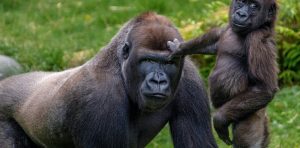
Gorilla (Gorilla beringei and Gorilla gorilla)
There are two species of gorillas: eastern (Gorilla beringei) and western (Gorilla gorilla), or three subspecies: eastern lowland, western lowland, and mountain gorillas, depending on who you ask. Both gorillas are threatened, regardless of who you ask. Just about 220,000 are thought to be left in the wild. Poaching for bushmeat, trophies, and magical talismans has resulted in significant losses due to habitat encroachment and poaching for bushmeat, trophies, and magical talismans. Since gorillas have such a complex social system and reproduce slowly—females only give birth once every four years at most—removal of even a few individuals from a troop can have a devastating effect on its ability to survive.