
Under the MISHTI scheme, mangrove plantation will be taken up along India’s vast coastline.

Healthy mangrove ecosystems support fisheries by providing important spawning grounds for commercial fish. (Photo credit: Timothy A Gonsalves via Wikimedia Commons)
As expected, Budget 2023 saw a big push on green growth. It prioritised India’s transition to a low carbon intensity economy, adoption of renewable energy, and creating green job opportunities. It also focused on sustainable development and initiated projects to mitigate the effects of climate change.
To this end, a new mission was launched for mangrove preservation and conservation – the Mangrove Initiative for Shoreline Habitats and Tangible Income (MISHTI). Under it, mangrove plantation will be taken up along the country’s coastline and salt pan lands.
So, what brought about the launch of MISHTI, and why is it so critical to India’s green future?
________________________________________________________________________
________________________________________________________________________
Mangroves as carbon stores
Conservationists have been saying for years now that mangroves have a crucial role to play in mitigating the effects of climate change. As per UNESCO’s Intergovernmental Oceanographic Commission, they are highly productive coastal ecosystems that are particularly important for their capacity to store carbon.
Scientific assessments show that they can sequester two to four times more carbon than terrestrial forests, thus making them a key component of nature-based solutions to climate change. Healthy mangrove ecosystems also provide habitat for marine species, support fisheries by providing important spawning grounds for commercial fish species, filter water flowing into our oceans, and protect coastlines from erosion and storm surges.
They are also increasingly threatened. According to the Blue Carbon Initiative, in the last 50 years alone, 30-50 percent of mangroves have been lost globally, and they continue to be lost at a rate of 2 percent each year. While it means that less CO2 is being absorbed, removal or damage of these ecosystems has also resulted in stored carbon being released back into the atmosphere.
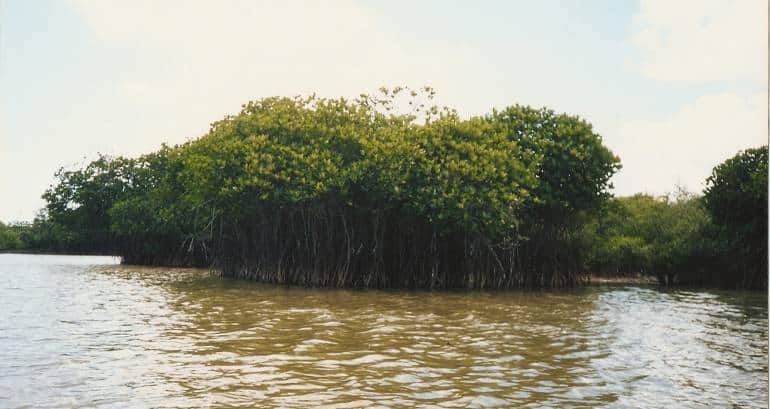 According to the Blue Carbon Initiative, globally, 30-50 percent Mangrove forests have been lost in the last 50 years alone. (Photo credit: B Balaji via Wikimedia Commons)
________________________________________________________________________
Read Also: THE MANY USES OF COW DUNG: A NATURAL AND RENEWABLE RESOURCEPERATURES DROP
________________________________________________________________________
The India factor
As per the India State of Forest Report (ISFR) 2021, our country has about 3 percent of South Asia’s mangrove cover. Besides West Bengal (42.45 percent of India’s mangrove cover is found here), substantial mangrove ecosystems can be found in Gujarat and the Andaman and Nicobar Islands.
However, human activities such as the building of roads, railways and infrastructure projects, as well as shifting coastlines, coastal erosion and an increase in storms due to extreme weather events have all taken a toll on them.
India’s 7,517 km-long coastline, which is home to nine coastal states and 1,382 islands, makes our country particularly vulnerable to the effects of ocean-driven climate change. It’s why restoring and protecting mangroves has emerged as a priority for India, and several countries around the world. Even at COP27, mangroves were identified as an important solution to climate change.
 Aerial view of mangroves in Vikhroli, Maharashtra. (Photo courtesy: Godrej & Boyce)
Growing forward
It led to the formation of the Mangrove Alliance for Climate (MAC) in November 2022. Led by the United Arab Emirates (UAE) and Indonesia, MAC also includes India, Sri Lanka, Australia, Japan, and Spain. Among its goals: educating and spreading awareness worldwide on the role of mangroves in curbing global warming and its potential as a solution for climate change.
________________________________________________________________________
Read Also: AI IN CLIMATE CHANGE AND DISASTER MANAGEMENT
________________________________________________________________________
Member countries will decide their own commitments and deadlines regarding planting and restoring mangroves, and share expertise and support each other in researching, managing and protecting coastal areas.
India’s growing focus on mangrove preservation has already produced some results. As per ISFR 2021, mangrove cover in the country increased by 17 sq km in 2021 as compared to the mangrove cover assessed in 2019. But a further thrust will need more funds. It also requires the active participation of all stakeholders – the local community, government and private sector. New plantations will be needed where damage to ecosystems is extensive, while rehabilitation will be the focus where sparse mangroves can become dense forests.
MISHTI is the first step in that direction.
NOTE – This article was originally published in moneycontrol and can be viewed here
Tags: #carbon, #climate, #climatechange, #climatecrisis, #environment, #forestfire, #getgreengetgrowing, #globalwarming, #gngagritech, #greenstories, #MISHTI, #nature, #UNESCO’






Great wordpress blog here.. It’s hard to find quality writing like yours these days. I really appreciate people like you! take care