“In order to understand the phenomena in a certain plasma region, it is necessary to map not only the magnetic but also the electric field and the electric currents. Space is filled with a network of currents which transfer energy and momentum over large or very large distances. The currents often pinch to filamentary or surface currents. The latter are likely to give space, as also interstellar and intergalactic space, a cellular structure.”
-Hannes Alfven

https://www.kanthal.com/en/applications/energyrenewablesustainability/waste-incineration/
When there is too much waste build-up in landfills, the wastes are burnt at very high temperatures and are incinerated. What remains after this incineration is the fuel which is useful for our daily needs and requirements. Even electricity can be produced by this high temperature. But this method of burning these huge amounts of waste was found to be harmful to the environment because it produces toxic gases that are the main cause of global warming and acts as pollution, harming humans, plants, and animals.
“Buy Organic Products Online at best prices at http://www.getgreen.co.in “.
The term Plasma Gasification may be relatively new to all of us. Let us start with what we know about plasma. We have often referred to plasma as the fourth state of matter. It is a very high temperature and highly ionized gas which is known to conduct electric current. A very common example of plasma that we can see in nature is lightning. Plasma has helped mankind in providing the necessary high temperatures that are required to process many new applications. Even though plasma is commonly found in nature, it can also be man-made by passing an electric discharge through some gas like air or oxygen. The interaction of this gas with the electric arc causes electrons and ions to discharge from the gas-producing temperatures almost as hot as the Sun’s surface.
So, what can we understand by the term Plasma Gasification? It is described as an extreme thermal process that uses plasma to convert organic matter into synthesis gas made up of hydrogen and carbon monoxide primarily. The growing amount of waste can be controlled by plasma gasification which is a form of waste management. This method turns huge amounts of waste into useful products of by-products only by using electricity and high temperatures, without the need for combustion.
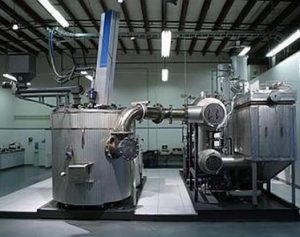
https://www.cahill-energy.com/plasma-gasification/plasma-gasification-process/
Plasma gasification may sound similar to incinerating waste, but the two processes are very different. Plasma gasification uses high temperatures to convert organic matter into some useful gas that still contains its chemical and heat energy. The inorganic wastes are broken down into an inert vitrified kind of glass, which is called slag. The slag is very useful for construction of buildings and many other purposes. Using this process, the amount of waste that is sent into landfills is greatly reduced, and the resultant products can act as fuel or even produce electricity.
Process
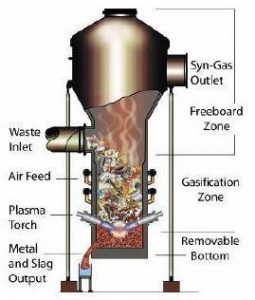
For making the process easier, we use plasma torches to bring about gasification. Smaller torches use an inert gas like Argon, while the bigger torches make use of stronger gases like Nitrogen. A very high voltage of electric current is applied between the two electrodes so that it can produce an arc. The gas applied under high pressure through the plasma produced by the arc gets ionized. The heat produced during this process is so high, that it can be compared to the temperature that is found on the surface of the sun.
https://netl.doe.gov/research/Coal/energy-systems/gasification/gasifipedia/westinghouse
Using plasma gasification, the waste is heated, melted and, vaporized. Molecular dissociation occurs only at these extreme conditions by the breaking up of molecular bonds that are present in the substances. During this process, the complex molecules get separated into individual atoms giving elemental components in a gaseous phase as the products. This molecular dissociation using plasma is commonly called plasma pyrolysis.
Advantages
- Plasma gasification has proved to be very useful when it comes to reducing the amount of waste that is found in landfills by converting the waste into useful products for our use.
- The by-product of plasma gasification is a kind of glass slag that is useful for the construction of a building.
- Because there is no incineration included in this process, there is no emission of any toxic gas whatsoever, making the process safe for the environment and our health.
- Some of this waste can be in the form of biomass, which is converted into a combustible gas called synthesis gas which is used to produce electricity and thermal energy.
- Plasma gasification is a safe way to dispose of medical and other hazardous wastes so that they cannot be accidentally reused for other purposes.
- The air emissions that are emitted from these industries and factories are much cleaner than those gases emitted from incinerators.
Disadvantages
- Unlike conventional methods like incineration, the initial cost of plasma gasification is higher. The operational cost of this process is also higher than incineration.
- There is very little useful energy produced by this method.
- If the waste is too wet, then the production of gases will be lesser and it will also result in higher consumption of energy.
- Since plasma gasification is a relatively new method of waste management, there are only a limited number of plants where this process takes place and there is a need for constant maintenance of the plant.
Read Also : Organic vs. Non-Organic: Is Organic Food Really Better?
Plasma gasification is starting to become more common nowadays which is beneficial for our total waste management. Even though it is relatively new, most countries have started accepting the advantages of this process with open arms. It is a very useful procedure that can help us clean each corner of our environment at a time, hopefully making way to a better future for us.
Sharon Ajith -28/05/2021
Tags: #animals, #getgreengetgrowing, #globalwarming, #gngagritech, #greenstories, #harminghumans, #oxygen, #plants, #Plasma, #Pollution, #wastemanagement