WHEN AND HOW SHOULD HYDRANGEAS BE PRUNED?
When do you prune your hydrangea? Well, it depends on the variety. Yes, we know that sounds tricky but it’s not if you consult our handy cheat sheet to figure out the best time to prune. We’ve included photos in case you’re not sure which hydrangea you have.
Properly pruning hydrangeas based on your hydrangea’s type will allow you to have more blooms next year. However, before you start pruning, it’s important to figure out which type of hydrangea you have. If you prune at the wrong time, you could be cutting off next year’s blooms!
HYDRANGEA PRUNING CHEAT SHEET
Use this table to determine when to best prune the hydrangeas in your garden. Some types should be pruned in late winter, while others should be left alone until after they bloom in the summer.
| Hydrangea Type | When to Prune | Where Flowers Appear |
|---|---|---|
| Bigleaf (H. macrophylla) | Summer, after flowering | On old growth |
| Oakleaf (H. quercifolia) | Summer, after flowering | On old growth |
| Panicle (H. paniculata) | Late winter, before spring growth | On new growth |
| Smooth (H. arborescens) | Late winter, before spring growth | On new growth |
| Mountain (H. serrata) | Summer, after flowering | On old growth |
| Climbing (H. anomala subsp. petiolaris) | Summer, after flowering | On old growth |
MORE ABOUT PRUNING DIFFERENT HYDRANGEA TYPES
Bigleaf Hydrangeas (Hydrangea macrophylla)
“Buy Organic Products Online at best prices at http://www.getgreen.co.in “.
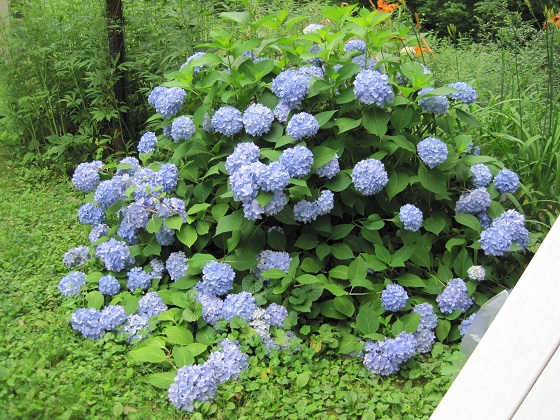
‘Endless Summer’ in a good year.
My other blue hydrangea is a lacecap-type, called ‘Let’s Dance Starlight’, but instead of the huge, mophead-type of flower cluster that ‘Endless Summer’ has, the lacecap hydrangea bears a flat blossom made up of many small, fertile flowers surrounded by a few showy, sterile flowers. It is also hardy to Zone 5 and blooms on both old and new wood.
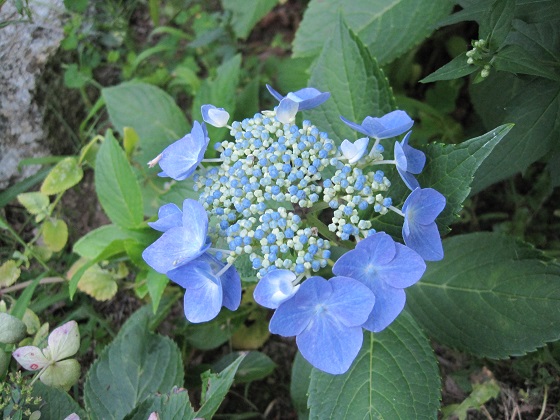
Lacecap ‘Let’s Dance Starlight’
Both mophead and lacecap hydrangeas are considered bigleaf or macrophylla hydrangeas, so they can be pruned right after flowering by cutting back the flowering shoots to the next bud. If you have older plants that aren’t blooming well, you can cut up to a third of the stems off at the base in late summer to encourage new growth.
Panicle Hydrangeas (H. paniculata)
The hydrangeas grown most often in New England gardens are the panicle-types, since they are not only beautiful, but also very hardy, surviving Zone 3 winters with no problems. One of the oldest and most reliable favorites is ‘Grandiflora’, also known as Pee Gee hydrangea. Native to China and Japan, it was the first Asian hydrangea cultivar introduced to the United States, in 1862. They were a big hit during the Victorian era. The flowers start out a creamy white and turn a rosy pink as they age. They can be dried and look lovely in a winter arrangement. Find out how to dry these lovely hydrangeas here.
There are many panicle-types to choose from. I have one called ‘Pinky Winky’ that has long, cone-shaped white and pink flowers, and also ‘Vanilla Strawberry’, which has panicles that color from white at the tip to pink in the middle and red at the base. For something different, try ‘Limelight,’ which has chartreuse flowers that gradually turn pink in autumn.
Read Also : Transition – The Law of Nature
Panicle-type hydrangeas should be pruned in late winter to keep them from becoming overgrown.
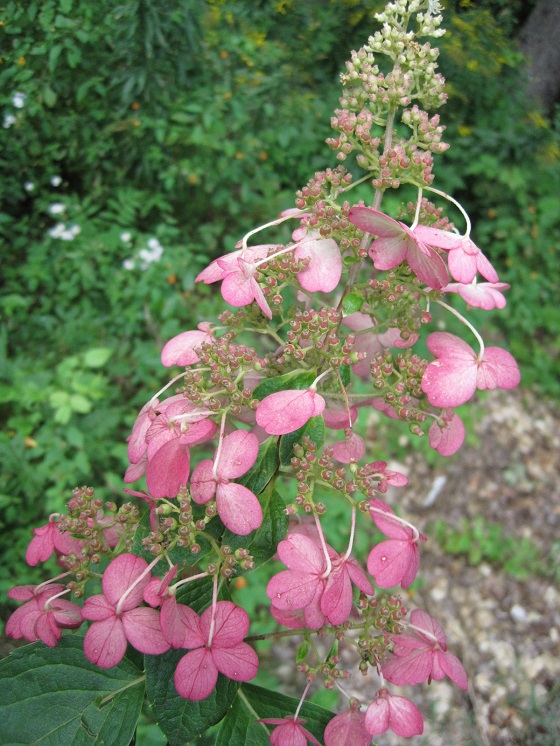
Panicle-type hydrangea ‘Vanilla Strawberry’
Smooth Hydrangeas (H. arborescens)
Smooth hydrangeas are North American natives, originally found growing wild in Pennsylvania. They tolerate light shade, begin to bloom in June, and continue to blossom until fall. Their white flowers are round and can reach 12 inches in diameter.
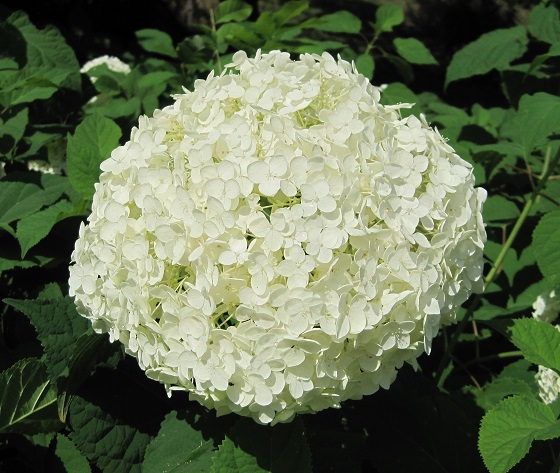
Smooth hydrangea ‘Annabelle’
The popular cultivar ‘Annabelle’ grows to be 3-5 feet tall and can be used to light up a shady path or as a mass planting at the edge of the woods. It is hardy to Zone 3.
Smooth hydrangeas can be pruned back to the ground in the fall or early spring.
Oakleaf Hydrangeas (H. quercifolia)
Oak-leaf hydrangeasare another North American native, having been discovered in Georgia in 1773.

Oak-leaf hydrangea
Also called swamp snowball, it is hardy to zone 5 and though it prefers full sun, it can take some shade and still blossom well. It blooms a little later than the other hydrangeas, beginning in August. Its flowers are large panicles that start out white and turn dark pink as they age. The leaves, which are deeply lobed like an oak leaf, turn a rich maroon red in the fall.
Tags: #blooms, #flowers, #getgreengetgrowing, #greenstories, #hydrangeas, #kinds, #starlight, #wood, #gngagritech