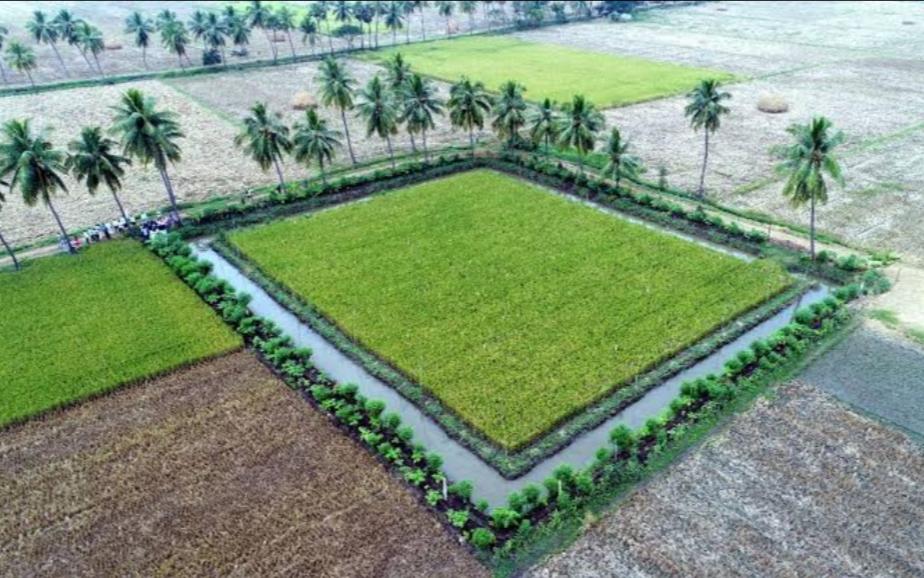

Zero-Budget Natural Farming (ZBNF) is a traditional choice to the current paradigm of expensive chemical inputs based farming. It is very beneficial in dealing with the anticipations of climate modification. ZBNF beliefs are in unity with the standards of Agroecology. Its identity is founded on the latest scientific findings in Agriculture, and, at a similar time, it is grounded in Indian belief. UN-FAO in April 2018 instructed all nations to walk towards the adoption of Agroecology to fulfill the identical goals of standard food safety and protection of the atmosphere.
_______________________________________________________________________
“Buy Organic Products Online at best prices at http://www.getgreen.co.in “.
_______________________________________________________________________
It is an agriculture exercise that undersands the natural development of crops without expanding any fertilizers and pesticides, or any other new components. The word Zero Budget pertains to the zero net expense of all products’ output (intercrops, border crops, multi crops). The intakes used for seed therapies and other vaccinations are locally accessible in the shape of cow manure and cow urine.
Mr. Subhash Palekar contended that the increasing expense of outer intakes is the primary reason for suicide and appreciation among growers. The effect of chemicals on lengthy period fertility and the atmosphere is ravaging. He joined with the Japanese scholar Fukuoka. They both arrived with methods of natural agriculture. They facilitated the procedure of biological agriculture widely in Karnataka as zero budget natural farming.
Institutions that Support and promote Zero Budget Natural Farming
There are the following organizations mentioned below that benefited zero budget natural farming in India.
- Isha sadhguru foundation
- The art of living foundation
- Karnataka Rajya Raitha Sangha
- Sony India private limited
The Strategic Government Schemes and Plans for Zero Budget Natural Farming
- India’s Legislature is progressing natural farming in the country from 2015-16 through the conventional agricultural growth plan’s enthusiastic schemes and the National Agricultural Development Plan.
- In 2018, Andhra Pradesh began a proposal to become the early state in India to exercise 100% natural agriculture by 2024. It intends to accomplish chemical agriculture on 80 lakh hectares of soil by converting 60 lakh growers of the state into ZBNF techniques.
_______________________________________________________________________
Read Also : Is Zero Budget Natural Farming Right for India?
_______________________________________________________________________
ZBNF has set many successful examples in the context of agriculture and farming. There are few examples illustrated below.
- The initial success article of ZBNF is Mr. Annadurai belongs to Musiri Trichy, Tamilnadu, a paddy agriculturist. He exercises ZBNF on 2 acres of soil, and he receives a good percentage of results per acre. He progressed the dignity to circulate it 10 acres.
- The achievement article of ZBNF is by Mr. Kudankavil, who resides in Idukki. He disciplined ZBNF in their area. And he got increased earnings and reasonable payment. Mr. Kudankavil announces if you attend Mr. Palekar’s approaches, you will receive favorable outcomes.

- Mr. T Suryanarayana belongs to the East Godavari area. He is a ZBNF agriculturist who develops paddy and oil palm. He earned reasonable earnings of oil palm and paddy.
Features of Zero Budget Natural Farming
According to zero budget natural farming beliefs, crops get 98% of their store of nutrients from the water, sunlight, and air. And the residing 2% can be completed by reasonable integrity with lots of encouraging microorganisms.
- Soil microclimate –The soil ever wraps an organic mulch, which shapes humus and facilitates good microorganisms.
- Cow –The agriculture strategy compels cow urine and cow dung attained by only Indian species cows.
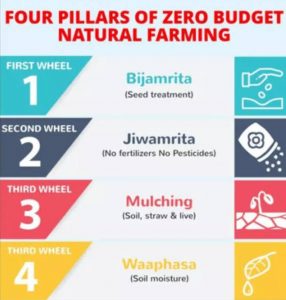
There are four primary roots of Zero Budget Natural Farming illustrated below. All are integrated to give rise to the technique of farming success.
1.Jeevamrutha
Jeevamrutha is the primary and crucial plank of zero budget agriculture. It is a mixture of aged cow urine and raw cow dung from India’s indigenous jaggery, water, pulse flour, soil, and cow offspring. This variety is one category of biological fertilizer that pertained to farmland.
2. Bijamrita
Bijamrita is the next tower of zero budget farming. There are various tobacco, green chilies, and neem leaf pulp utilized for pests and pest supervision. It’s employed to deal with seeds, and it furnishes natural safety to roots.
3. Acchadana (Mulching)
Acchadana (Mulching) is the third base of zero budget agriculture. It encourages to strengthen soil moisture quantity. This pillar enables the conservation of the surface of soil cultivation and does not damage it by planting.
4. Whapasa
Whapasa is a circumstance where water molecules and air molecules are current in the mud. It enables to decrease the additional irrigation condition.
Advantages of Zero Budget Natural Farming
From the (NSSO) National Sample Survey Office documents, 70% plus growers expend more earning, and most planters have a deficit. The indebtedness degree is over 90% in states like Andhra Pradesh and Telangana, where each family has a regular obligation of Rs 1 lakh. To attain the central government’s pledge to make twice as much the farmers’ revenue by 2022, one characteristic being contemplated is natural farming techniques zero budget natural farming.
- Farmers rely on loans.
- The financial questionnaire has brought out the ecological advantages.
- The expense of agriculture inputs is quickly improving.
- The amount of farmer’s suicide trials is thriving continuously.
- The need for safe food is boosted among consumers.
- It gives rise to a volatile market rate.
Benefits of Zero Budget Natural Farming
- Zero budget natural farming lessens the preliminary expense of growers.
- Farmer’s revenue automatically rises.
- The soil ecosystem enhances.
- Cow dung expands soil importance. It is entire of nutrients significance and accessible locally.
- Bacteria of cow dung deteriorate the organic course in soil and prepare the ground for the grains.
- It compelled limited electricity and water.
- ZBNF enhances the productivity of the ground.
- It reduces the disease assault hazard on the crop.
- In Zero Budget Farming, we utilize little chemical fertilizer, agriculture production integrity enhances.
_______________________________________________________________________
Read Also : New report outlines potential yield challenges to scale-up of zero budget natural farming in…
_______________________________________________________________________
Disadvantages of Zero Budget Natural Farming
- This agriculture technique is utilized in some portions of India.
- The category of farming being disputed, and there is not much scientific study under examination.
- It is highly sustainable agriculture.
- This farming method is used in scarce regions.
A questionnaire achieved by LVC indicates that ZBNF helps not just in agronomic phrases but also arouses a variation of social and economic advantages. A prevalence of respondents documented that by approving ZBNF, over time, they saw modifications in earnings, soil preservation, seed diversity, integrity of harvest, family food autonomy, income, and health. Most encountered inferior farm payments and a lessened demand for credit, one of the significant difficulties afflicting Indian farmers. In this path, zero budget natural agriculture is an extraordinary farming technique for Indian growers for planting with great productivity at a minimum expense.
Image Sources
https://images.app.goo.gl/UfUBJoLw9Rah8wVG6
https://images.app.goo.gl/V98MieWybutuQEhs9
https://images.app.goo.gl/Ce1S9nGtS85cJ64j6
Tags: #agriculture, #agricultureeconomic, #agriculturist, #agrifacts, #agrilife, #agronomy, #animalhusbandry, #animalscience, #breeding, #entomology, #facebook, #farming, #instagram, #kisan, #krishi, #plantbiotechnology, #soilhealth, #ZeroBudgetNaturalFarming