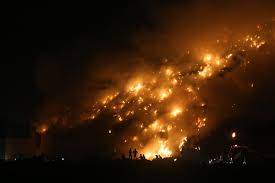
In the midst of a scorching heatwave, a landfill in New Delhi, India has spontaneously combusted, pouring toxic smoke into the air for three days straight, according to ABC News.
___________________________________________________________________
Read Also: Why we should regenerate and restore High Carbon Ecosystems!
___________________________________________________________________
This is no ordinary landfill. Per ABC, the dump is more of a garbage mountain, looming taller than a 17-story building and wider than 50 football fields. (So, a pile of trash more than 240 feet, or 73 meters, high and more than 15,000 feet, or 4,572 m, long). Video taken from a nearby highway and shared on Reddit on Tuesday (April 26) shows a towering inferno billowing toxic smoke into the air, while hordes of motorists stop traffic to take in the spectacle.
The fire reportedly began due to the spontaneous combustion of methane (CH4) — a potent greenhouse gas released by decaying organic matter, in addition to occurring naturally underground. (See Turkmenistan’s “gates of hell” for an idea of what happens when natural methane catches fire.)
___________________________________________________________________
Read Also: Will the Race for Electric Vehicles Endanger the Earth’s Most Sensitive Ecosystem?
___________________________________________________________________
When methane reaches a certain concentration, it may spontaneously explode in the presence of heat, studies have shown. Sadly, that means landfill fires like this one are a common occurrence.
“There’s a fire every year,” Bhairo Raj, a waste worker who lives next to the landfill, told ABC. “It is not new. There is risk to life and livelihood, but what do we do?”
Three other landfills around New Delhi have also caught fire in recent weeks, ABC reported. The landfill where the most recent fire ignited was planned for closure more than a decade ago, but more than 2,300 tons (2,086 metric tons) of garbage are added to the trash heap every day, according to ABC.
________________________________________________________________________
Read Also : ” Twitter storm: noise pollution creates havoc for birds, study shows”
________________________________________________________________________
Around the world, summer heatwaves have become both more common and more severe in recent years due to manmade climate change, Live Science previously reported. July 2021 was the hottest month in recorded history, the National Oceanic and Atmospheric Administration (NOAA) said.
NOTE – This article was originally published in livescienc and can be viewed here