
Archaeologists found a 4,000-year-old painted stone in Indonesia that may trace the shared beliefs and identities carried by ancient ocean voyagers.
Moving means deciding what to carry and what to leave behind. Four thousand years ago, people crossing open ocean toward islands they had never seen faced that same decision. A painted stone dug up on Wetar Island in eastern Indonesia suggests their cargo included a shared symbol – a red, sun-like sign of who they were.
Archaeologists from the Australian National University (ANU) and Indonesia’s National Research and Innovation Agency (BRIN) found the stone during the island’s first archaeological excavation. Charcoal buried beside it makes it roughly 4,000 years old.
That makes the plaque the oldest securely dated painting in a tradition tied to prehistory’s widest ocean migration. Ceri Shipton, an ANU archaeologist and co-author of the study, said the find offers a new perspective on what the earliest voyagers brought with them.
“People didn’t just carry technologies and possessions when they voyaged to new islands,” he said. “They carried ideas, identities, and new ways of understanding the world.”
Archaeologists uncover a painted plaque
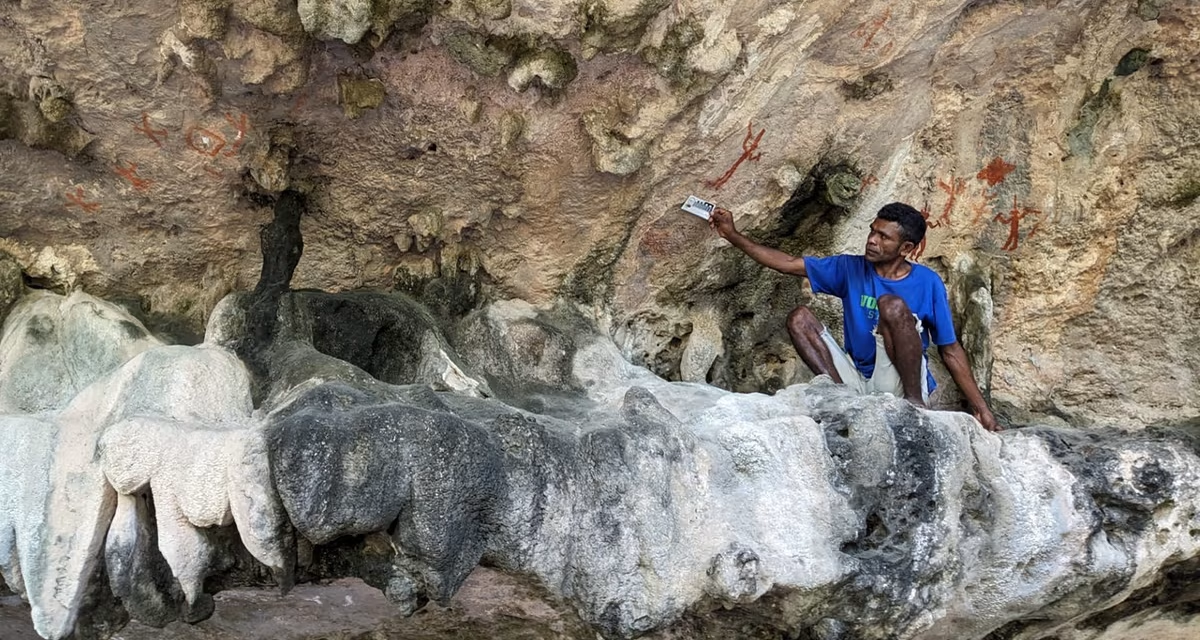
Wetar is the largest island in Maluku’s southwestern province. A 2023 survey near the coastal village of Ilwaki found limestone rockshelters painted with boats, small human figures, and circular designs in an area called Huknaur.
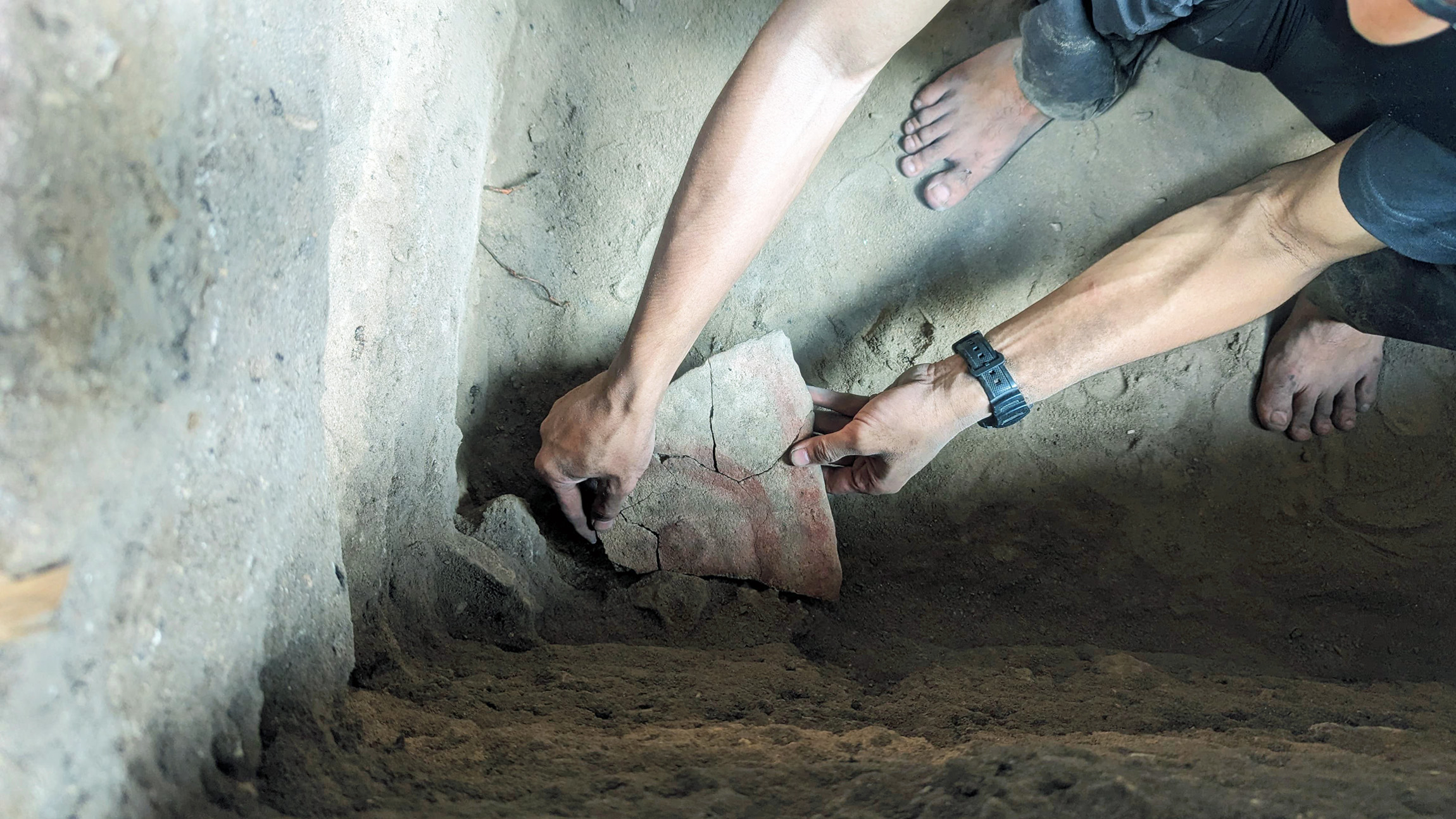
In 2024 the team opened a trench about 7 by 3 feet (2 by 1 meters) in front of the main painted wall. The shelter sits about 200 feet (60 meters) from the sea, and the slab came out of one corner of the trench looking like any other rock.
“When we first excavated the painted slab we had no idea that it had painting on it,” lead author Sue O’Connor, a professor at ANU, told Earth.com.
Her team brushes the dirt off every rock it lifts, checking for signs of use such as hammering or grinding seeds and nuts. This rock was different.
“We were amazed that it had the painting clearly visible in red pigment on one side,” she said. “We quickly replaced the rock into the excavation so we could be absolutely certain of its orientation.”
The painted plaque is a flat slab of fine-grained limestone about the size of a hardcover book. It measures roughly 9 by 7 inches (22 by 18 centimeters) and about an inch (2.5 centimeters) thick. It’s broken through the middle of the design, and the missing piece never turned up, so it may have cracked and been thrown away before it was buried.
________________________________________________________________________
Charcoal dates the plaque to 4,000 years
The red pigment is an iron-rich mineral, a form of ochre, so it contains no carbon for radiocarbon dating to measure. Co-author Shimona Kealy dated charcoal from the plaque’s layer instead. Two samples place the slab between about 4,090 and 3,900 years old.
O’Connor said the team recognized portable art in the Austronesian style right away. The age was another matter.
“When we got the radiocarbon dates the impact really hit,” she added.
The dig went down about five feet (1.6 meters) through 12 layers of debris, and the deepest layers show people first used the shelter about 9,500 years ago.
One sun design spans many islands
One face of the slab carries a solid red dot inside a red circle. Faded lines radiate out between the two. The team interprets that faded pigment as white, though the chemistry can’t confirm it – common white minerals match the limestone itself.
A second red line follows the plaque’s edge, probably the remains of an outer frame. The design matches a rock art style found across eastern Indonesia and on islands around New Guinea, wherever Austronesian languages are spoken. Archaeologists call it the Austronesian Painting Tradition, or APT.
Indonesia’s far older ice age art is different: hand stencils and large naturalistic animals, including a 51,200-year-old cave painting that ranks as the world’s oldest known narrative scene.
Wall paintings are hard to date. Estimates of the tradition’s age ranged from the first Austronesian arrivals to a metal-working era that began about 2,500 years ago.
The only APT images dated before now were human figures, with ages starting around 3,900 years. The Wetar plaque is older, and it’s the first of the style’s signature circles ever dated.
Painted symbol predates pottery
The Austronesian expansion started in Taiwan about 4,800 years ago. People crossed open water to the Batanes Islands, north of the Philippines, about 4,200 years ago, then spread across Island Southeast Asia and the Pacific. Their descendants reached Madagascar in one direction and Easter Island in the other.
Archaeologists usually track that expansion by the things it left behind: red-slipped pottery, squared stone axes, domestic dogs and pigs, and in some areas crops such as rice.
At Huknaur, the plaque sits below the first pottery. Charcoal at the boundary above it dates to between about 3,870 and 3,715 years ago. The painting is therefore roughly 200 to 500 years older than the first pots at the site.
That order matters. Archaeologists have long treated pottery as a signature of Austronesian arrival, so a symbol that is older than the pots suggests the tradition’s ideas spread ahead of its goods. O’Connor said portable symbols could travel with people and may have helped island communities signal shared identity and beliefs.
In historic times, people on the Kai Islands of eastern Maluku painted similar sun-like designs on boat prows to protect their voyages, and variations served as clan markers.
Beads point to a cultural shift
The plaque isn’t the only sign that something shifted in that layer. The dig produced 135 beads, including older ones fashioned from whole olive snail shells and discs of mother-of-pearl.
In the plaque’s layer, those give way to beads cut from cone snail shells. The same type marks early Austronesian-linked sites from the Philippines to the far western Pacific.
Asked by Earth.com about other findings from the study, Shipton pointed to those beads.
“The change in bead types provides independent evidence for a change in belief system.”
The newcomers didn’t sail into an empty world, either. Volcanic glass tools from the site all come from a single source. That points to an exchange network that moved stone between islands for thousands of years before people painted the plaque.
________________________________________________________________________
More painted stones may remain buried
The plaque doesn’t show where the tradition began. The style may have been invented in these islands before Austronesian settlers arrived, or it may have come in with the first settlers themselves. A 2024 genetic study found that Papuan and local island ancestries may already have been mixing in the region before the expansion reached it.
Archaeologists have excavated only one portable piece of the tradition, and O’Connor doesn’t expect them to find another quickly.
“There are likely to be more such portable art objects but finding them is a bit like looking for the proverbial needle in a haystack,” she said in an email interview with Earth.com.
Shipton said the team will now excavate under other painted rockshelters, favoring islands that show signs of the exchange networks that may have attracted Austronesian pioneers.
He also laid out a quicker check. “Since beads are much more reliably preserved in archaeological sites than portable art, looking for a similar change in bead types in layers just before the appearance of pottery at other sites will be a good test of our hypothesis.”
If more painted stones are out there, they’re sitting under rockshelter floors that nobody has dug yet.
NOTE – This article was originally published in Earth and can be viewed here