
Soft-bodied animals almost never become fossils. Their bodies break down quickly and leave little behind. This is why a new discovery from Québec stands out.
Scientists have identified a 450-million-year-old tubular polyp fossil that relates closely to modern jellyfish. The fossil survived conditions that usually erase this kind of life.
Researchers named the species Paleocanna tentaculum. It is the first soft-bodied cnidarian polyp found from the Ordovician period in North America.
This discovery fills a major gap in the story of how jellyfish and their relatives evolved over time.
Paleocanna tentaculum jellyfish
Cnidarians include jellyfish, corals, and sea anemones. These animals date back hundreds of millions of years.
Yet their fossil record is uneven. Hard-skeleton forms like corals appear often in rocks, while soft-bodied forms, especially polyps, are rarely preserved.
Scientists have found some early polyps in Cambrian rocks in China, but the Ordovician period remained almost empty of such fossils. This left a missing chapter in the evolutionary timeline.
“Soft-bodied organisms do not preserve as well as hard-bodied organisms, usually making any soft-bodied fossil more valuable to understanding the history of life,” said Louis Philippe Bateman, co-author of the study. This new find begins to close that long-standing gap.
Inside a rare fossil hotspot
The fossils came from a quarry near Saint Joachim, northeast of Québec City. Researchers studied 15 slabs of rock that held around 135 specimens. Out of these, 39 were complete enough for detailed measurements.
The site also contained many other marine fossils. These included corals, brachiopods, snails, cephalopods, trilobites, and sea lilies. This mix shows that the area once hosted a rich ocean ecosystem.
Christopher Cameron described the importance of the location as “among the most species-rich fossil localities on the planet” for fossils from the Ordovician period. This makes the quarry an important window into ancient marine life.
Paleocanna tentaculum lived in tubes
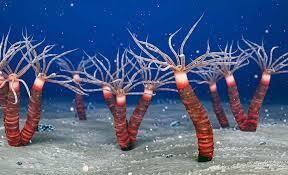
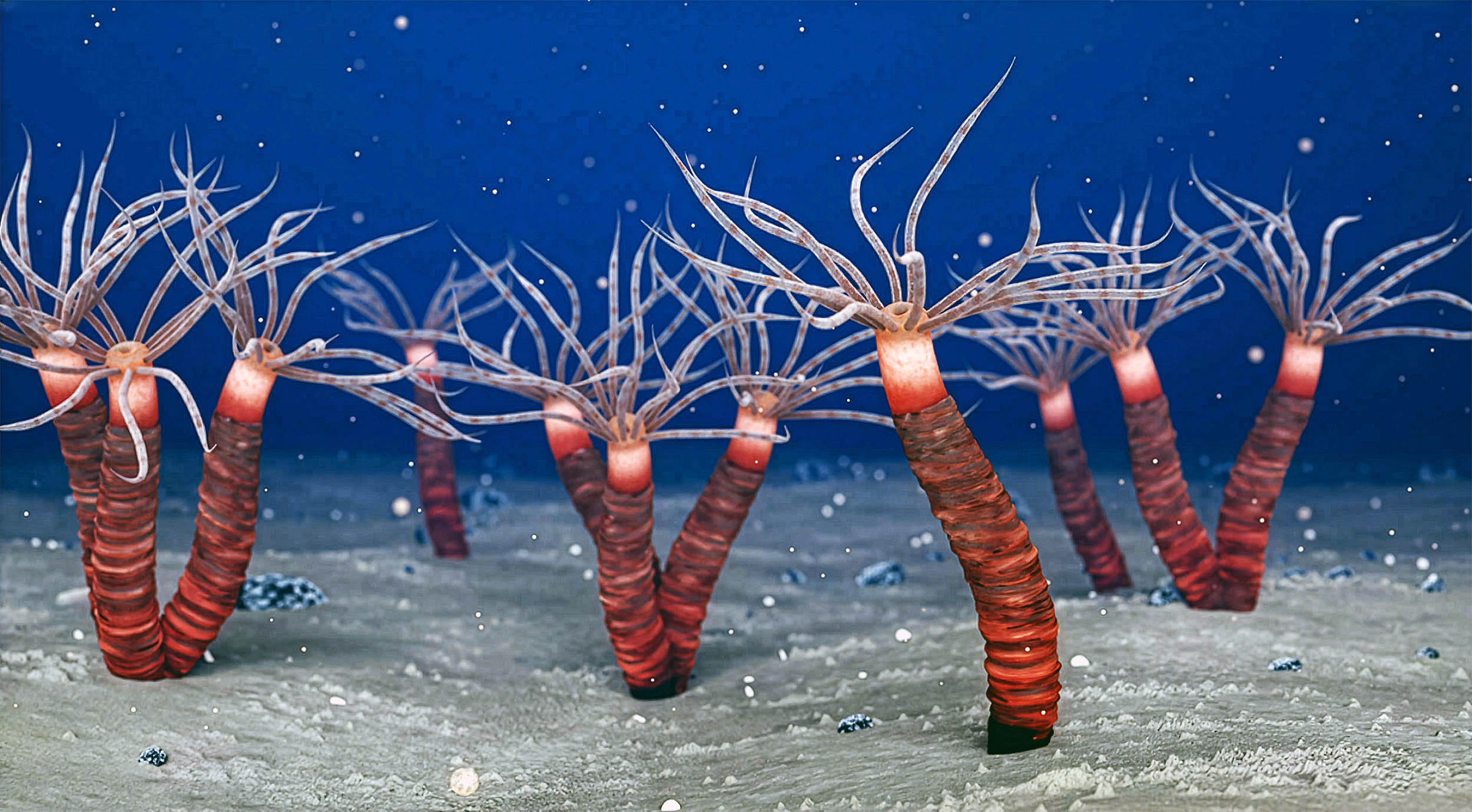
Each Paleocanna tentaculum lived inside a narrow tube. The animals stood upright and reached about 37 millimeters (about 1.5 inches) in length and 6 millimeters (about 0.24 inches) in width. Some lived alone, while others formed small groups that shared a base.
The soft body extended out of the tube opening. At the top sat a ring of around 12 tentacles. In well-preserved specimens, these tentacles appear finger-like or feathery. They made up about one-quarter of the body length.
Scientists did not find a visible mouth. However, based on modern relatives, it likely sat hidden within the ring of tentacles.
Feeding in ancient seas
The tentacles offer clues about how this animal lived. They are thin and numerous rather than thick. In modern cnidarians, this structure often links to filter feeding.
Paleocanna likely captured tiny food particles drifting in the water. It may have allowed particles to settle onto its tentacles.
It could also have moved its tentacles gently to create currents that brought food closer. This suggests a calm lifestyle anchored to the seafloor, feeding on passing nutrients.
Preserving soft-bodied life
The most striking part of this discovery is how the fossils formed. Soft-bodied animals decay within hours or days under normal conditions. Preserving them requires rare circumstances.
Scientists found that the darkest parts of the fossils contain carbon films. This means traces of the original organic material still remain after 450 million years.
“Because several individuals are aligned in the same direction, we think they were buried in place or were not transported far before being buried,” said Greta Ramirez Guerrero, first author of the study.
“This rapid burial, combined with low-oxygen conditions in the surrounding environment, slowed decay and helped preserve the animals before the sediment turned to rock.”
These conditions protected the delicate structures long enough for fossilization.
Linking to famous fossils
The preservation style resembles what scientists call Burgess-Shale-type fossilization. The Burgess Shale in British Columbia is famous for preserving soft-bodied animals from the Cambrian period.
The Québec fossils share similar features. Fine sediment, calm water, high organic content, and low oxygen all helped preserve these fragile organisms.
This connection highlights how rare environments can capture details that usually vanish from the fossil record.
Paleocanna tentaculum and modern jellyfish
Researchers compared Paleocanna with 69 other species, both living and extinct. This analysis helped them understand its place in the evolutionary tree.
The results show that it sits close to modern jellyfish groups. These include box jellies, true jellies, and stalked jellies. This position is closer to modern forms than many other ancient tube-dwelling animals.
This means Paleocanna fossil provides a clearer link between early cnidarians and the jellyfish seen today.
A rising fossil region
This discovery also changes how scientists view Québec as a fossil region. It shows that the area holds more scientific value than previously thought.
“I’ve often caught myself saying that we have a less glamorous fossil record than places like British Columbia or Alberta,” Bateman said. “Discoveries like this one show that many things have yet to be discovered and described here.”
The region may hold many more hidden fossils waiting to be studied.
________________________________________________________________________
From collector to science
The fossils now sit at the Musée de Paléontologie et de l’Évolution in Montréal. Amateur fossil collector John Iellamo first found them in 2010. He recognized their importance and donated them for research.
“We must pay tribute to John Iellamo, a reputed amateur fossil collector and member of our museum, who found these fossils in 2010 and subsequently donated them to the MPE,” said Mario Cournoyer, a co-author of the study.
“He was able to recognize the scientific importance of these fossils and made them available for research. Without him, we would not be talking about this new species.”
This shows how collaboration between enthusiasts and scientists can lead to major discoveries.
More discoveries likely ahead
Researchers believe this is only the beginning. Sites like the Saint Joachim quarry often continue to produce new findings over time.
“Once you find them, these kinds of sites tend to keep producing spectacular new material and species for many years, so I’m expecting many more new interesting discoveries to come,” said Bateman.
This jellyfish fossil discovery reminds us that even the most fragile creatures can leave a lasting mark when the conditions are right.
The study is published in the Journal of Paleontology.
NOTE – This article was originally published in Earth and can be viewed here