In the years since the independence, Or i would say under the leadership of then Prime minister Lal Bahadur Shashtri till now, India has gained tremendous headway towards accomplishing food security. Its population has significantly increased, however food-grain creation has more than quadrupled; there has in this manner been a generous expansion in accessible food-grain per capita.
Be that as it may, there’s always scope and expectation for more. Harvest yields in India are still only 30% to 60% of the best manageable yields attainable in the homesteads of created and other non-industrial nations. What’s more, helpless foundation and disorderly retail implies India has one of the world’s most elevated levels of post-reap food misfortune.
________________________________________________________________________
Read Also : The concept of Human Development Needs to be Redefined!
_______________________________________________________________________
Plainly, it is the ideal opportunity for change. We not just need to react to long-standing issues and difficulties, but also likewise confront more current real factors. The normal assets on which agribusiness is based – land and water, most importantly – are being debased and there is developing rivalry for their utilization. Environmental change is now compounding the present circumstance, making agribusiness more hazardous, and it will have a considerably more prominent effect later on.
However, the public-private partnership model (PPP) could be only the distinct advantage India’s rural area needs. By drawing on the aggregate force of every single agricultural stakeholders, PPPs can change the area at numerous levels. With the public authority giving and co-financing the back-end of the value chain, and the private area and farmers contribution wrapping up, the rural area could stay an essential driver of country development and poverty decrease in India.
Soil Health Enhancement:

India has arrived at a phase being developed where it needs ‘evergreen transformation’, for example creating more in less land with less water. Agri-business and agri-handling ought to be the fundamental drivers of this unrest with crop broadening as one of the primary procedures.
Agricultural colleges, research organizations, krishi vigyan kendras, manure organizations, state divisions of horticulture and farmers associations should work to improve soil productivity by paying attention to its physical, chemical (macro and micronutrients), and microbiological aspects at the same time. Dry cultivating regions need specific consideration.
________________________________________________________________________
Read Also : Education along with Research drives Growth & Development of Human Society
______________________________________________________________________
Value chains
PPPs could assist with prodding the advancement of the food processing industry, one of the newest field in Indian horticulture. The food processing industry must do more than simply extend food shelf life, preserve food nutrients, and offer fortified products. Instead, it should consider providing farm extension services, improving price realisation, eliminating intermediaries, and improving the supply chain through forward and backward linkages, with support from both the government and private sector.
A significant job of the public authority, other than subsidizing, will be to establish an empowering climate for private investment. This must be accomplished through tax reform, duty exemptions, increased public spending, priority sector lending, and FDI.
For example, these will help private area interest in store network framework and administrations, prompting a decrease in squander and more added esteem.
Water system Water Supply Augmentation and Management:
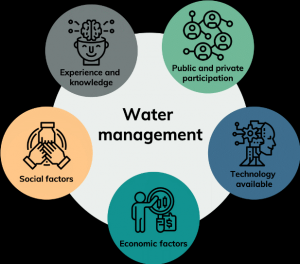
https://www.researchgate.net/figure/Elements-of-the-water-management-process_fig1_340890045
Water is a public decent and a social asset resource and not a private property. The privatization of its dissemination is full of risks and could prompt wars pertaining to water in local communities. Further Rainwater harvesting and aquifer recharging should be made mandatory to improve supply.
Furthermore, a broadly discussed and acknowledged technique for watering 10 million hectares of new region under Bharat Nirman Program ought to be created. Existing wells and ponds should be refurbished. Improved irrigation practises, such as sprinkler and drip irrigation, should be prioritised for demand management.
________________________________________________________________________
Also read : WHAT’S BIOCHAR? HOW TO STABILIZE CARBON IN YOUR SOIL
A water literacy Campaign ought to be dispatched and guidelines should be created for Sustainable utilization of ground water just as for forestalling pollution. Seawater farming should be advanced in coastal regions through the development of mangroves, salicomia, casuarinas and suitable halophytic plants. The conjunctive utilization rain, river, ground, sea, and treated sewage water should all be turned into the standard.
Increasing access to credit, Technology, and market opportunities
PPPs could aid in the introduction of cutting-edge agricultural technologies ways to deal with India’s farming area. IT and biotech remain to have the potential to transform agriculture, increasing production levels and yields. We need PPPs that focus on getting ranchers admittance to vital information, strategies and the furthest down the line innovation to help them in regions, for example crop rotation, weather patterns, fertiliser use, and going organic – all with the snap of a button or a simple SMS on their mobile phones.
Biotechnology, in the interim, can outfit producers with methods for developing high-yield crops, managing pests, better utilising waste water, and focusing on nutrition. The exceptional forward leaps made in the grain production industry show the amount of effect biotechnology can make. PPPs can assist with recreating this achievement in significant regions, for example, oil seeds and pulses which are profoundly import-escalated.
Similarly, PPP projects, when focused on assisting Farmers with interfacing with their marketplaces and financial institutions for micro-funding, can introduce gigantic modifications in the rural economy.
Increasing farmers’ resistance to environmental shocks
Farmers in India are constantly threatened by bad weather and environmental conditions, which can lead to crop failure. Flooding and droughts are frequent occurrences in India’s agricultural community. PPPs that protect the agricultural sector from natural disasters can save lives. Such interventions can, in fact, save lives in a country where farmer suicides are common. PPPs that help the rural area manage climate stuns, and permit farmers to limit risk through protection, can be an essential assistance. While PPPs in the agri space are not ordinary, they should be. For example, The Maharashtra government has at this point disclosed a start with its Maharashtra Public-Private Partnership for Integrated Agriculture Development (PPPIAD) project. Under the aegis of this drive, Maharashtra is creating coordinated value chains for selected crops through PPPs and co-speculation.
Locally Differentiated Strategy:
With wide varieties in agro-climatic and financial conditions across nation, there can’t be a solitary technique of agriicultural development to be followed all over the place.
At the large scale level, the advancement methodology should be separated by wide local attributes of agro agro-economic circumstances as follows:
- North-Western High Productivity Region:
The strategy will be to encourage agricultural diversification and the production of high-value crops, as well as to strengthen strong ties with the agro-processing industry and exports, as well as the development of appropriate infrastructure.
- Eastern Region: The strategy for this region should be to maximise its productivity potential so that yields can match those of high-productivity states like Haryana and Punjab. Flood control, drainage management, irrigation facility improvement, particularly minor irrigation, and input delivery systems supported by adequate credit and extension facilities should be prioritised.
- Peninsular India’s ARD Zones: The emphasis should be on:
- The advancement of efficient water harvesting and conservation techniques and methodologies
- Appropriate irrigation packages based on a watershed strategy; and
- The promotion of a relevant farming system that saves water and generates higher land value.
- Ecologically Fragile Areas, such as the Himalayas and Deserts:
The focus should be on the development of an agricultural system that does not jeopardise the region’s fragile ecological balance, but rather aids in the conservation and strengthening of natural resources’ long-term viability.
Tags: #agri, #farmer, #food, #framework, #getgreengetgrowing, #gngagritech, #greenstories, #horticulture, #nutrients, #rain, #Rainwater harvesting, #river, #Seawater farming, #waste, #water