https://climate.nasa.gov/resources/global-warming-vs-climate-change/
GLASGOW, Scotland, November 8- At the United Nations climate meeting in Glasgow, international leaders repeatedly emphasised the need to keep global warming below 1.5 degrees Celsius.
The 2015 Paris Agreement pledges countries to keep global average temperature rise well below 2 degrees Celsius over pre-industrial levels, with a goal of 1.5 degrees Celsius.
________________________________________________________________________
Read Also : ‘Code red’: UN report sounds alarm over irreversible climate impact, warns global warming threshold…
________________________________________________________________________
Crossing the 1.5°C barrier, according to scientists, risks causing significantly more severe climate change repercussions on humans, wildlife, and ecosystems.
To avoid it, scientists, financiers, negotiators, and activists at COP26 are debating how to attain and pay for nearly halving global CO2 emissions by 2030 from 2010 levels and clipping them to net-zero by 2050 — an ambitious task that researchers, financiers, negotiators, and protesters are deliberating how to achieve and pay for.
But What is the difference between a 1.5°C and a 2°C increase in temperature?
WHERE DO WE STAND RIGHT NOW?
The earth has already warmed by 1.1°C over pre-industrial levels. Since 1850, each of the last four decades has been hotter than the previous four.
In barely a few decades, we’ve never witnessed such fast global warming. Half a degree means more severe weather, which can happen more frequently, be more intense, or continue longer.
Hundreds of people were killed this year as severe rains inundated China and Western Europe. When temperatures in the Pacific Northwest reached record highs, hundreds more people perished. Massive melting events occurred in Greenland, wildfires ravaged the Mediterranean and Siberia, and portions of Brazil saw record drought.
Climate change is already affecting every populated location on the planet. HEAT, RAIN, AND DRYNESS
More warming, up to 1.5°C and beyond, will exacerbate these effects.
“Changes in extremes increase bigger with each increment of global warming,” said Sonia Seneviratne, a climate scientist at ETH Zurich.
Heat waves, for example, would become more frequent and intense.
According to the United Nations Climate Science Panel, an intense heat event that occurs once per decade in a climate without human impact would occur 4.1 times per decade at 1.5°C warming and 5.6 times at 2°C warming (IPCC).
________________________________________________________________________
Read Also : Is it possible to prevent Global Warming?
________________________________________________________________________
If global warming continues at its current rate of 4°C, such an event may occur 9.4 times per decade.
Warmer air can contain more moisture, resulting in more intense rainfall and increased flood danger. It also causes increased evaporation, resulting in more severe droughts.
CORAL REEFS, ICE, AND SEAS
https://facts.net/coral-reef-facts/
For Earth’s seas and frozen regions, the difference between 1.5°C and 2°C is important.
At 1.5°C, we have a good chance of preventing most of the Greenland and west Antarctic ice sheets from collapsing.This would help keep sea level rise to a few feet by the end of the century, but it would still be a significant change that would damage coasts and flood several tiny island states and coastal communities. If temperatures rise over 2°C, the ice sheets might disintegrate, causing sea levels to rise up to 10 metres (30 feet), according to Mann, but how rapidly this happens is unknown.
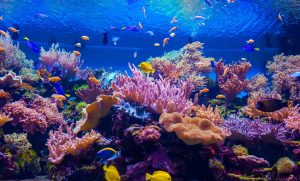
At 1.5°C, coral reefs would be destroyed in 70 percent of cases, while at 2°C, more than 99 percent would be lost. Fish habitats and populations that rely on reefs for food and livelihoods would be destroyed as a result.
DISEASE, FOOD, AND FORESTS
Warming by 2°C instead of 1.5°C would have a greater impact on food output.
If crop failures occur in a couple of the world’s breadbaskets at the same time, broad portions of the globe may experience severe food price increases, hunger, and famine.
Mosquitoes that transmit illnesses like malaria and dengue fever may increase their range as the planet warms. However, compared to 1.5°C, 2°C will cause a greater number of insects and animals to lose most of their habitat range, as well as increasing the chance of forest fires, which is another threat to species.
‘TIPPING POINTS’ is a term used to describe the process of accumulating points.
The risk of the earth reaching “tipping points,” where Earth’s systems pass a threshold that causes irreversible or cascading repercussions, grows as the world warms. It’s impossible to say when such points will be achieved.
________________________________________________________________________
Read Also : Global Warming Kills 14 Per Cent Of World’s Corals In A Decade: Survey
________________________________________________________________________
Droughts, decreased rainfall, and continuous deforestation in the Amazon, for example, might cause the rainforest system to collapse, releasing CO2 into the sky instead of storing it.
Alternatively, melting Arctic permafrost might allow long-frozen vegetation to breakdown, releasing massive amounts of carbon dioxide into the atmosphere.
That’s why continuing to emit from fossil fuels is so dangerous… because we’re increasing the chances of crossing one of those tipping points.
BEYOND 2 DEGREES COLD
So far, the climate promises that governments have made to the UN’s registry of pledges have placed the globe on course to warm by 2.7 degrees Celsius. Although several experts questioned the figure, the International Energy Agency claimed Thursday that new commitments made at the COP26 meeting, if executed, could keep global warming below 1.8°C. It remains to be seen if these promises will be fulfilled in reality.
Warming of 2.7°C would bring “unlivable heat” to sections of the tropics and subtropics for parts of the year. According to experts, biodiversity would be greatly diminished, food security would be jeopardised, and extreme weather would overwhelm most metropolitan infrastructure’s capacity to adapt.
If we can keep warming below 3°C, we will likely remain within our civilization’s adaptive capabilities, but above 2.7°C, we will face enormous suffering.
Tags: #carbondioxide, #climate, #climatechanges, #climatecrisis, #COP26, #envorinment, #getgreengetgrowing, #globalwarming, #gngagritech, #greenstories, #rain, #rainforest, #wildlife