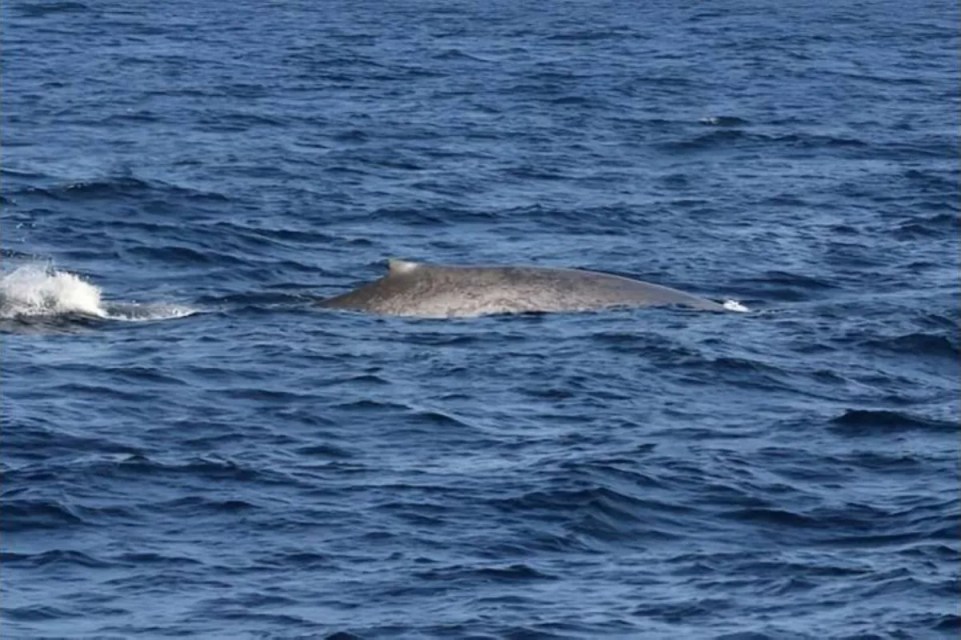
“The data collected in Seychelles gives us hope and encourages us to do more.”
Blue whales are among the rarest creatures on Earth, with experts estimating that only 5,000-15,000 are left. However, a group of researchers recently undertook an expedition to find blue whales at the Seychelles archipelago and were happily surprised by how many they spotted.
Jeremy Kiszka, an associate professor of biological sciences at Florida International University, summarized the trip for The Conversation. Along with Kathleen Stafford, an associate professor at Oregon State University’s Marine Mammal Institute, and with help from the University of Seychelles and Oceanic Films, the group made two trips to the Seychelles archipelago off the coast of east Africa between 2020 and 2021.
________________________________________________________________________
Read Also: Your Gut Influences Your Overall Mental & Physical Wellbeing; Eat These 8 Foods In Rotation Daily
________________________________________________________________________
The researchers used several “innovative and resource-intensive research methods,” which resulted in five sightings of groups of up to ten blue whales. The scientists used vessel-based visual surveys that focused on the deep waters where the whales dive, as well as a hydrophone (an underwater microphone capable of recording whale vocalizations).
“Because of our blue whale discoveries, we have engaged with local tourism operators and the government, particularly to identify measures to limit the impact of the potential development of whale watching as an activity. These are positive steps towards their conservation,” Kiszka wrote. “We still know so little about blue whales. But the data collected in Seychelles gives us hope and encourages us to do more.”
The whaling industry decimated blue whale populations worldwide beginning in the 19th century. In Seychelles, in particular, Soviet whalers illegally killed 500 blue whales in the 1960s, making it especially encouraging that the creatures have been able to return to that region.
________________________________________________________________________
Read Also: Climate change is hurting India’s rice crop
________________________________________________________________________
Although commercial whaling is now banned almost everywhere (except for Norway, Iceland, and Japan), whales now face new challenges to their well-being — namely, ocean pollution in the form of plastics. One recent study found that whales were ingesting as many as 10 million pieces of microplastics per day.
In addition, at least 20,000 whales are killed per year by collisions with shipping, cruise, and commercial vessels.
There is still much that needs to be done to protect these incredible animals — but the findings from the researchers in Seychelles are encouraging for the future survival of blue whales.
NOTE – This article was originally published in thecooldown and can be viewed here
Tags: #animals, #Blue whales, #climate, #earth, #fish, #getgreengetgrowing, #gngagritech, #greenstories, #marine, #nature, #ocean, #Oceanic, #oceanpollution