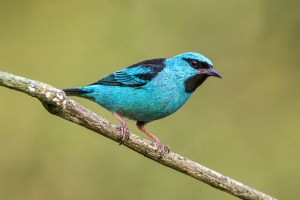
Blue dacnis
Dacnis cayana
The blue dacnis also known as the turquoise honeycreeper is a small songbird found in parts of Central and South America and Trinidad. Despite its alternative name, it is not a honeycreeper which have longer bills. The male blue dacnis is turquoise with black patches around the eyes, on the throat and back, while the female has mostly green plumage with a blue head.
It inhabits forests and woodlands as well as parks and gardens, and feeds on insects and sometimes fruit such as berries, figs, and bananas.
02
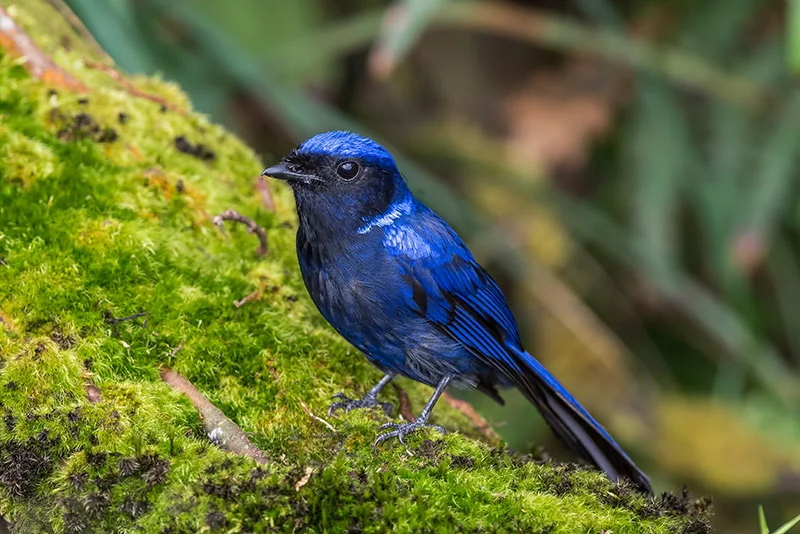
Large niltava
Niltava grandis
The large niltava is an Old World flycatcher found across Asia including Bangladesh, Bhutan, Cambodia, China, India, Indonesia, Laos, Malaysia, Myanmar, Nepal, Thailand, and Vietnam. The male has bright, purple-blue upperparts and dark blue lower parts with a darker face. The female has dark brown plumage with a blue patch on the neck.
It lives in subtropical and tropical montane forests, but can be round in rural gardens too, and eat insects and other invertebrates as well as berries.
________________________________________________________________________
Read Also : Water footprints – need to calculate to avoid a water crisis.
________________________________________________________________________

03
Steller’s jay
Cyanocitta stelleri
Closely related to the blue jay, Steller’s jay is a covid found in western North America and mountainous areas of Central America. Its plumage shows considerable variation across its range with individuals in the north having dark heads which become bluer towards the south. The body is silvery blue while the primary feathers and tail are a richer blue. The sexes are similar although the female is slightly smaller.
It lives in evergreen forests, agricultural habitats, and residential areas, and has a omnivorous diet consisting of seeds, nuts, and berries, as well as insects, small rodents, and eggs and nestlings. There have been reports of Steller’s jay eating small reptiles such as snakes and lizards.

04
Mountain bluebird
Sialia currucoides
The mountain bluebird is a small thrush that can be found in open country and mountainous areas of western North America. The male has bright turquoise upperparts and lighter blue underparts with a pale lower belly. The female has grey-brown plumage with some patches of blue in the wings and tail. She sometimes has a pale orange wash on her breast.
They inhabit grasslands, prairies, and steppes where there are few trees as well as pastures and residential areas where they will nest in nest boxes. During the summer, the mountain bluebird’s diet consists mainly of insects while in the autumn and winter they eat mostly berries such as juniper and elderberry, as well as seeds.

05
Siberian blue robin
Larvivora cyane
The Siberian blue robin is a songbird that was formerly classified as thrush but is now considered a member of the Old World flycatchers. It is found in Asia from Siberia to northern Mongolia, northeast China, Korea, and Japan. Larger than the European robin, the male has blue upperparts and a pure white belly with a line of black that runs from the eye to the middle of the wing. The female is brown with pale underparts and a blue wash on the rump.
It lives in the undergrowth of coniferous forests often near rivers and streams and will venture into parks and gardens. It eats small invertebrates such as beetles, ants, worms, spiders, and insect larvae, and occasionally berries and seeds.

06
Blue rock thrush
Monticola solitarius
The blue rock thrush is a species of chat that is found in southern Europe, northwest Africa, and Central Asia. It is about the size of a starling with the male having blue-grey plumage with darker wings. The female is brown with darker upperparts and lighter, scaly underparts.
________________________________________________________________________
Read Also : What is Water Footprint Assessment?
________________________________________________________________________
It lives in mountainous regions including cliffs, rocky coastlines and valleys, as well as ruined buildings, and eats a varied diet that includes insects, small reptiles, berries, and seeds.

07
California scrub jay
Aphelocoma californica)

08
Shining honeycreeper
Cyanerpes lucidus

09
White-throated magpie jay
Calocitta formosa

10
Blue-grey tanager
Thraupis episcopus

11
Indigo bunting
Passerina cyanea

12
Blue jay
Cyanocitta cristata
________________________________________________________________________
Read Also : Know the key details about water footprints
________________________________________________________________________

13
Hyacinth macaw
Anodorhynchus hyacinthinus

14
Cape starling
Lamprotornis nitens

15
Blue whistling thrush
Myophonus caeruleus

16
White-tailed robin
Myiomela leucura

17
Violet sabrewing
Campylopterus hemileucurus

18
Asian fairy-bluebird
Irena puella

19
Blue grosbeak
Passerina caerulea

20
Ultramarine flycatcher
Ficedula superciliaris

21
Kalij pheasant
Lophura leucomelanos
______________________________________________________________________________
Read Also : Seaweed: The answer to the plastic crisis?
______________________________________________________________________________

22
Black-naped monarch
Hypothymis azurea

23
Red-legged honeycreeper
Cyanerpes cyaneus

24
Tree swallow
Tachycineta bicolor

25
Nilgiri flycatcher
Eumyias albicaudatus
NOTE – This article was originally published in birdspot and can be viewed here