It was just a few years ago when AI (Artificial Intelligence) seemed like a complex, futuristic concept discussed only by scientists, academicians, and tech experts. Today, the term AI has become commonplace in conversations across all sections of society. We have long heard about robots, driverless cars, air taxis, and an endless array of smart gadgets, from household appliances to smartphones. Today, we have become so dependent on GPS that we struggle to reach a destination without its help.
In 2024, in China, 2.7 million parcels were delivered via drones. Now, they aim to apply this experience to air taxis. In the U.S., Sam Altman assured Trump, that AI would achieve intelligence on par with human beings within his tenure. We never realized when we started not just using AI but also becoming dependent on it. Now, “AI is no longer just a buzzword, but a reality.”
________________________________________________________________________
Read Also: REGENARATIVE AGRICULTURE : SUSTAINABLE FARMING FASHION
________________________________________________________________________
What Exactly is AI (Artificial Intelligence)?
Before delving into AI, let’s first understand human intelligence and its significance. Intelligence is defined as the ability to learn, reason, improve, and solve various issues in different situations. It includes observation, perception, analysis, memory, communication, attention, and the complex interplay of cognitive faculties. The cognitive abilities to think, reason, and evaluate are inherent in human beings and continue evolving with time. This is the most essential part of human intelligence, enabling individuals to adapt to new and changing external situations and circumstances. Human survival is based on the acquired process of learning and gaining intelligence through various subjective experiences.
AI is the science of making machines that can think like humans, recognize patterns, make judgments, learn, adapt, and improve over time. In simple terms, “AI is the simulation of human intelligence by machines.” AI is not just limited to computers and robots that can think like humans; rather, it is a broad field encompassing various technologies and applications, many of which have been in development for decades. The functioning and performance of AI rely on data processing and decision-making based on patterns and algorithms. AI is a realm where technology meets creativity, continuously redefining the boundaries of what machines can achieve. The inception of artificial neurons to analytical excellence at the speed of light are just a few milestones that have brought us closer to a future of endless possibilities.
________________________________________________________________________
Read Also: 18 Advantages and Disadvantages of Organic Farming in Modern Agriculture
________________________________________________________________________
The History of AI
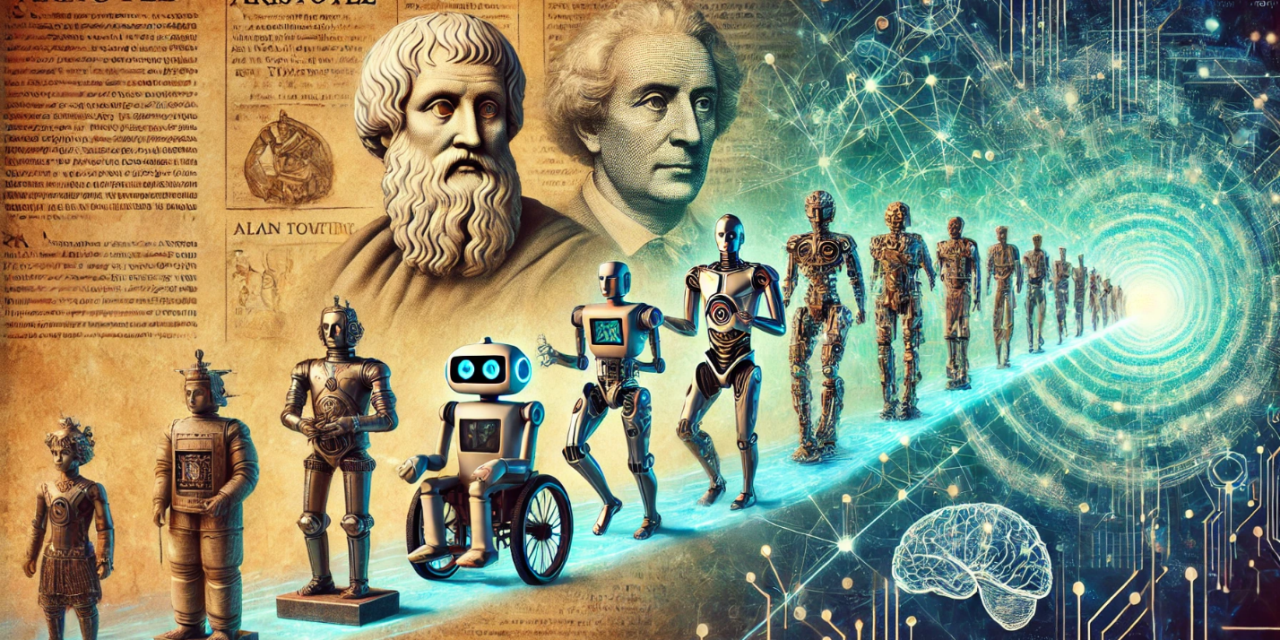
Although AI has become widely recognized in recent years, it has a long history. In the 10th Century BC, You Shi presented King Mu of Zhou with mechanical men capable of moving their bodies independently. Between 384 BC and 322 BC, Aristotle described the syllogism, a method of formal mechanical thought in *Organon*. He also introduced means-end analysis (an algorithm for planning), later used by Newell and Simon’s General Problem Solver in 1959. In the 3rd Century BC, Ctesibius invented a water clock with an alarm, an early example of feedback mechanisms. By the 1st Century AD, Hero of Alexandria had created mechanical men and other automatons, producing what could be considered the world’s first practical programmable machine.
The Modern Era of AI (1940-1990s)
The inception of AI as a scientific discipline occurred between the 1940s and 1950s. In 1943, Pitts and McCulloch founded the concept of artificial neurons. By 1950, Alan Turing had proposed the Turing Test, which conceptualized the idea of intelligent machines. The year 1965 saw the unveiling of Eliza, an early chatbot, marking the advent of human-like machine interactions. In 1968, Terry Winograd created SHRDLU, a program that could understand natural language and interact with users. Danny Hillis designed parallel computers for AI and computational tasks in 1981, paving the way for modern GPUs. Peter Brown advanced the field of language translation in 1988. The decade concluded with a milestone achievement in 1997 when IBM’s Deep Blue defeated Garry Kasparov, the world chess champion, showcasing AI’s potential in strategic thinking.
AI’s Rapid Growth in the 21st Century
Over the past decade, AI has witnessed exponential growth. The year 2011 marked a significant milestone when IBM’s Watson defeated Brad Rutter and Ken Jennings, the reigning *Jeopardy!* champions. That same year, Apple introduced Siri, a virtual assistant using speech recognition and natural language processing. In 2013, Boston Dynamics created Atlas, a humanoid robot capable of performing various tasks both indoors and outdoors. The following year saw the introduction of generative adversarial networks (GANs), where two neural networks compete to generate better solutions. By 2016, the Face2Face program had enabled deepfake video creation, raising concerns about AI’s role in misinformation. Google made a breakthrough in 2017 by introducing the first Transformer, capable of understanding entire sentences and extracting meaning based on context, revolutionizing large language models (LLMs). In 2020, Google DeepMind released *AlphaFold*, an AI algorithm trained on 170,000 protein sequences, achieving lab-level accuracy in protein structure prediction and revolutionizing biological research. By 2022, OpenAI had introduced ChatGPT, which is now widely used by millions worldwide.
________________________________________________________________________
Read Also: Biodiversity loss: Agriculture ‘threatening 86% of at-risk species’, says major UN-backed report
________________________________________________________________________
The Future of AI: Promise and Peril
AI breakthroughs were not as sudden as they may have seemed in the news. However, AI is now advancing at an unprecedented pace. Our response to it will shape the nature of truth, our relationship with reality, the exploration of knowledge, the physical evolution of humanity, and even human existence itself. Never before have digital tools been so responsive to human intelligence, complementing our capabilities. AI can enhance analytical and decision-making abilities, but there are also concerns about its misuse.
The potential misuse of AI and machine learning could lead to widespread misinformation. If AI-driven systems manipulate existing web data, they could mislead future generations, blurring the lines between fact and fiction. How will we distinguish between truth and deception when both appear indistinguishable? AI as a propaganda engine is a serious concern, and we are already witnessing its effects.
As we stand at the crossroads of this AI revolution, we must navigate its future responsibly, ensuring that it serves humanity rather than undermining it.
Tags: #AI, #airtaxis, #ArtificialIntelligence, #automatons, #driverlesscars, #getgreengetgrowing, #gngagritech, #GPS, #greenstories, #humanintelligence, #robots, #scientists, #technologies