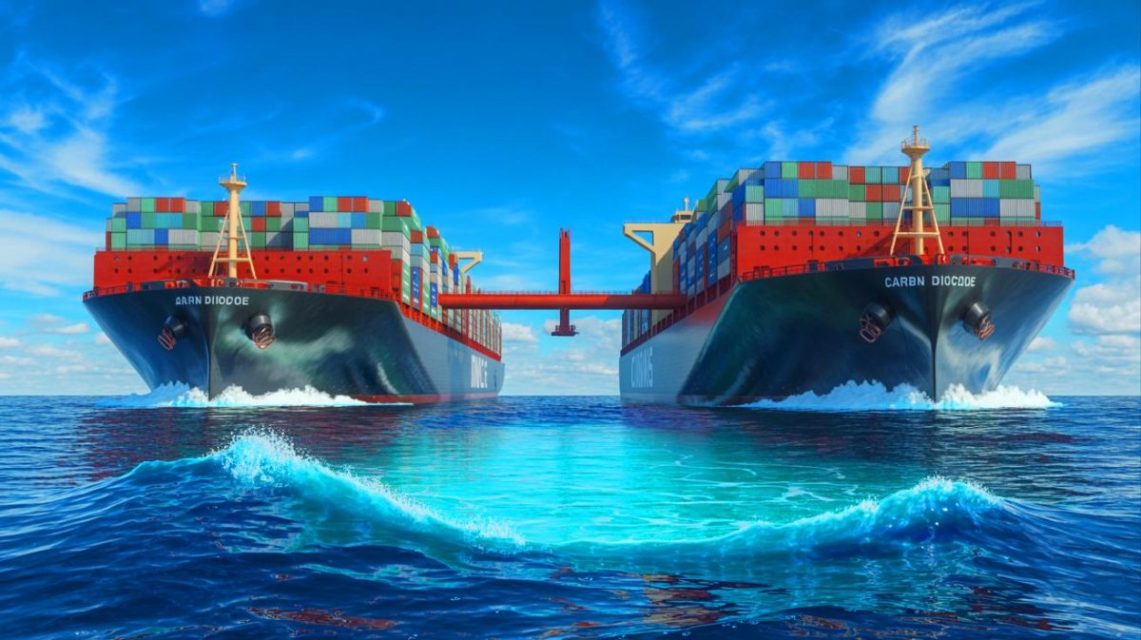
In a historic maritime achievement, Shanghai has completed the world’s first ship-to-ship transfer of liquid carbon dioxide, revolutionizing the shipping industry’s approach to reducing emissions and setting a new standard for sustainable practices.

In a groundbreaking achievement for sustainable maritime practices, Shanghai has accomplished the first-ever ship-to-ship transfer of liquid carbon dioxide (CO₂) at sea. This monumental step forward not only marks a significant breakthrough in maritime decarbonization but also transforms ship emissions from mere waste into a valuable commodity. This historic operation took place on June 19, 2025, involving the Panamanian-flagged EVER TOP, a 14,000-TEU container ship, which successfully offloaded captured CO₂ onto another vessel, the Dejin. The event unfolded at the Shengdong Terminal of Yangshan Deepwater Port, setting a global benchmark in green shipping and offering a promising solution for reducing maritime carbon footprints.
________________________________________________________________________
Read Also :10 High-Protein Fruits to Add to Your Diet
________________________________________________________________________
Emission Handoff at Sea
The concept of transferring captured emissions between ships at sea emerged as a practical solution to existing challenges in the shipping industry. Previously, in 2023, the EVER TOP had already achieved a milestone by completing the world’s first ship-to-shore transfer of captured CO₂ at the same port. This latest advancement builds on that success, utilizing an Onboard Carbon Capture and Storage (OCCS) system developed by the Shanghai Marine Diesel Engine Research Institute. The OCCS system is capable of capturing over 80 percent of a ship’s CO₂ emissions at a remarkable 99.9 percent purity, making it a highly efficient technology.
Moreover, the retrofitting costs for this system are around $10 million, significantly less than the cost of converting a vessel to methanol or ammonia power. According to Du Mingsai, project manager for the transfer operation, ship-to-ship transfer offers clear advantages over traditional methods. It is significantly cheaper than land transport and enables a single CO₂ carrier to handle vastly larger volumes than a tanker truck. This innovation not only promises cost-effectiveness but also paves the way for more sustainable shipping practices.
Carbon Becomes Liquid Currency
The captured CO₂ is not just a waste product—it is a potential revenue stream. By selling the CO₂ for industrial use, a single ship could generate up to $8 million per year. However, the challenge lies in offloading the captured gas, as many buyers are located near smaller ports that cannot accommodate large container vessels. The ship-to-ship transfer method addresses this issue by allowing transfers to take place mid-voyage, without the need to dock. This can be done using anchorages or sheltered sea lanes, after which the CO₂ can be routed via smaller carriers to specialized terminals, completing the logistical loop.
This innovation provides Shanghai with a full-chain ecosystem for maritime carbon capture, positioning the city as a global leader in cutting shipping emissions. By setting a new benchmark for the industry’s green transition, Shanghai serves as a model for other ports and shipping companies worldwide. As stricter emissions regulations from the International Maritime Organization (IMO) come into play, the OCCS system offers a more cost-effective alternative to other retrofitting options, cutting expenses by half and extending vessel lifespans.
_______________________________________________________________________
Read Also : JADE PLANT BENEFITS | ADVANTAGES OF GROWING JADE PLANT
_______________________________________________________________________
Impacts on the Global Shipping Industry
With the global shipping industry emitting approximately 1 billion tons of CO₂ annually, accounting for nearly 3% of total global emissions, innovative solutions like the OCCS system are crucial. The system not only reduces the carbon footprint of ships but also turns captured emissions into a potential source of revenue. This dual benefit makes it an attractive option for shipowners facing costly choices due to new regulations.
Experts behind the project are already contributing to a new IMO working group aimed at defining carbon capture protocols for the entire shipping industry. The success of this project demonstrates the transformative potential of integrating carbon capture technologies into maritime operations. As the industry moves towards greener practices, the lessons learned from Shanghai’s achievement will likely influence global standards and inspire further innovations.
________________________________________________________________________
Read Also : Top 10 Fat Burning Fruits to Supercharge Your Weight Loss
The Future of Maritime Decarbonization
Shanghai’s successful ship-to-ship CO₂ transfer is a pivotal moment in maritime history, showcasing the potential for greener shipping solutions. As the world grapples with the challenges of climate change, the maritime industry must adapt and innovate to reduce its carbon footprint. This breakthrough not only highlights the feasibility of onboard carbon capture but also underscores the economic viability of turning emissions into a commodity.
Shanghai has set a new standard for sustainable shipping practices, and the implications of this advancement are far-reaching. As other ports and shipping companies look to emulate this model, the question remains: Will this revolutionary approach become the norm in maritime decarbonization, and how quickly can it be scaled globally?
NOTE – This article was originally published in sustainability-times and can be viewed here