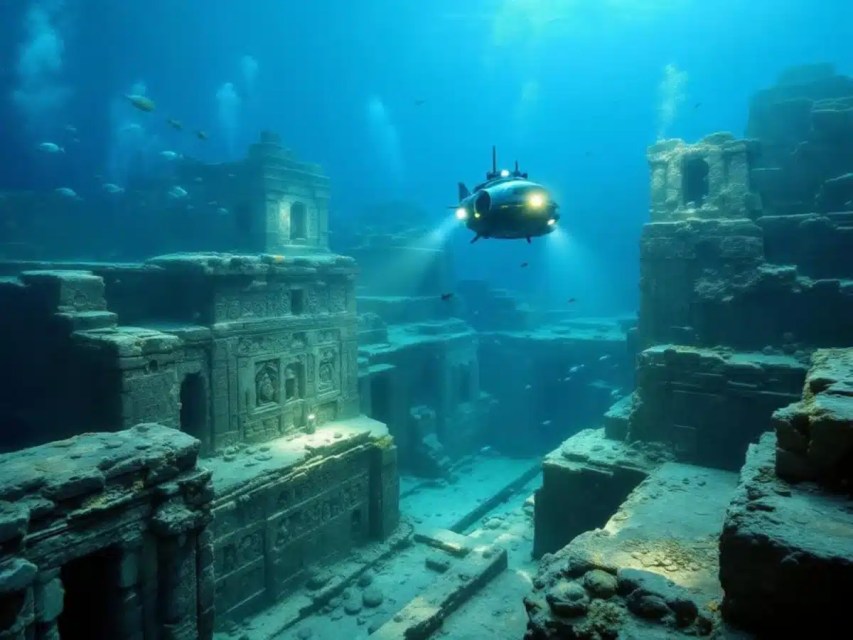
Archaeological discoveries often lead to long-term research, but the underwater exploration of a submerged city by Indian oceanographers in the Gulf of Khambhat at the end of 2000 has caught the world’s attention. It raised numerous questions about a potential lost civilization from 9,000 years ago.
The Indian subcontinent and surrounding areas, from Pakistan to Afghanistan, hold many historical mysteries. One of these mysteries emerged in the early 2000s when deep-sea excavations were conducted in the Gulf of Khambhat, located in northwest India. In 2002, the BBC published an article titled “The Lost City That Could Rewrite History,” unveiling partial findings from these underwater operations. Researchers from the National Institute of Ocean Technology (NIOT) in India uncovered ancient structures 36 meters below the surface.
________________________________________________________________________
Read Also : Google bans ads on content, including YouTube videos, with false claims about climate change.
________________________________________________________________________
They discovered artifacts, pottery, and human remains, all dating back over 9,000 years. This major find revealed the presence of structured societies in India, well before the Harappan civilization, challenging existing theories on the development of ancient societies in the region.
A Vast Submerged City
The NIOT explorers didn’t uncover just a few scattered structures—they found an entire city stretching across several square kilometers. The city measures 8 kilometers in length and about 3 kilometers in width. The sonar technology used by their equipment provided a clear view of the seafloor, confirming the extent of the discovery. Additionally, recovered objects and skeletal remains supported the theory of a submerged city.

However, dating the artifacts became a significant challenge for experts. The existence of a society thriving around 7000 BC in this region of India raised questions about traditional archaeological timelines. Most scholars believe the first structured civilization in the subcontinent developed around the city of Harappa, peaking around 2600 BC. Some, like British writer Graham Hancock, argue that an ancient, advanced civilization may have disappeared due to significant geological or climatic events. But as Indy100 points out, Hancock’s controversial personality and speculative theories have polarized the discussion, making this idea both fascinating and disruptive to the current historical narrative.
________________________________________________________________________
Read Also : The Science of Climate Change Explained: Facts, Evidence and Proof
________________________________________________________________________
Clashing Theories to Explain the Discovery
The structures beneath the water’s surface are clear, but how do we explain their location? The Gulf of Khambhat may have been submerged by rising sea levels following the end of the Ice Age and the warming of temperatures. Rising sea levels and increased river flow would have gradually submerged the area. This theory reminds us of the legendary Kumari Kandam, a mythical land bridge that allegedly connected India, Madagascar, and Australia. Bodies and objects could have been carried into the gulf, explaining the presence of 9,000-year-old artifacts. The structures, however, appear to be of human origin.
Some archaeologists argue that the sonar data might have been misinterpreted, while others suggest that errors in carbon-14 dating may have skewed the results. But no single explanation has been universally accepted. Experts are still working to confirm the existence of a submerged city, built long before known civilizations. Although research has continued for the past two decades, the mystery remains unresolved.
NOTE – This article was originally published in futura-sciences and can be viewed here
Tags: #civilization, #climate, #discovery, #environment, #getgreengetgrowing, #gngagritech, #greenstories, #nature, #sea, #underwater