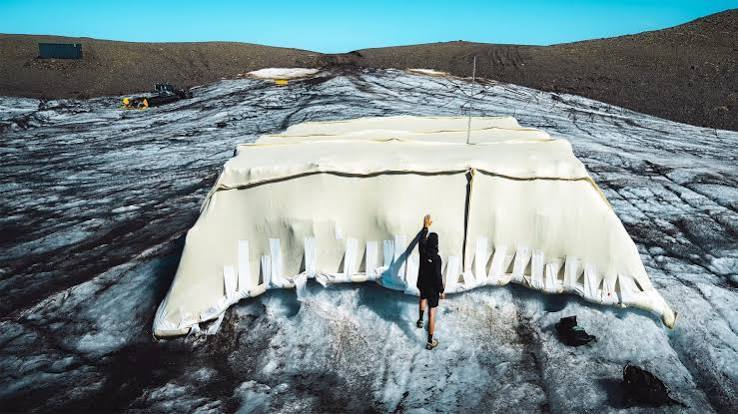

Swiss researchers tested biodegradable sheep’s wool blankets on a glacier, reducing summer ice melt by 50 to 70 percent without synthetic fibers.
Every summer, workers in the Swiss Alps spread large white sheets over patches of glacier ice to slow the melt. Those covers are usually made of synthetic fabric, a plastic-based material that can shed fibers into the environment.
This year, a team in western Switzerland tried something different: blankets made of sheep’s wool.
Early results from the “Keep It Wool” project suggest the wool limited melting about as well as the standard synthetic covers on a small test area of the Tsanfleuron Glacier. The researchers are clear, however, that the method protects only tiny patches of ice and does nothing to stop global warming.
Four students with a great idea
The project is led by the Summit Foundation, a Swiss environmental nonprofit, together with the University of Lausanne. Four master’s degree students came up with the idea.
The Tsanfleuron Glacier stretches about 2.2 miles (3.5 kilometers) and reaches roughly 9,840 feet (3,000 meters) above sea level. Part of it lies within the Glacier 3000 ski area, near the village of Les Diablerets.
In late June 2026, the team laid out two wool blankets, each covering about 1,080 square feet (100 square meters), on the glacier.
Scientific oversight came from the university and the Glacier Monitoring Switzerland network, known as GLAMOS, according to Swissinfo.
The aim, project manager Timothee Steiner told Reuters, was to “explore a biodegradable alternative while finding a use for Swiss wool, 40-70 percent of which is discarded each year.”
The blankets were made by the Swiss wool company Fisolan. Even the supplier had doubts at first.
“I thought it wouldn’t be stable enough,” said Niklaus Saegesser of Fisolan.
________________________________________________________________________

How the wool performed
Throughout the summer, the team took measurements every two weeks. They compared the wool with a conventional geotextile cover of the kind already used on Swiss glaciers.
The wool limited melting as well as the synthetic material, Reuters reported. According to the Summit Foundation, both materials reduced melt in the covered zones by 50 to 70 percent.
“Now we have a result we can see and even touch. It worked incredibly well,” said Elliot Gaffiot, one of the students behind the project.
Wool has another advantage. Plastic-based covers can shed polluting microfibers, while wool is biodegradable and renewable.
According to the Summit Foundation, there is no risk of particles from wool entering the water cycle.
Why glaciers get covered
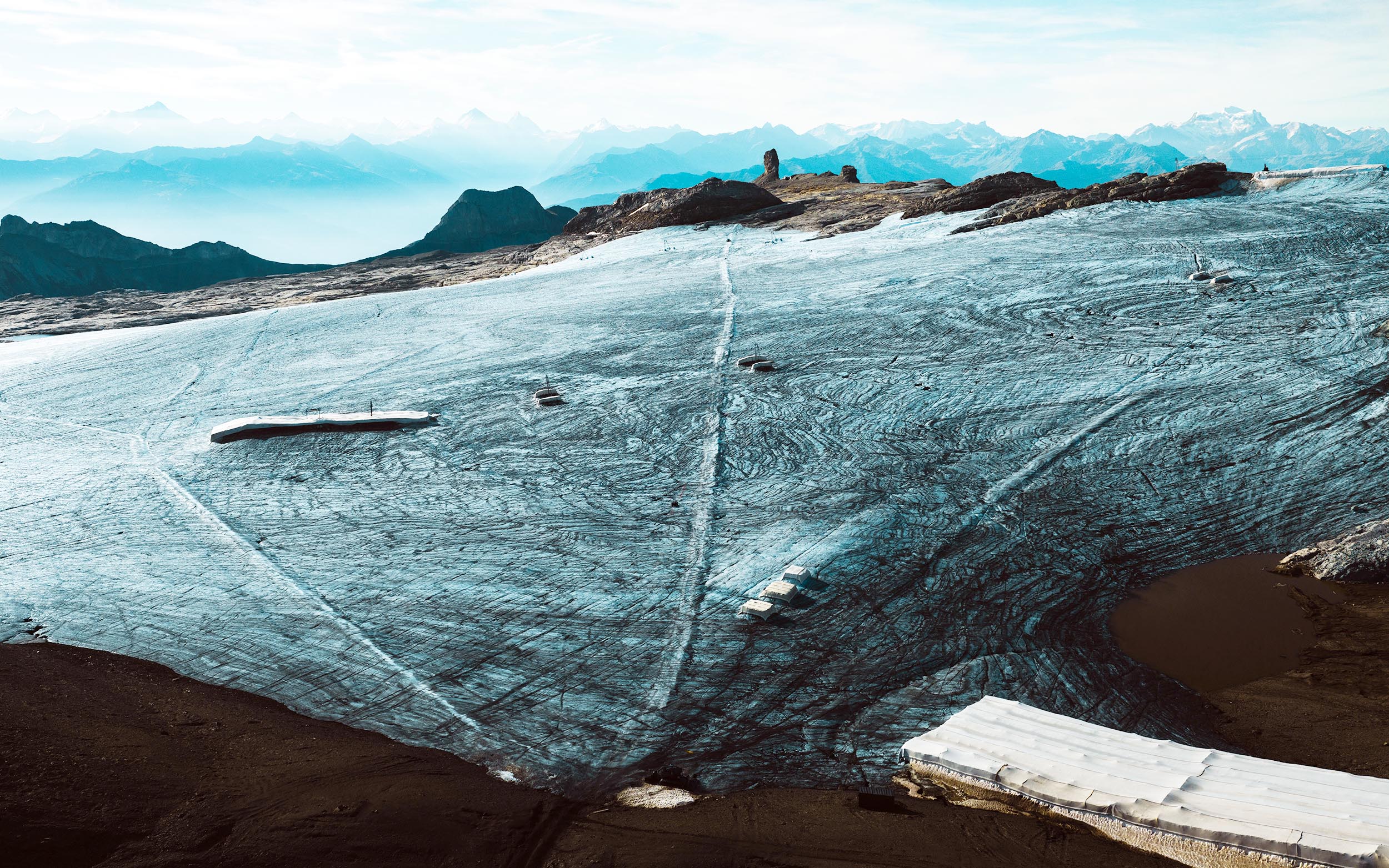
Covering glacier ice is not new in Switzerland. The first site, on the Gurschenfirn glacier on the Gemsstock mountain, has been protected since 2004.
A 2021 study led by glaciologist Matthias Huss examined covers at eight Swiss sites, at elevations between about 7,380 and 10,660 feet (2,250 and 3,250 meters). Such covers are mainly used to protect ski areas and other tourist sites.
“Approximately 60% less ice and snow melts under the white tarpaulins than in adjacent areas,” according to the Swiss Federal Institute for Forest, Snow and Landscape Research (WSL).
Across Switzerland, the covers save up to 350,000 cubic meters (about 12.4 million cubic feet) of ice each year. But they cover only about 44 acres (0.18 square kilometers), roughly 0.02 percent of the country’s glacier area.
The method is also expensive. Covering all Swiss glaciers would cost more than 1 billion Swiss francs a year, the researchers estimated.
2026 was a record melt year
The experiment took place during a punishing season for Alpine ice. In 2026, Swiss glaciers lost more than 5 percent of their volume, according to GLAMOS data released by the University of Fribourg.
A winter with little snow was followed by a hot, dry summer. The freezing level stayed above 13,100 feet (4,000 meters) on 76 days, more than double the historical average.
Over the past five years, Switzerland has lost nearly 20 percent of its glacier ice, a pace described in detail in recent coverage of five extreme summers.
________________________________________________________________________
Some small glaciers, including the Bella Tola Glacier, have vanished entirely. A new tool now lets people see when individual glaciers are projected to disappear.
Melting ice also raises risks for nearby communities. In 2025, a massive glacier collapse buried much of the Swiss village of Blatten.
Not a fix for warming
The team behind Keep It Wool stresses that blankets are not a solution to global warming. They can only slow melting on small patches of ice during the summer.
Huss has made the same point about glacier covers in general.
“The only way to effectively limit the global retreat of glaciers is to reduce greenhouse gas emissions and thus the warming of the atmosphere,” he said.
Glacier loss also affects water supplies far beyond the mountains. Shrinking ice threatens water security for communities that depend on glacier-fed rivers.
For now, the wool trial offers a cleaner way to do something Swiss resorts already do. Whether it can work at a larger scale, and over more than one season, remains to be tested.
The information on the Keep It Wool trial was obtained from Reuters, and the data on glacier covers from a WSL press release.
NOTE – This article was originally published in Earth and can be viewed here