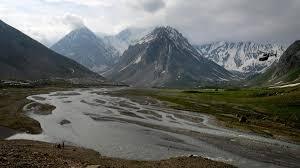
The study identifies 219 such unstable glaciers, sensitive to warming temperatures and shifting weather patterns, in the Alaknanda basin of Uttarakhand(Himalaya)

The researchers identified 219 hanging glaciers — these cling to steep valley walls and often terminate abruptly — across the basin, covering approximately 72 square km with an estimated ice volume of 2.39 cubic km, including less than one square km of hanging ice mass. File | Photo Credit: The Hindu
Unstable hanging glaciers on steep mountain slopes could trigger devastating avalanches and downstream disasters, a new study focused on a sensitive section of the Central Himalaya has warned.
Four researchers from the Indian Institute of Science (IISc), Bengaluru, the Indian Institute of Technology (IIT), Bhubaneswar, and the Defence Research and Development Organisation (DRDO), Chandigarh, assessed such glaciers in the Alaknanda basin of Uttarakhand, a key headstream region of the Ganga. Their findings revealed the scale of the growing but largely overlooked danger, and a sharp rise in human exposure, driven by rapid development in high-altitude areas.
The authors are Nandu Krishnan and Anil V. Kulkarni from IISc’s Divecha Centre for Climate Change, Ashim Sattar of IIT-Bhubaneswar’s School of Earth, Ocean, and Climate Sciences, and Harendra Singh Negi of DRDO-Chandigarh’s Defence Geoinformatics Research Establishment.
________________________________________________________________________
Their study was published in the latest issue of npj Natural Hazards, a peer-reviewed journal.
The researchers identified 219 hanging glaciers — these cling to steep valley walls and often terminate abruptly — across the basin, covering approximately 72 square km with an estimated ice volume of 2.39 cubic km, including less than one square km of hanging ice mass. These glaciers predominantly face southeast-west and north-northeast, with the Upper Alaknanda basin containing 30% of the total hanging mass volume.
Nearly one-third of these glaciers, assessed using a grid-based numerical model, are in a highly ‘unstable’ state, making them prone to sudden break-offs.
Warmer than elsewhere
“Glaciers in high-elevation alpine environments are highly sensitive to climate variability and warming. This sensitivity is particularly pronounced in the Himalaya, where warming over the past two decades has exceeded the global average, resulting in accelerated glacier retreat,” the study said.
“Such retreat has led to the detachment of tributary glaciers from trunk glaciers and has destabilised mountain glaciers (glaciers located on mountain sides) that were previously stable. These instabilities are often compensated by mass shedding in the form of snow and/or ice avalanches, a process characteristic of hanging glaciers,” it said.
The natural process, however, becomes hazardous when it occurs near settlements or infrastructures in the basin, which is also characterised by high seismicity.
The Alaknanda basin, with elevations ranging from about 400 metres to 7,800 metres, is both geologically fragile and increasingly populated. The basin hosts pilgrimages, including Badrinath and Kedarnath, as well as towns, roads, trekking routes, and hydropower projects — most of them near glacier-fed valleys.
Possible devastation
Using satellite imagery, elevation models, and avalanche simulations, the researchers assessed the farthest potential ice avalanches could travel and their likely impact. They deduced that in a worst-case scenario, modelled flows could reach major settlements, including Mana, Badrinath, and Hanuman Chatti.
The simulations suggested that avalanche debris could be over 50 metres high in some areas, with even greater intensities upstream. Apart from burying land and infrastructure, such events could temporarily block rivers, forming unstable lakes that may burst and cause devastating floods downstream.
Such cascading disasters are not merely hypothetical, the study suggested. Past avalanches in the region have dammed rivers and triggered flash floods, while more recent events (the 2021 Chamoli disaster) demonstrated how glacier-related collapses can evolve into fast-moving debris flows, causing large-scale damage.
According to the researchers, the rapid increase in exposure makes the current situation more alarming. The study estimated that built-up areas within vulnerable zones have expanded dramatically, from about 8,000 square metres in 2000 to over 150,000 square metres projected by 2030.
During this period, the number of people living in these exposed areas could increase from fewer than 400 to more than 8,500.
________________________________________________________________________
The Badrinath-Mana stretch showed the most striking growth, with both population and infrastructure expanding toward steep glacier slopes. Roads such as National Highway 7, vital for connectivity and pilgrimage, run through areas identified as potential avalanche paths.
Unequal threat
The study stated that not all hanging glaciers pose an equal threat. Some overhang larger glaciers and are less likely to affect populated areas, while others hang directly above river valleys and settlements, where even a moderate collapse could have severe consequences.
The study underscored the lack of large-scale monitoring of hanging glaciers in the Himalayas, unlike similar glaciers in the Alps that are closely observed using radar systems, time-lapse cameras, early-warning mechanisms, and other advanced tools.
The researchers argued that adopting targeted monitoring in high-risk Himalayan locations could significantly reduce future risks. While full-scale systems may be difficult to implement across such vast terrain, they said that identifying the most perilous glaciers and focusing resources would be a practical first step.
NOTE – This article was originally published in The Hindu and can be viewed here