A lost ritual chamber sealed in stone may rewrite what we know about Mexico’s ancient cultures, and who vanished from history.

A cave chamber in Mexico’s Guerrero highlands has surfaced in the archaeological record under rare and tightly preserved conditions. The site, sealed for centuries, contains materials that may redefine long-held assumptions about cultural networks in Postclassic Mesoamerica.
Preliminary analysis links the discovery to an extinct Indigenous group previously known only through limited colonial-era documentation. The configuration and content of the chamber suggest a specialized ritual function, potentially tied to fertility, cosmology, and subterranean worship.
The findings, recorded between late 2023 and 2025, have prompted renewed investigations into highland ceremonial infrastructure and long-distance trade routes. Access to the chamber remains restricted pending environmental and cultural assessments.
________________________________________________________________________
Hidden Room, Preserved Time Capsule
The chamber was accessed in September 2023 by Russian speleologist Yekaterina Katiya Pavlova and local guide Adrián Beltrán Dimas while mapping flooded sections of the Tlayócoc cave, located approximately 2,380 meters above sea level in the Sierra de Guerrero. Known in Nahuatl as the “Cave of Badgers,” Tlayócoc has been a local source of water and bat guano, but had not been systematically explored by archaeologists.
Roughly 150 meters into the cave, the explorers encountered a section where the ceiling dipped to just 15 centimeters (six inches) above the waterline, forcing them to hold their breath and navigate partially submerged passages. Beyond the constriction, they located a secondary chamber where artifacts were carefully arranged on small stalagmites.
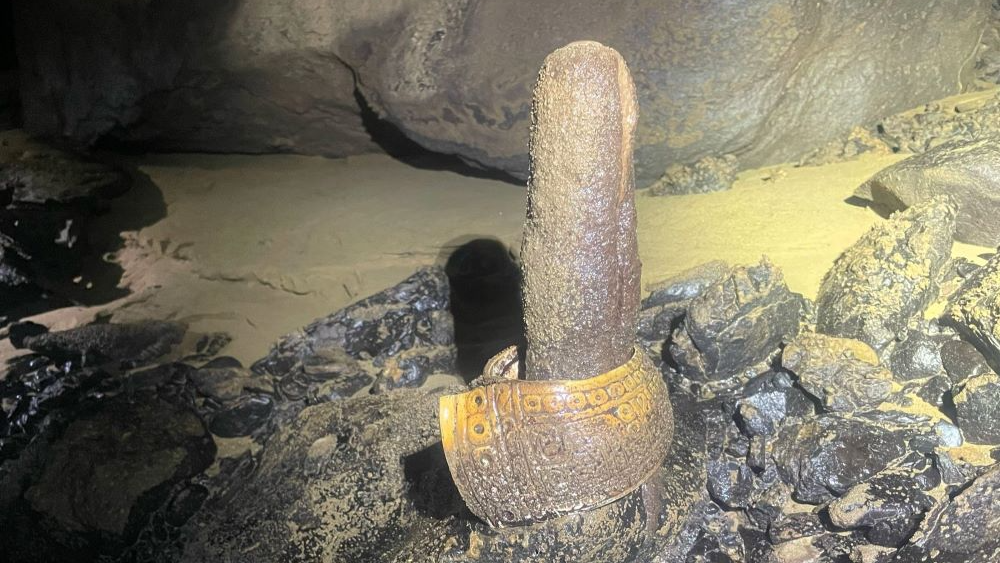
According to Pavlova, the discovery was accidental: “We thought it was trash at first,” she noted in a translated statement. Upon closer inspection, the items appeared intentionally placed and ritual in nature. The two explorers contacted the Mexican National Institute of Anthropology and History (INAH), which conducted a formal archaeological assessment.
The full inventory and contextual analysis were detailed in INAH’s official bulletin. The artifact assemblage includes:
- 4 shell bracelets, three with detailed engravings
- 1 decorated marine snail shell (Strombus genus)
- 2 complete black stone discs
- 6 fragmented stone discs
- 1 piece of carbonized wood
INAH archaeologists noted that the objects were arranged on modified stalagmites with phallic connotations, suggesting that fertility rituals may have been performed in the chamber. The cave’s microclimate, high humidity with minimal temperature fluctuation, likely contributed to the exceptional preservation of the materials, according to INAH archaeologist Miguel Pérez Negrete.
Ancient Symbols, Distant Echoes
The bracelets include incised xonecuilli (S-shaped symbols), a design element tied to Venus, timekeeping, and broader cosmological themes in Mesoamerican iconography. Another motif, a human profile figure,may represent Quetzalcoatl, the creator deity associated with wind, knowledge, and fertility.
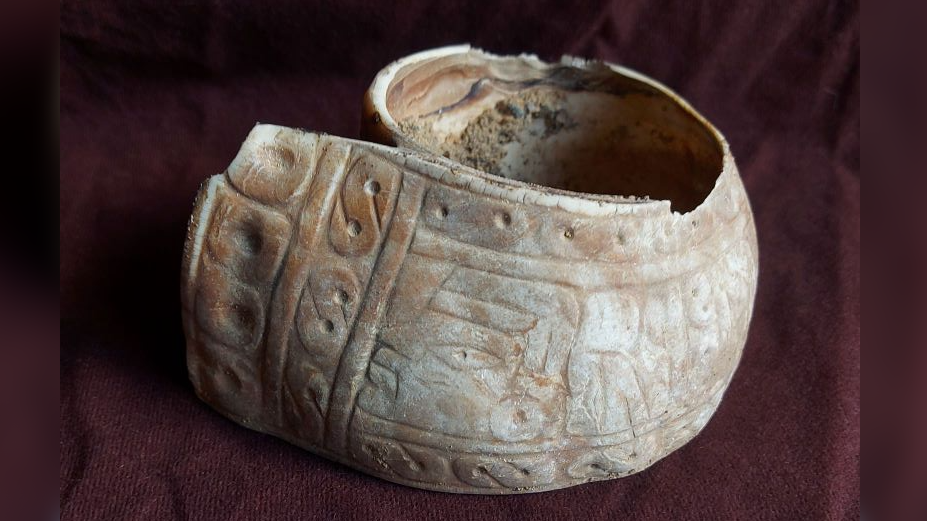
Archaeologists dated the assemblage to the Postclassic period (A.D. 950–1521) and linked it to the Tlacotepehua, an Indigenous group that once occupied the Guerrero highlands but remains poorly documented in the archaeological record. The association is based on both geographic and stylistic evidence.
The use of marine shells in a highland cave suggests long-distance trade or cultural transmission networks. Comparable black stone discs and shell ornaments have been identified in both El Infiernillo, a cave site in Coahuayutla, and in the Huastec region, located several hundred kilometers northeast. The Huastec, a culturally distinct Mayan offshoot, are known for integrating marine symbolism and mirror-like stone artifacts in ritual contexts.
________________________________________________________________________
Fragile Artifacts, Logistical Gridlock
The site’s extreme elevation and isolated geography present persistent challenges. INAH’s 2024 assessment was the first formal archaeological activity conducted in Carrizal de Bravo, the nearest settlement. The physical configuration of the cave, particularly the submerged entry route, limits both exploration and conservation operations.
As of 2026, the artifacts remain under the custody of local community authorities. They have been registered in the national heritage database and digitally photographed for further analysis. No decision has been made about whether the artifacts will be extracted for conservation or preserved in situ. The latter poses long-term risks due to the cave’s hydrological dynamics.
INAH’s restoration division is currently evaluating preservation scenarios, but no timeline has been announced. Further exploration of nearby chambers has been suspended until environmental and cultural safeguards are formally established.
What the Cave Reveals, and Conceals
The Tlayócoc discovery adds to a growing body of cave-related ritual data in Mesoamerican archaeology. Caves were widely believed to represent portals to the underworld, as well as symbolic wombs of the Earth, and often served as spaces for offerings linked to birth, fertility, and cyclical renewal.
The reshaped stalagmites and deliberate artifact placement offer rare insight into sacred spatial design. Unlike open-air temples or platforms, which often suffer from looting or environmental exposure, sealed cave sites retain original layout and orientation, critical variables in interpreting ritual purpose and symbolic meaning.
NOTE – This article was originally published in Indian Defence Review and can be viewed here