
Farmers for Forests
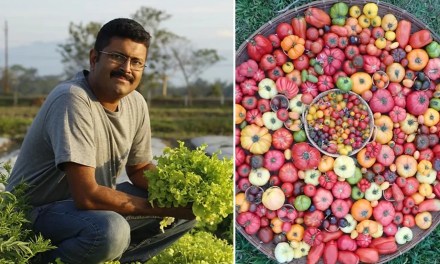
Krutika Ravishankar is a co-founder of Farmers for Forests (F4F), which uses drones, AI, GPS, and satellites to connect smallholder farmers across India to global carbon markets — with full accountability at every step. The stakes are high: little of India’s land remains forested, and nearly 30% is degraded. So far, 26,000 farmers — most of them women — are participating, 100,000 have been trained in regenerative practices, and over 50,000 tons of carbon have been sequestered. The organization works with five state governments, including Maharashtra, where a formal MoU with the Forest Department is driving large-scale restoration. Krutika spoke with Ashoka’s Shruti Nair.
Shruti Nair: Krutika, what first made you believe that farmers could be powerful stewards of forests?
Krutika Ravishankar: Way back in college, I stumbled across the work of Anna Hazare and what he’d done in Ralegan Siddhi in Maharashtra. This was a village that was completely destroyed, but in a matter of 25 years, through watershed management and afforestation — just planting more trees on farmlands and common lands — the fortunes of the village transformed.
Trees are climate superheroes. They’re not just absorbing carbon from the air, but they’re replenishing the water table, replenishing the soil, they are homes and habitats for birds, small mammals, all sorts of things. As the water levels increased and the trees grew, there was more water for crops, more fodder for cows, and through increased yields and dairy income, everything changed.
But what struck me was that Anna Hazare is an exceptional person. At 26, he devoted his entire life to this. He still lives in a temple. I thought, “How do you really scale this?” That was where we started thinking: what if all of this could be funded, and we could catalyze many more Anna Hazare’s across the country?
Nair: So what does Farmers for Forests actually do — and why does the approach matter?
Ravishankar: The problem we’re trying to solve is vast. Nearly 30% of India’s land is degraded, and over 40% of the population depends on agriculture and forests for their livelihoods. Just from 2018 to 2022, over five million large, mature trees were cut down because farmers wanted more land for crops, or felt trees were harming their yields. The research doesn’t back this up — having trees on your land actually increases yield — but we needed a way to get that information to farmers, and to get the right saplings into their hands. Unlike seeds, which you can buy at any agriculture shop, high-quality saplings and organic fertilizer are hard to source.
________________________________________________________________________
Our model is built around agroforestry — integrating fruit trees and timber trees with crops, so there is a direct livelihood connection from the start. The carbon markets provide the funding. What they’re doing is paying for the ecosystem services these trees provide: the carbon removed from the air, the biodiversity value, the soil health. So forest regeneration and farmer income aren’t a trade-off. They reinforce each other. That’s really the heart of what we’re doing — making farmers the custodians of this transition, rather than treating them as obstacles to it.

Farmers for Forests
Nair: What were the biggest assumptions you’ve had to unlearn along the way?
Ravishankar: We made a lot of mistakes in the early years. We were really focused on getting back the “right” trees — wilder trees, more biodiversity, stronger ecological function. Our idea was that we would get farmers to plant these and support them financially through payments for ecosystem services.
The mistake was underestimating how farmers think about trees economically. If you’re planting a mango tree or a lemon tree, farmers know the economics well — they know what the return will be in 20 or 30 years. But if you’re planting wild trees without an immediate livelihood benefit, even with cash transfers, farmers weren’t trusting that the cash would keep coming. A lot of our early efforts failed, and we had to shift to trees focused on livelihood generation, with wild trees woven in.
The deeper lesson was this: while we were doing what was probably the best thing ecologically, it wasn’t sustainable from a livelihood point of view. The trees you plant only provide ecological benefits if they survive. And for these trees to survive, the community really has to believe in the value of those trees.
Nair: Carbon markets are notoriously inaccessible for smallholders. How do you bring farmers in?
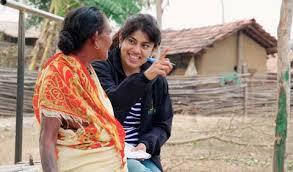
Ravishankar: Explaining carbon markets to farmers is genuinely complex — even I don’t understand all the intricacies completely. So we’ve had to try a variety of things: a WhatsApp chatbot, street plays, community meetings, videos, one-on-one trainings, local farmer influencers. Recently when we were working in Gadchiroli, we made a 90-page report in Marathi on the Kyoto Protocol and shared it with the community Gram Sabha. Empathy, warmth, storytelling — that is critical. Using the language, the music, the culture to convey information has really helped.
On the other end, the companies paying for carbon credits are often sitting thousands of miles away in Europe or America. They need a reliable way to know their money is actually creating the carbon and biodiversity impacts they’re paying for. That’s where technology comes in — helping us quantify biodiversity impact and carbon removal, and providing that data reliably so the finance to farmers keeps flowing.

Farmers for Forests
Because we’re a nonprofit and all our tech is open-source, we’re ensuring the money flowing in isn’t captured by intermediaries. The idea is building a tech stack that multiple organizations can use — open and transparent — so more money actually reaches farmers. AI has enabled us to do this a lot more quickly and with a lot more accuracy than we might have otherwise.
________________________________________________________________________
Nair: How important is government partnership to scaling this work?
Ravishankar: Critical. Getting any collaboration with the government has a huge impact because of the scale and reach that the government has. Incorporating these best practices into schemes like MGNREGA, or into national and state-level agroforestry policies, could be transformative — because the amount of money needed to fuel this transition at scale simply cannot come from carbon markets alone. Government has to be part of it.
Nair: How do you balance the pressure for results with the slower timelines of nature?
Ravishankar: Honestly, I don’t think we’ve found the right balance yet. On one hand, scaling on market-based funding means investors who want things done quickly and at massive scale. On the other hand, you have nature, which takes its own time. It’ll have to be a lot of trial and error. We haven’t figured it out yet — and I think being honest about that matters.
Nair: What would you say to young social entrepreneurs just starting out?
Ravishankar: Get co-founders. Entrepreneurship is often seen as an individual thing, but I really believe it’s a team sport. We have five co-founders — four active now — and I don’t think I would have been able to do any of this alone. Working as a team makes everything more fun and easy and doable.
And second: accept that no matter what you do, there are going to be a few fires that continue burning. I personally get very stressed when things aren’t perfect, and I’m really working on just putting in my best effort and showing up on the bad days. Being okay with the fact that thousands of things are going to go wrong — and still showing up anyway — that’s probably the most important thing I’ve learned.
–
Krutika Ravishankar is an Ashoka Fellow.
Shruti Nair leads Ashoka’s work supporting innovators for the public across South Asia.
This interview was condensed for length and clarity.
NOTE – This article was originally published in Forbes and can be viewed here