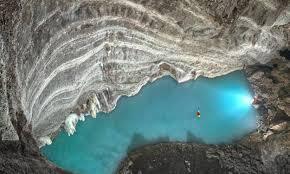

Scientists have confirmed the largest known underground lake of warm water, located about 328 feet (100 meters) below the border between Albania and Greece.(Atmos cave)
Tests show that water from this hidden lake can move through connected caves in just a few hours, reshaping scientists’ understanding of how these underground water systems behave.
Steam leads underground
Steam pouring from a rocky valley near Konitsa, a town in northwestern Greece, led cavers to an unassuming opening.
Following that vapor underground, Marek Audy, a Czech speleologist with the Czech Speleological Society, reached warm water at the bottom.
A column of steam rising from the slope pulled Audy back, and the team reached the lake in February 2025.
Careful mapping turned that moment of discovery into a water puzzle that could affect every spring in the valley.
Inside Atmos Cave
Inside Atmos Cave on the Albanian side of the border, explorers found a warm pool sitting in a collapsed chamber.
Laser and underwater scans measured it at about 454 feet long and 138 feet wide, holding 2.2 million gallons of mineral-rich water.
“When we first entered this cave and saw the lake, we were amazed,” said Audy.
Nicknamed Lake of Nerves, the pool became a starting point for tests that tracked where the warm water escaped.
Toxic gas underground
Rotten-egg odor signaled hydrogen sulfide, a toxic gas from sulfur-rich water, in the cave air near the lake.
Portable detectors logged it at 2 to 22 parts per million in open sections of the cave. Safety guidelines set a 10-ppm ceiling and a 100-ppm immediately dangerous level for hydrogen sulfide, making the cave readings serious.
“We had to have gas detectors so we could be alerted in time,” said Audy, noting that the gas shapes the cave.
________________________________________________________________________
Cave growth from below
Contact with air turned some of the dissolved gas into acid, and that reaction started eating the limestone.
Geologists call the process sulfuric acid speleogenesis, cave growth driven by sulfuric acid reactions, and it can hollow chambers from below.
Whirling flow released more gas into the cave air, so the strongest corrosion happened near rapids, not calm lake surfaces.
Over time, collapses blocked old passages, trapped warm water in basins, and forced it into fractures that formed new routes.
Dye tracks underground flow
To follow the hidden routes, the team ran tracer tests, dye releases that track water movement underground, across several caves.
Within hours, the dye showed up at nearly every spring in the valley, including those fed by narrow cracks.
Flow sped along at up to 18.6 miles (30 kilometers) per day, and deep thermal water moved far faster than expected.
That result overturned the idea that each crack carried isolated pristine water, and it reframed how the caves connect.
Environmental risks below
Downstream springs released around 3,170 gallons (12,000 liters) per minute, so the cave water did not stay sealed underground.
In karst, landscapes shaped by dissolving limestone, cracks can move water fast and leave little time for natural filtering.
Because of this rapid flow, surface pollution or heavy construction could slip into those same fractures and reach cave habitats before anyone notices.
Protecting the valley means watching both groundwater and surface decisions, because the underground lake depends on what happens above.
Stable thermal system
Temperature readings stayed close to 79°F (26°C) year-round, showing that deep heat fed the system steadily.
Rising groundwater picked up warmth underground, then pushed through cracks with dissolved minerals that gave the water its chemical signature.
Along the Vromoner valley on the Albania-Greece border, springs matched the lake’s temperature and chemistry, pointing to one source.
Such stability let researchers use the lake to interpret the region’s geothermal water system, rather than blaming seasonal weather.
Life in harsh water
Slimy biofilms, layers of microbes coating cave mud, covered streambeds and became the base of the underground food chain.
Instead of relying on sunlight, those microbes used sulfur compounds for energy and produced nutrients that small animals could eat.
In the Vromoner caves, the study found dense insect larvae but few types of animals, because the water stayed low in oxygen.
Those same fast connections also created migration routes, so disturbances in one cave could quickly spread through the whole system.
Protecting a fragile system
Local officials have started talking with the exploration team about protecting the caves as part of Vjosa National Park.
Park status could limit road building and dumping near sinkholes, and therefore reduce the chance that pollutants reach the connected springs.
Plans for a dam on the Greek side of the Sarantaporos River, a border river, could disrupt the caves’ water levels.
Cross-border decisions will matter, because the lake and its springs ignore political lines once water starts moving.
Next steps ahead
The lake and its fast-moving routes turned a caving find into a lesson about how warm groundwater reorganizes underground landscapes.
More tracer work in other sulfur-rich caves could test the revised model, while local protection decisions will set the pace of discovery.
The study is published in The International Journal of Speleology.
Photo: Marek Audy archives
NOTE – This article was originally published in Earth and can be viewed here