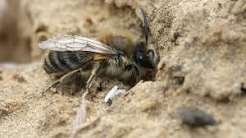

Solitary bees make natural plastic that breaks down in soil, offering clues for designing less persistent synthetic materials.
A plastic wrapper may be useful for a few minutes, then stay in the environment for centuries. But a small bee makes a plastic-like material that starts breaking down in soil within months.

The bee, Colletes inaequalis, uses it to cover the inside of its underground nest. The material helps protect the young bee growing inside.
Researchers studied these nests in Tennessee. In fresh nests, plastic made up 73% of the lining’s weight, but four months later, that share had fallen to 40%.
Now the team wants to learn how the bee makes a material that is tough but still breaks down. The answer could help scientists make better plastics for everyday use.
A bee worth studying
Jonathan Coote, an assistant professor at Virginia Tech, led the study.
Laura Russo, who studies bees at the University of Tennessee, first told him about the material while he was a doctoral student there.
Coote kept studying it during his later research at the University of Minnesota. After joining Virginia Tech in 2025, he made it his main research focus.
Scientists identified the chemical makeup of the bee’s plastic more than 45 years ago. But for years afterward, few people studied it further.
A home underground
Most bees live alone rather than in hives. This species, common in the eastern United States, digs tunnels in the ground and builds small rooms for its young.
The female covers each room with a thin, clear layer, which gives these insects the name cellophane bees. She adds pollen and nectar, lays one egg, and closes the room.
The young bee spends more than 90% of its life inside. The lining likely protects it and its food from water and fungus.
The lining contains silk and a natural plastic made by the female.
A gland connected to her stinger releases tiny, ring-shaped molecules, which join into long chains as she spreads them over the walls.
Why plastic hangs around
The bee’s material resembles polyethylene, a plastic widely used in packaging.
Polyethylene contains long chains of carbon atoms held together by strong bonds that are hard to break, even in industrial compost.
Only about 9% of the world’s plastic was recycled in 2022. Nearly a third is poorly managed and ends up in the environment, where it can break into tiny pieces called microplastics.
Scientists have tried making similar plastics with weaker links in their chains. Water or enzymes, natural substances that help chemical reactions happen, can break these links.
These materials are called polyesters, and the bee’s plastic belongs to this group. “This is a polyester that mimics polyethylene,” Coote said.
Copies are hard work
Even with weaker links, most lab-made versions barely break down.
Their chains pack closely together and keep water out, making the weaker links hard to reach.
The best-studied version lost only 18% of its weight after 280 days in industrial compost. It did not break down at all under milder conditions.
The bee’s nests offered a clue that its material was different. More than 10,000 nests can share one site, and bees may return to the same ground for decades.
Yet the old plastic linings do not seem to pile up. Something appears to break them down.
Strong, but not permanent
The team first tried to dissolve the bee’s plastic to study its chains. After two days in a solvent heated to 302°F (150°C), the material still held its shape and size.
This suggested that the chains were linked together like a net.
About 60% of the plastic also formed tightly packed areas called crystals, arranged like those in polyethylene.
Usually, these tightly packed areas make plastic harder to break down. So the bee’s material seemed to have the same features that cause trouble in lab-made plastics.
Following nests for months
The researchers collected fresh nests in March 2023 in Hamblen County, eastern Tennessee.
They returned in July and October 2023 and February 2024, digging seven to 12 inches (17 to 30 centimeters) down to find them.
After four months, the linings could still bend and hold their shape. By about seven months, when the young bees had become adults, cracks had appeared.
By 11 months, the linings crumbled when handled roughly. They had not vanished, but they were falling apart.
Plastic broke down faster
At first, the lining was about 73% plastic and 27% silk by weight. After four months, plastic made up only 40% of the remaining lining.
Silk usually breaks down fairly quickly, so the team was surprised to find the plastic breaking down even faster.
Later, the balance changed less, suggesting both materials were then breaking down at roughly the same pace.
Tightly packed regions accounted for about 60% of the plastic initially and nearly 100% of the remaining plastic after four months. By 11 months, their share had fallen to 39%.
This suggests the looser parts broke down first. The tightly packed parts appear to have broken down later.
Looking for an explanation
The answer may lie in the plastic’s tiny building blocks. Most are rings with 18 carbon atoms, while some have 20 or 22.
Mixing these sizes may spread the weaker links unevenly along the chains. That could leave more links where water and enzymes can reach them.
The tightly packed areas are also small and less orderly, which could help. Microbes in the nest may also play a part.
Another idea involves an enzyme in the bee’s saliva. It might help build the plastic, then help break it down later.
A small enzyme test
The researchers rinsed the linings three times and collected the liquid. They added a chemical that this kind of enzyme can break apart.
Liquid from both a new lining and a four-month-old lining broke down the chemical. This suggests enzymes could keep working in the nest for months.
But the test used only one new nest and one older nest. More tests are needed to find out what those enzymes actually do.
Making our own version
The team still does not know which explanation matters most. Each nest provides only a few milligrams of lining, so some tests ran just once or twice, and all the older nests came from one site.
“The goal is to be able to answer that and then engineer it into something that we can make at scale. I don’t see a future where we have these massive bee farms making all of our plastic products,” Coote said.
If the spacing of the weaker links is the key, scientists could try copying it. They want a useful plastic that can break down in soil after its job is done.
The study is published in the journal Proceedings of the National Academy of Sciences.
NOTE – This article was originally published in Earth and can be viewed here