Defying the conventional laws of design, camouflage architecture is all about embracing the art of blending in with the environment rather than standing out. These buildings become harmonious extensions of their landscape, dissolving into their surroundings to transcend visibility. In these 4 examples from the archives of AD, the boundary between structure and scenery is beautifully blurred.
A Conference Centre Cocooned In China’s Mountains
One of the most influential business organisations in China—Yabuli China Entrepreneurs Forum (Yabuli CEF), which includes the likes of Jack Ma (Alibaba), Robin Li (Baidu), Yang Yuanqing (Lenovo), Lei Jun (Xiaomi) and 74 other members, had been meeting for the past 19 years, every winter to exchange ideas. After almost two decades, the organisation decided they needed a permanent building for their massive events. And to build a centre in the middle of the mountains—a quiet destination—they invited MAD architects on board.
________________________________________________________________________
Read Also : HOW SEAWEED FARMS COULD CHANGE THE FACE OF THE FUTURE
________________________________________________________________________
MAD conceptualised a building inside a mountain forest, and presented the centre as a place of power that embodies courage and wisdom. In addition to its main function, the building will also serve as an exhibition space showcasing the history of Chinese entrepreneurship. The design of the centre resembles a canopy, slightly powdered with snow. And the silvery-white surface echoes the peaks of the mountains surrounding the building. – Ekaterina Karpukhina
An Almost-Invisible Outhouse In Australia
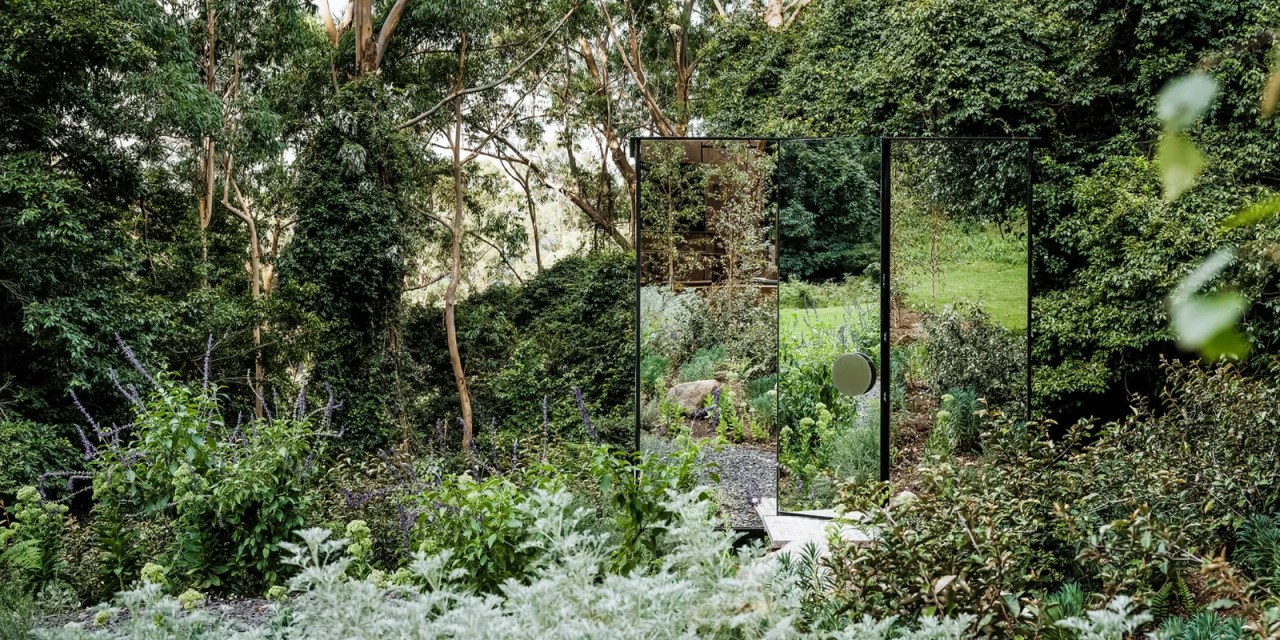
How about a bathroom situated in a dense landscape that completely disappears during the day? It is not magic, just a smart architectural marvel. We are talking about a masterpiece crafted by Paddington-based design studio, Madeleine Blanchfield Architects. Situated on a hillside about 30 kilometres from the accommodation, the mirrored cube is elevated above the existing ground and can be accessed through a pathway in a dense landscape.
The outhouse structure completely disappears during the day. It reflects the lush landscape and only the subtle lines of the cube’s edges are visible. When in the bathroom, the walls are all glass and so it does not impede the view of the surrounding landscape. The architect says, “The developed conceptual framework was to create a bathroom with minimal impact on the surrounding landscape and give the user a sense of being ‘outdoors’. It is rare to have a site without any concerns for privacy and this was to be embraced in the developed design.” – Suman Prasad
________________________________________________________________________
Read Also : 10 Ways Urban Farms Benefit The Community
________________________________________________________________________
This Tamil Nadu Abode Champions Camouflage Architecture
Vinu Daniel of Wallmakers sought the earth’s counsel to build chuzhi — a Malayalam word that translates to “spiral”. A house sunk into a rocky bed and covered by a canopy of tamarind trees, it is a sincere statement of sustainability and staying true to the origin of the site on which it stands. The structure of Chuzhi House, designed by Vinu Daniel, has a fitting complexity to match its name—starting from the very origins of the site on which it stands. Situated in a gated community called Sanctity Ferme in the picturesque Shoolagiri in Tamil Nadu, the 2,122-square-foot space is a case study in sheer defiance—of what can be built on odd sites that are mostly dismissed as “unsuitable” for construction.
For Daniel, the site submitted itself to exciting explorations in camouflage architecture, a unique concept that expresses itself as buildings that stay hidden and merge seamlessly with the existing topography. Like a sunken bowl, Chuzhi is a subterranean abode that emerges from a rocky bed and encompasses three massive tamarind trees in its hearty embrace. Its glass roof adds to that unrivalled feeling of what it is to live under a canopy of trees. The swirls that characterize the house start as walls that spiral all the way up to the roof. The resulting structure offers a secure private space below for the residents, and a space around the trees that ensures that the thick vegetation and ecosystem continue to thrive undisturbed. That the entire flora of the site survived the onslaught of construction is something that Daniel is understandably proud of: “The idea was to allow the natural ecosystem of the trees and the (surrounding flora) to be retained as they are above the house, without compromising on the comfort of the inhabitants.” – Rajashree Balaram
_______________________________________________________________________
Read Also : Wildlife Trade Brings Huge Risk of The Next Outbreak, Study of Over 800 Species…
________________________________________________________________________
This Karnataka Community Centre Evokes Caves
Three hours away from Bengaluru, Kaggalipura is a leafy village frequently draws in bird watchers, owing to its proximity to the Bannerghatta National Park. Now, it is also home to “Subterranean Ruins”, an unconventional space spread across a lush three-acre farm where mango, coconut, and avocado trees thrive. Characterized by exposed brick walls, graceful arches, and open-air seating areas, the space could potentially become a microcosm of Kaggalipura’s spirit, and its epicentre of culture and community.
In his initial conversations with the young Bengaluru-based architectural firm A Threshold, businessman V.S. Bhaskar asked that a farmhouse be built. Avinash Ankalge—architect and cofounder of A Threshold—says the firm responded with a vastly different proposition: a dynamic, multifunctional structure that could serve as a homestay, a meeting place for the local community, and a site where exhibitions and artist residencies could be facilitated. The design leverages the topography, embracing its contours to make the space welcoming and sustainable.
Envisioned as caves moulded out of the earth, this “non-building” is the coming together of built and unbuilt forms such that it blends into the terrain instead of sticking out obtrusively. Notably, the proportion of unbuilt courtyards far exceeds the built rooms—leaving it up to the user to dictate their purpose. The terrain is also the very bone and sinew of the structure, as fragments of excavated boulders find a place in its walls, and pebbles from the site form its flooring. – Neerja Deodhar
NOTE – This article was originally published in architecturaldigest and can be viewed here