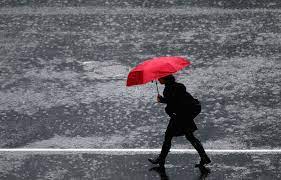
It’s raining harder across most of the U.S. and climate change is to blame, new research has found.
A new paper published in Geophysical Research Letters has found that the country is seeing heavier rainfall as the climate changes. Researchers at Northwestern University connected their findings to the fact that as the planet becomes warmer, air begins to hold more moisture, the Washington Post reported.
_______________________________________________________________________
Read Also :How Wildlife Conservation Can Benefit Sustainable Human Development
________________________________________________________________________
In the past, scientists have used something called the Clausius-Clapeyron relation as a way to measure how much more rain is likely as the planet becomes warmer. This equation holds that for every degree Celsius (1.8 Fahrenheit) warmer the air becomes, it can hold on to about 7% more moisture.
In the study, the researchers compared historical precipitation data of two time periods—between 1951-1980 and 1991-2020—within 17 different climate regions in the U.S. This helped the Northwestern researchers conclude that precipitation intensity for both rain and snow had increased for most of the country since the middle of last century, but especially throughout the Midwest, southern states, and the East Coast, according to Northwestern Now.
Researchers couldn’t detect changes in precipitation for areas out West, including areas like the West Coast or the Rocky Mountains, but did conclude that when it rains east of the Rocky Mountains, there is about 5% more rain in the 1991-2020 period, compared to the earlier period.
_______________________________________________________________________
Read Also : Wildlife Trade Brings Huge Risk of The Next Outbreak, Study of Over 800 Species…
________________________________________________________________________
The researchers pointed out that tracking how climate change is shifting regular weather patterns could also help us understand extreme weather as well. “When people study how climate change has affected weather, they often look at extreme weather events like floods, heatwaves and droughts,” Daniel Horton, the study’s senior author, told Northwestern News. “For this particular study, we wanted to look at the non-extreme events, which are, by definition, much more common. What we found is pretty simple: When it rains now, it rains more.”
More rain, even if it isn’t a lot more, can increase the likelihood of flooding throughout the country. This is only made worse by rising sea levels. And heavier rains also increase the likelihood of landslides—a study published earlier this year predicted more instances of these for the U.S. as well.
_______________________________________________________________________
Read Also : Top 5 conservation Projects for Wildlife in India
________________________________________________________________________
The U.S. has experienced several “thousand-year rainfall” events this summer alone. This includes heavy rainfall that caused widespread flooding throughout Saint Louis and Kentucky this past July. Warming temperatures have also been connected to hurricanes dropping more rain as they move north.
NOTE – This article was originally published in gizmodo and can be viewed here
Tags: #CausingWetter, #climate, #climatechange, #climatecrisis, #environment, #flooding, #getgreengetgrowing, #gngagritech, #greenstories, #rain, #rainfall, #weather