

Researchers have identified that a climbing vine called Smilax insularis controls its pollinator’s behavior using a single rare scent released at different times of day.
That coordination keeps pollen moving between flowers while limiting damage from the insect’s own offspring.
Smilax insularis calls the shots
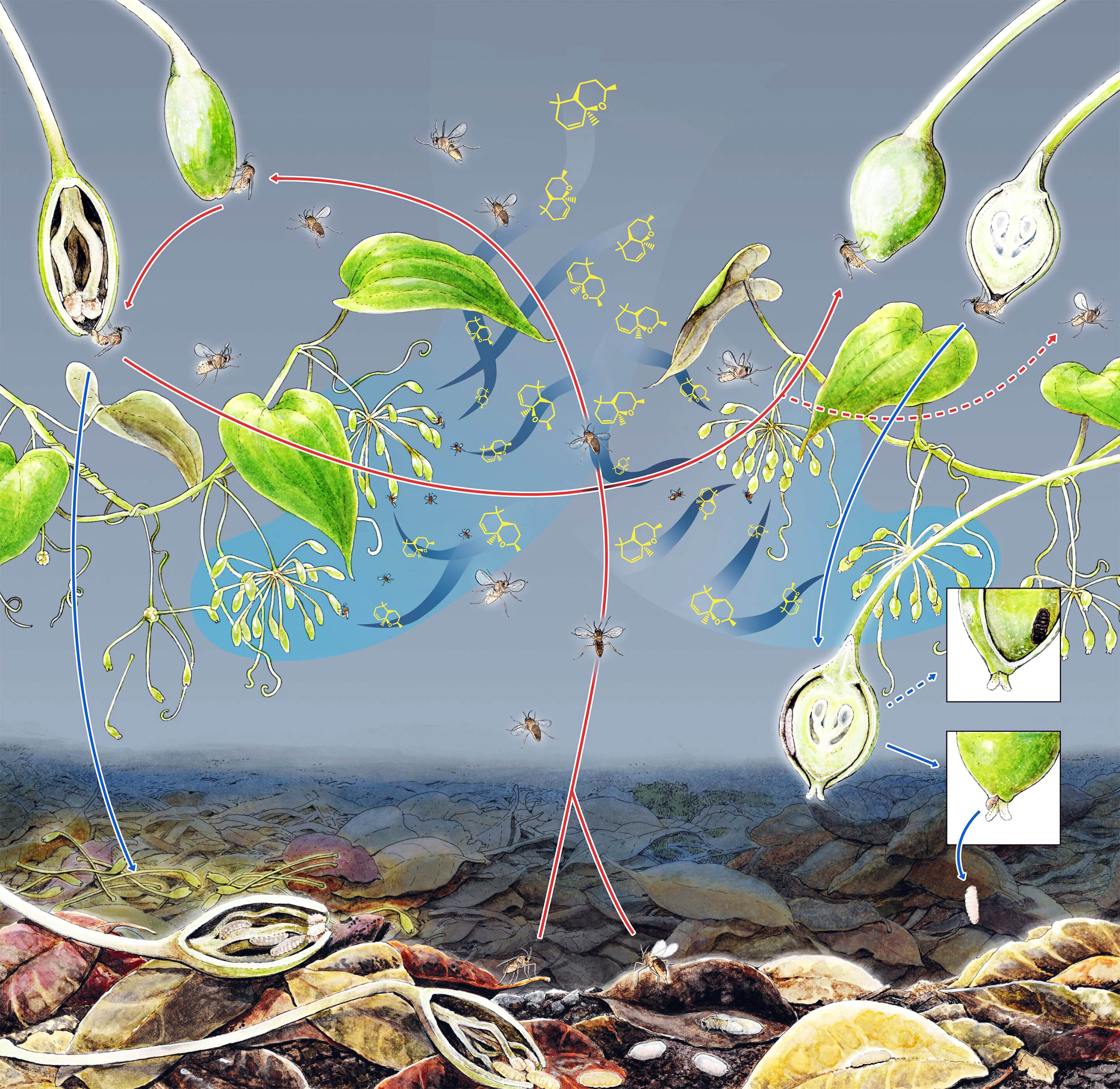
In natural populations of Smilax insularis, male flowers consistently opened earlier each day and released the same rare scent before female flowers.
Linking that sequence to pollinator behavior, Kenji Suetsugu at Kobe University documented that female gall midges, tiny flies whose larvae develop inside plants, left these flowers carrying pollen before moving on to female flowers later in the day.
A few hours later, female flowers released the same scent, receiving pollen while rarely supporting successful egg-laying.
This sequence showed that the plant guides both pollination and reproduction through timing alone, raising the question of how the signal remains exclusive to a single insect partner.
A risky bargain
Biologists call this exchange brood-site pollination, where adults carry pollen while larvae breed inside the flowers.
Because young insects can eat tissues the plant still needs, these partnerships often mix cooperation with a serious built-in conflict.
Only a small number of plant lineages are known to rely on that trade, and they usually involve very strict pairings.
For Smilax insularis, pollination had to stay reliable without letting larvae overrun the plant’s costly female flowers.
Pollination failed in the absence of the gall midge (Dasineura heterosmilacicola), a tiny fly whose young develop inside plant tissues, leaving Smilax insularis without any alternative route to fruit.
Female flowers needed pollen from another plant, so a missed visit meant no fruit at all. A partner this essential could not be guided by a vague floral smell that many other insects might follow.
________________________________________________________________________
Smilax insularis has a rare scent
The air around both male and female flowers of Smilax insularis was filled almost entirely with a single rare scent instead of a typical mix of odors.
Male and female flowers released little else, reducing the signal to a single, highly specific cue for the right insect.
Synthetic bait carrying just that compound drew female midges into the same zigzag flights seen around real flowers.
With that signal isolated, the rest of the plant’s strategy started to look even tighter and more precise.
Shape decides everything
Tiny twists in the molecule changed the outcome, even though the altered version kept the same atoms.
A closely related form of the molecule failed to attract the midge, proving the insect reads far more than a rough odor alone. No other insect came to the bait during field tests carried out across five islands.
Early each morning, male flowers opened first and started releasing the scent while their pollen was fully ready.
Because female midges tried to lay eggs there, their bodies picked up pollen during the visit.
A few hours later, female flowers opened and released the same signal after the insects were already loaded with pollen.
As a result, one smell became a reliable delivery route from pollen source to the later seed-making flower each day.
Larvae hit limits
Rare eggs in female flowers seldom helped the insect because the young there rarely finished development at all.
Larvae that hatched there did not feed on developing seeds, and many died from starvation or drying out.
Inside male flowers, the larvae fed on spare pollen and escaped when those expendable flowers dropped within a few days.
In effect, the plant shifted nursery costs into short-lived male blossoms and protected the tissues that matter most for fruit.
Private and secure channel
Here, the odor functioned as a private channel, a signal only intended partners detect, rather than a broad invitation for insects.
One molecule and one daily schedule delivered that channel in a form the midge consistently used in the wild.
Loyal behavior followed because the insect received the same cue from both flower sexes, just in a different order.
Such tuning can stabilize cooperation without forcing the plant to punish every misplaced egg after landing.
Future study of Smilax insularis
One part of the story still resists explanation because female midges usually avoid laying eggs in female flowers.
Researchers do not yet know which close-range cue warns them off after the shared scent brings them into the flower.
“I am really excited about this combination of chemical precision and ecological balance,” Suetsugu said.
Answering that last question could show how plants turn defensive chemistry into selective communication over very long evolutionary time.
By combining one rare odor with a delayed opening schedule, Smilax insularis kept pollen moving and most larvae out of future fruit.
The finding points to a simple rule for fragile alliances in nature, guide behavior early, and damage stays limited later.
The study is published in Current Biology.
NOTE – This article was originally published in Earth and can be viewed here