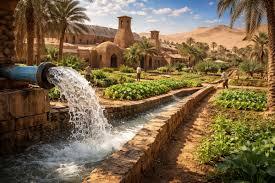

Deep wells are the starting point for a bold attempt in the Dakhla Oasis in Egypt’s Western Desert, where families want to create an ecovillage combining fossil water, permaculture, traditional techniques, and adaptation to extreme heat.
Os deep wells They define survival in the Dakhla Oasis, one of the driest landscapes on the planet. In the eastern Sahara, where it is normal to record zero millimeters of rain in a year And since the last significant rainfall occurred about 13 years ago, any life project depends entirely on water extracted from the subsoil.
________________________________________________________________________
That’s precisely why a group of families from Cairo decided to start there when planning a permaculture-based ecovillage. The proposal is to combine ancestral oasis practices with contemporary ecological design, but the local reality raises an inevitable question: To what extent can a sustainable settlement exist where everything depends on fossil water and deep wells?
Old water sustains life in the middle of the Sahara

In Dakhla, the water doesn’t come from rain. It flows from a deep, ancient aquifer. The oasis sits atop the Nubian Sandstone Aquifer, described at the base as the largest fossil aquifer on the planet.
ARTICLE CONTINUES BELOW
See also other features
-
-
With approximately 60 megawatts of power, a hull designed to climb ice, and the ability to break through ice floes up to 3 meters thick while maintaining a constant speed, Russia’s largest nuclear icebreakers are clearing paths in the Arctic Ocean and freeing ships trapped in frozen waterways.

-
ITA student develops research on superconducting qubits and quantum circuits, a technology that could usher in a new generation of computers capable of revolutionizing fields such as medicine, cryptography, and materials development.

-
Scientists opened up the Greenland ice sheet and found a disturbing message: hydrogen levels plummeted 16% during the Little Ice Age, a sign that the climate may be controlling this cycle more forcefully than previously predicted.

-
Unprecedented image of the galaxy reveals mystery about the Sun and the origin of the solar system.

-
This means that the water stored there was deposited in a different climatic era and It is not being recharged by the current rains.Because there is practically no rainfall in that part of the desert.
One of the most impressive examples observed on site was one of the government’s wells, powered by solar energy, with 1.300 meters deep and production of 200 cubic meters of water per hour while the sun shines on the panels.
Water emerges from underground at 40 ° CIt’s warm to the touch, like a hot spring. Without these deep wells, Dakhla would be nothing but sand.
The oasis lives off an immense, but finite, reserve.
The relative abundance of water helps explain why the oasis has existed for millennia, but it does not eliminate the central problem.
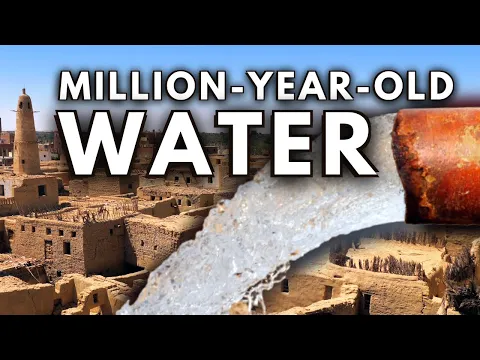
This is a non-renewable reserve. According to the database, radiocarbon analyses estimate that the water in this aquifer is between… 100 and 1 million years.
At the same time, the volume is still gigantic. The International Atomic Energy Agency is cited as being responsible for the estimate that this groundwater would be equivalent to almost seven times the Great Lakes of the United States or about 500 years of Nile River flow.
This reduces the feeling of immediate collapse, but it doesn’t erase the underlying issue. The water that sustains the present does not replenish itself at the rate of human use.
Deep wells have brought progress, but also new questions.
In the presence of deep wells It completely changed the scale of occupation of the oasis. Before the electric pumps, water use followed a different rhythm.
With modern technology, the cultivated area has grown exponentially, and so has consumption. The result is a constant lowering of the water table.
According to the material, the water level is dropping at a rate of approximately 50 meters every 10 years.
Local drillers reported that the deepest government well in the oasis reaches… 1.700 meterswhile there is still water available to 150 meters at some points.
________________________________________________________________________
The informal projection presented on site suggests at least 300 years of availability At the current rate, possibly more, depending on the total depth of the aquifer. That’s a long time on the scale of a human life, but a short time when it comes to actual permanence.
Iron, heat, and salt make irrigation a constant challenge.
Finding water isn’t enough. You also need to be able to use it. In Dakhla, the water has a high iron content, which greatly complicates modern irrigation systems.
The residue clogs emitters and pipes, making conventional drip or sprinkler irrigation difficult or even impossible for many farmers.
For this reason, the dominant practice is still flood irrigation, with water running through open channels to the crops.
The problem is that this model consumes large volumes of resources and also contributes to the emergence of saline areas in the low-lying parts of agricultural zones.
The productive landscape depends on deep wells, but it also suffers from the ecological cost of the intensive use of this water.
In some properties, alternative solutions are beginning to emerge. A smaller farm, of 30 acres, used a system with an electrified magnet attached to the pipes to neutralize the iron and thus allow drip and sprinkler irrigation with much less water consumption. This same property maintained new date and mango orchards irrigated by drip irrigation.
Ecovillage attempts to unite local tradition and ecological design.
The ecovillage project arose from the desire of families in Cairo to leave the metropolis and seek a more sustainable rural life.
The proposal is to combine the traditional knowledge of the oasis with more recent principles of ecological design, observing patterns of water, agriculture, architecture, energy, and settlement organization.
The idea seems simple in theory, but it becomes extremely complex when it comes into contact with the desert.
Designing an ecovillage in Dakhla is not just about designing houses and gardens, but about deciding how to live for decades in a place where everything depends on deep wells, energy, and careful land management.
Ancient architecture shows how to cope with 49°C
If water is the first major challenge, heat is the second. During the most severe waves, the temperature can exceed… 49 ° CAnd it was precisely at this point that the traditional architecture of the oasis proved to be an essential reference.
The old village of Al-Qasr, considered the oldest in the oasis and inhabited for about 1.400 years, showcases impressive solutions.
The buildings are constructed of adobe blocks plastered with clay, placed very close to each other, creating narrow, shaded alleyways protected from the wind. There were also wind catchment and direction systems that aided in passive cooling.
According to the base, the interior of this protected labyrinth can hold an average of… 15°C colder. In such an environment, architecture is not about aesthetics: it’s about survival.
An oasis inhabited for millennia still teaches how to live in the desert.
The Dakhla Oasis has been continuously inhabited since 6.000 BC, which means about 8.000 years of continuous human presence.
This gives the place enormous historical significance and shows that life in the desert never depended solely on modern technology.
Today, the oasis brings together 16 villages, with a total population of approximately 90 thousand people within an area of 1.000 km².
In many ways, ancient architecture still inspires more recent constructions, but the material also highlights that several modern buildings ignore the traditional logic of the desert.
This exchange of knowledge between past and present can determine whether the new ecovillage will be resilient or just another fragile experiment in the Sahara.
Wind and sand dominate the landscape’s design.
In many permaculture projects, water tends to be the dominant pattern. In Dakhla, the wind fiercely challenges this role.
The dunes are constantly shifting and can encroach on agricultural land. The base describes the sand almost like a winding river migrating across the landscape.
At the project site, there were dunes up to Meters 18 formed by the wind after the abandonment of the old fields.
Excavators worked to flatten these dunes and restore agricultural areas. Windbreaks appear as crucial pieces to reduce the force of the wind and contain the advance of the sand.
In the Sahara, designing an ecovillage requires considering both the deep wells and how the wind reshapes the terrain day after day.
Local agriculture is already practicing solutions similar to permaculture.
Visits to farms in the region showed that many practices already strongly resemble the principles of permaculture, even without using that name.
In orchards near the houses, it was possible to see polycultures with date palms, olive trees, mango trees, and citrus trees coexisting in dense, shaded systems protected from the wind.
The integration of prickly pear hedges, nitrogen-fixing trees, and cover crops also drew attention.
On one of the properties, traditional pigeon breeding towers completed a low-maintenance production cycle, providing meat and manure for fertilization.
Perhaps the strongest lesson is this: the innovation of the ecovillage depends not only on new technologies, but on recognizing that the oasis has already developed intelligent responses over the centuries.
A sustainable future depends on very tough choices.
Egypt has approximately 97% of the population in just 3% of the territory., primarily around the Nile Valley. This puts pressure on the country to expand settlements in areas such as the oases of the Western Desert.
________________________________________________________________________
Dakhla, therefore, is not just an isolated case of life in the desert, but part of a national equation of water, food, housing, and population growth.
This is where the ecovillage project gains greater importance. It attempts to answer how a settlement can endure in an environment of extreme climate, non-renewable water, strong winds, and increasing pressure on resources.
Deep wells allow you to get started, but they alone do not guarantee permanence. The future of the place will depend on the ability to combine water conservation, adapted architecture, agricultural diversity, and social organization compatible with the desert’s limitations.
Dakhla shows just how far humanity’s attempt to live in the impossible can go.
The Dakhla Oasis is impressive precisely because it brings together extremes. There is brutal heat, almost no rain, ancient water sources, agriculture in the middle of the sand, and a long history of human occupation in seemingly improbable conditions. The attempt to build an ecovillage there makes all of this even more challenging.
In the end, experience shows that surviving in the Sahara requires much more than technology. It demands an understanding of the landscape, respect for ancestral knowledge, and careful decisions about how to use each resource.
NOTE – This article was originally published in CPG and can be viewed here