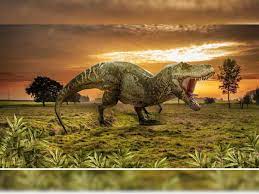
A groundbreaking study suggests that dinosaurs might exist currently on other planets. A recent study published in the Monthly Notices of the Royal Astronomical Society Journal, argues that there is a possibility of some dinosaur-like species on other planets far away from the Earth.
Lead author of the study, Lisa Kaltenegger revealed, “Our current understanding of habitable planets has been heavily influenced by Earth’s distinct light fingerprint, but there was a time when this fingerprint was even stronger, making signs of life easier to detect.”
But the good news is that humans possess the technology that can detect the species.
________________________________________________________________________
Read Also : SHOULD WE CONSERVE HYBRIDS?
________________________________________________________________________
Humans on Earth can detect “Jurassic World” on other planets
As per the study, researchers on Earth could detect such probable life on other planets. The key to identifying these possible extraterrestrial creatures lies in searching for compounds, compounds that are not found on present-day Earth but prevalent during the era of dinosaurs.
The study suggests that the increased oxygen levels during the age of dinosaurs could serve as a valuable indicator for the existence of complex life on other planets. The Earth had higher levels of oxygen, about 30 per cent, during the time of dinosaurs, allowing the complex creatures to grow. Currently, oxygen levels on Earth have stabilised at 21 per cent.
One way to detect the life of dinosaur-like species on other planets could be by employing advanced telescopes on Earth, as per the scientists. And one lead in this expedition could be whether a planet is in a Phanerozoic stage.
If a planet is in the Phanerozoic stage it will allow it to host large and complex life forms, a potential source for the existence of dinosaurs.
_______________________________________________________________________
Read Also :10 Health Benefits of Drinking Green Tea with Lemon
________________________________________________________________________
“The Phanerozoic is just the most recent 12% or so of Earth’s history, but it encompasses nearly all of the time in which life was more complex than microbes and sponges,” Cornell University scientist Rebecca Payne told The Sun. “This gives us hope that it might be just a little bit easier to find signs of life — even large, complex life — elsewhere in the cosmos.”
Another method could be searching for planets with higher levels of oxygen, said Katlenegger. Planets with high levels of oxygen could not only lead to the discovery of interesting life forms but also make the process a bit easier.
NOTE – This article was originally published in wionews and can be viewed here
Tags: #animals, #climate, #dinosaurs, #earth, #environment, #fingerprint, #getgreengetgrowing, #gngagritech, #greenstories, #nature, #Phanerozoic, #planets