Understanding the various processes that drive plant growth is critical for successful farming. Evapotranspiration (ET) is one such process that has a major impact on agricultural productivity. Often overlooked, ET plays a pivotal role in maintaining soil moisture levels and sustaining plant health.
Modern technologies, in particular remote sensing and accurate hyperlocal weather data, allow farmers to minimize the time and effort previously required to calculate and continuously monitor the level of crop evapotranspiration, especially in large fields. We’ll go through what evapotranspiration is, define how it affects crop yields, and discuss the techniques for making it easier to calculate and factor into your irrigation plans.
What Is Evapotranspiration?
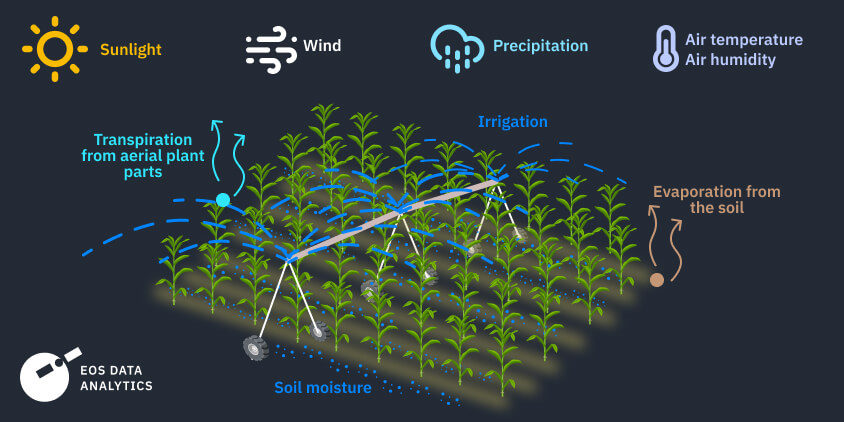
The term “evapotranspiration” refers to the total amount of water evaporating and transpiring from the Earth’s surface. Evaporation of water from the soil surface, the capillary fringe above the groundwater table, and surface water bodies are all components of ET. Transpiration, the process through which water moves from the soil through plants and into the air, is also part of the evapotranspiration system.
Rain is water that falls from the sky; ET is water that rises from the earth; thus, you can think of evapotranspiration as the opposite of rain. Clouds formed by the condensation of water vapor from evaporation and transpiration eventually release their load of precipitation as rain or snow. ET is second only to precipitation in terms of importance to water resource management and determining how much water should be applied to farms through irrigation.
_______________________________________________________________________
Read Also : Traditional Agriculture: An Efficient and Sustainable Farming Method
________________________________________________________________________
Process Of Evapotranspiration
Two components of the evapotranspiration process, evaporation and transpiration, are worth exploring in more detail. Evaporation is the transition of water from a liquid to a vaporous or gaseous state. Solar energy causes this effect on bodies of water as well as moist soil. When the water molecules absorb enough heat, they gain the energy necessary to leave the liquid’s surface and enter the air as vapor. This mechanism plays a crucial role in bringing moisture from the earth up into the atmosphere.
Transpiration, the release of water vapor into the atmosphere, is made possible by the microscopic pores (stomata) on the stems, leaves, and other aerial plant parts. During this part of the evapotranspiration process, the plant transports water from the ground through its root system to its aerial parts, where it evaporates. So, we may distinguish three distinct stages of transpiration:
- roots draw moisture up from the ground;
- water travels up through the plant, performing its vital functions along the way;
- stomata “exhales” moisture into the atmosphere.
Why Is Evapotranspiration So Important In Agriculture?
Farmers who take plant evapotranspiration into account may optimize water consumption and boost crop yields while contributing to global food security. Estimates of ET are crucial in the following areas of modern agricultural water management and cultivation:
_______________________________________________________________________
Read Also : Home Advice Vegetables to plant in August: top 10 crops to sow and grow…
________________________________________________________________________
- Optimizing irrigation. The use of evapotranspiration data to fine-tune irrigation scheduling helps avoid wasteful overwatering and protect precious water supplies. Farmers can cut down on their water use and energy bills by using precision irrigation based on ET rates.
- Boosting crop health and productivity. Keeping an eye on ET helps ensure appropriate soil moisture, which is necessary for healthy root growth and nutrient uptake as well as enhanced crop yields.
- Preparing for a drought. Since evapotranspiration frequently increases during droughts, with ET data at hand you can create more effective drought management programs and better allocate water resources in the event of dry spells.
- Water stress control. Monitoring ET readings, which open up the plants’ water needs, helps mitigate water stress and increase crop resilience.
- Raising the level of agricultural precision. By combining ET data with other information, farmers may tailor their field activities to the exact needs of each crop and soil type.
Factors That Affect Evapotranspiration
The main determinants of ET are the local climate and terrain, as well as the plant’s specific physiology. Let’s look at each one and its influence in more detail.
- Type of soil. The composition and structure of soil determine its ability to retain water and its evapotranspiration properties. Soils with a high proportion of sand or gravel have a lower capacity to hold water and will lose more of it to evaporation than, say, loamy or clay ones.
- Air temperature. The air temperature is a known factor in the evapotranspiration process. As the temperature rises, so does the air’s moisture-carrying capacity. Furthermore, increasing the amount of heat energy applied to water accelerates its vaporization, which raises the ET rate.
- Solar radiation. There is more to solar radiation than mere heat. Variations in energy, frequency, and albedo, all of which affect evapotranspiration rate, are site- and time-specific. These are important aspects to take into account, but quantifying them without technologically advanced methods and tools can be difficult.
- Humidity. Relative humidity (RH) is the amount of water vapor that the air can retain. High relative humidity (as seen, for instance, after rainfall) limits the amount of water vapor the air can absorb, resulting in a decrease in ET. Reduced humidity increases evapotranspiration because the air can potentially hold more moisture.
- Plant cover. Plants adapt to their environments in different ways. Some are better at storing water for use during droughts, while others lose moisture far more quickly. The evapotranspiration value also depends on the plant’s age and health conditions. The deeper the roots, the longer crops can survive without rain or watering. Because of physiological differences between different types of crops, ET rates vary a lot, calling for specific approaches to irrigation.
- Wind speed. Since wind is usually what propels both evaporation and transpiration, it plays a crucial role in soil moisture evapotranspiration. Strong winds blow away the layer of damp air that forms over crop-covered surfaces, increasing the ET rate. The wind’s effect on the diffusion of vapor from plant pores also contributes to increased transpiration rates. A decrease in ET may occur, though, if extremely strong, dry winds prevent water vapor from diffusion.

EOSDA Crop Monitoring
Fields analytics based on high-resolution satellite images to track all the changes on-the-spot!
Different Concepts Of Evapotranspiration
Crop evapotranspiration can be viewed in terms of three concepts:
- ET(0), or reference evapotranspiration;
- ET(c), or evapotranspiration in a typical setting;
- ET(c adj), or evapotranspiration in an atypical setting.
The atmospheric evapotranspiration power, denoted as ET(0), is a climate-related parameter. ET(c) describes the amount of water lost through evapotranspiration in well-maintained, massive, optimally moistened fields that produce at maximum capacity given the typical weather patterns. Since inefficient crop management and environmental limitations hinder evapotranspiration, it is common practice to adjust ET(c) under atypical conditions.
________________________________________________________________________
Read Also : Organic Farming Solve the Climate Crisis
________________________________________________________________________
Reference Evapotranspiration
The rate of evapotranspiration that occurs at a water-rich reference surface is known as reference ET. A hypothetical grass cover that meets certain criteria serves as the reference surface.
Reference ET allows us to analyze atmospheric evaporative demand regardless of crop variety, growth stage, and cultivation practices. Since the reference surface used to calculate ET is well-moistened, soil conditions do not impact evapotranspiration. So it’s not necessary to determine a unique ET threshold for each crop at each growth stage.
Climate variables are the only factors determining ET(0). The following table provides the typical ET(0) value ranges for different agroclimatic zones . These numbers are meant to give a feel for what’s common but should not be used directly.
NOTE – This article was originally published in eos and can be viewed here
Tags: #climatechange, #crop, #earth, #environment, #Evapotranspiration, #getgreengetgrowing, #gngagritech, #greenstories, #Measuring, #nature, #planthealth, #rain, #soil, #water, #weather