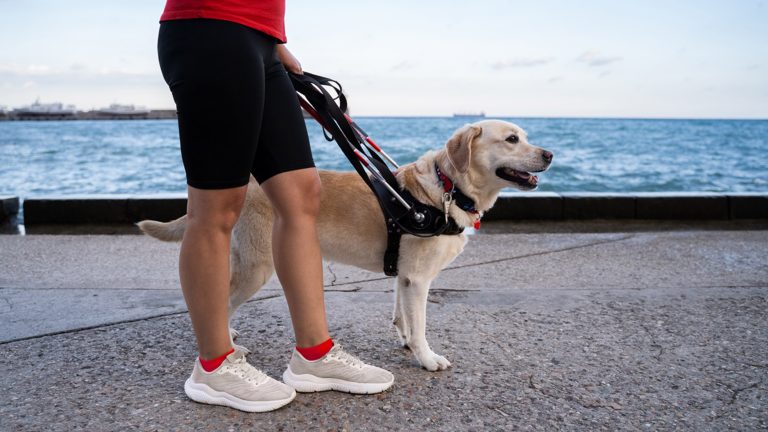
Dog owners spend years teaching a puppy to listen. Breeding for life alongside people has already reorganized the pathways dogs use for voices and words. Dogs that finish service training differ too, in far fewer places.

That leaves a harder question. Does training build those connections, or are dogs born with them more likely to succeed in training?
Mélina Cordeau at Harvard University led the work with Sophie Barton and Erin Hecht in the Department of Human Evolutionary Biology. The dogs came from Harvard’s Canine Brains Project and from service dog organizations. Owners volunteered them, and none was housed in a lab for the work.
Breeding changed dogs’ sound networks
The team scanned 108 dogs, 50 males and 58 females, with a form of MRI that follows water through the brain’s wiring. Tracking where the water goes maps which regions connect to which.
Then they split the dogs two ways. The first split was history: 95 modern breeds against 13 dogs from ancient lines, including Arctic breeds, East Asian spitz dogs, and village dogs.
The two groups differed in how lopsided their brains were, though not in one direction. Modern breeds were more lopsided in some regions and ancient lines in others. Only one network came out clearly different overall: the temporal one, which handles sound.
Lopsidedness is generally read as a sign of specialization. One side does more of the work instead of both sides sharing it. Dog brains have been changing for thousands of years, and breeding has altered more than wiring: head shape shifts behavior too
Service dogs differ in brain wiring
The second split was training, and the comparison group is what makes it work. Seventeen fully trained service dogs were set against 11 dogs from the same breeding program who never finished the course.
________________________________________________________________________
Those 11 left for reasons that had nothing to do with behavior: allergies, overbites, and a glut of puppies during the pandemic. Same breeding stock, same early life, different training histories.
Here the differences were small and local. One pathway stood out, running between a patch of brain that responds to human voices and another that helps organize movement. Earlier work has tied that pathway to how many human words a dog picks up, and dogs vary widely in how many they learn.
Trained dogs had more of those fiber paths on the left side. The released dogs had more on the right.
Averaged across the trained group, the scans traced 393 fiber paths on the left and 364 on the right. In the released dogs, the figures were 398 and 658.
The fibers themselves measured the same in both groups. What set the groups apart was which side carried more of them.
Trainability spans five brain networks
Owners answered an eight-question survey about their dog, covering how it responds to commands, how well it holds attention, and how fast it learns. The team checked those answers against the wiring.
Dogs with higher scores had stronger connections across five networks, covering movement, planning, touch, and sound. Dogs with lower scores had stronger connections to a relay deep in the brain that passes sound on to the outer layers.
No single region accounted for the difference.
“This suggests that successful learning relies on coordinated interactions across multiple brain systems rather than on one isolated area,” Cordeau told Earth.com.
Breed alone does not explain much about what a dog can do. Skull shape does not predict working ability, and brain size tracks breed function only loosely.
Does dog training reshape the brain?
Asked by Earth.com what any of this means for someone training a dog at home, Cordeau declined to endorse a method.
“So rather than pointing to one specific training method, our results highlight the importance of providing dogs with rich, consistent opportunities to learn and communicate with people,” she said.
She had a reason for the caution. Each dog was scanned only once after its training period had ended.
“We found that trainability is associated with the organization of communication-related brain networks, but we still don’t know whether some dogs are born with brain networks that make them easier to train, or whether training itself gradually reshapes those networks,” Cordeau said.
Cordeau said inherited tendencies and learning most likely both contribute.
Repeat scans could test training effects
No dog here was scanned before its training and again afterward. Each one went into the machine once, so the team could rank dogs against each other but could not follow a single animal forward.
________________________________________________________________________
The smaller groups add another limitation. Thirteen ancient-line dogs and 11 released service dogs are not many, and a real difference could go undetected in groups that size. The trainability scores also came from owners rather than from a standard test.
What would settle it is obvious and slow. Earth.com asked Cordeau what comes next.
“The next step will be to follow dogs longitudinally, scanning them before and after training,” she said.
Beyond that, she wants to know whether some dogs are more changeable than others, and whether those are the ones that get the most out of being taught. No study has yet followed individual dogs in a way that could answer that question.
NOTE – This article was originally published in Earth and can be viewed here