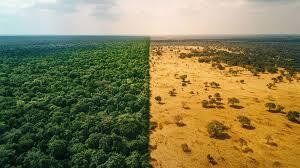

Deforestation has a drastic impact on an area’s weather patterns. © M, Adobe Stock
A specialist in extreme weather phenomena and environmental issues, this journalist and TV host has been explaining climate topics since 2009. With over 15 years of experience in both French and American media, she is also an international speaker.
Trained in communication and environmental sciences, primarily in the United States, she shares her passion for vast natural landscapes and the impacts of climate change through her work on biodiversity and land management.
Human activity changes the climate in many ways. We often think about greenhouse gas emissions, but environmental degradation plays a powerful role too. A recent study published in Communications Earth and Environment provides concrete evidence of the climate impact caused by forest loss. According to the findings, deforestation leads to ‘higher surface temperatures, lower evapotranspiration, reduced rainfall and fewer rainy days, especially in regions where forest cover falls below 60 percent’.
The explanation is straightforward. With fewer trees and plants, there is less evapotranspiration. Vegetation naturally releases moisture through its leaves, and water also evaporates from the soil. This moisture rises into the atmosphere, where it contributes to cloud formation and rainfall, alongside evaporation from the oceans. When forests disappear, that cycle weakens. The air becomes drier. Rain becomes less frequent.
________________________________________________________________________
Read Also : Tracing Sustainable Value Chains: Is India Ready for the EU’s Deforestation Regulation?
________________________________________________________________________
Up to 4°C hotter in deforested areas
The numbers are striking. In areas where forest cover drops below 60 percent, temperatures rise by as much as 3°C during the dry season. At the same time, evapotranspiration declines by 12 percent, and rainfall is 25 percent lower compared with intact forest zones.
The situation becomes even more severe when forest cover falls below 40 percent. In those heavily cleared areas, temperatures increase by up to 4°C compared to untouched regions. Researchers also observed an average of 11 fewer rainy days in deforested zones.
This is not simply a matter of lighter showers. Deforestation affects both the amount of rain and the number of rainy days – in other words, the very formation of rain itself. The shift is structural, not occasional.

From rainforest to savanna
What follows is a cascade of consequences, even after logging has stopped. The newly altered climate begins to affect the remaining forest. With less rainfall, trees struggle to survive. Gradually, the ecosystem shifts.
The transformation goes beyond temporary weather fluctuations. Tropical rainforest conditions begin to resemble those of a savanna – a climate that should not naturally exist in such a humid region. Once this tipping point is approached, recovery becomes far more difficult.
Satellite images between 1985 and 2024 show the scale of the change. Brazil’s Amazon rainforest has lost 13 percent of its vegetation over that period – around 520,000 square kilometres. That is an area larger than Spain. Much of the lost forest has been replaced by pasture, crops and mining operations.
________________________________________________________________________
Read Also : Solar Trees Could Save Forests From Deforestation While Generating the Same Power as Solar Farms
________________________________________________________________________
There is a sliver of cautious optimism. Over the past three years, the pace of deforestation has slowed. Yet it remains far too high to prevent long term ecological disruption.
The message is clear. Forests are not just scenic backdrops or carbon storage units. They are active players in regulating temperature, rainfall and atmospheric balance. Remove them, and the climate responds – quickly.

In a world already grappling with rising global temperatures, the findings serve as a stark reminder. Protecting forests is not only about preserving biodiversity or reducing emissions. It is about maintaining the delicate environmental systems that allow regions to remain stable, habitable and productive.
The link between trees and weather is no longer theoretical. It is measurable, immediate and increasingly visible. And once that balance is disturbed, nature does not simply reset itself overnight.
NOTE – This article was originally published in Futura Sciences and can be viewed here