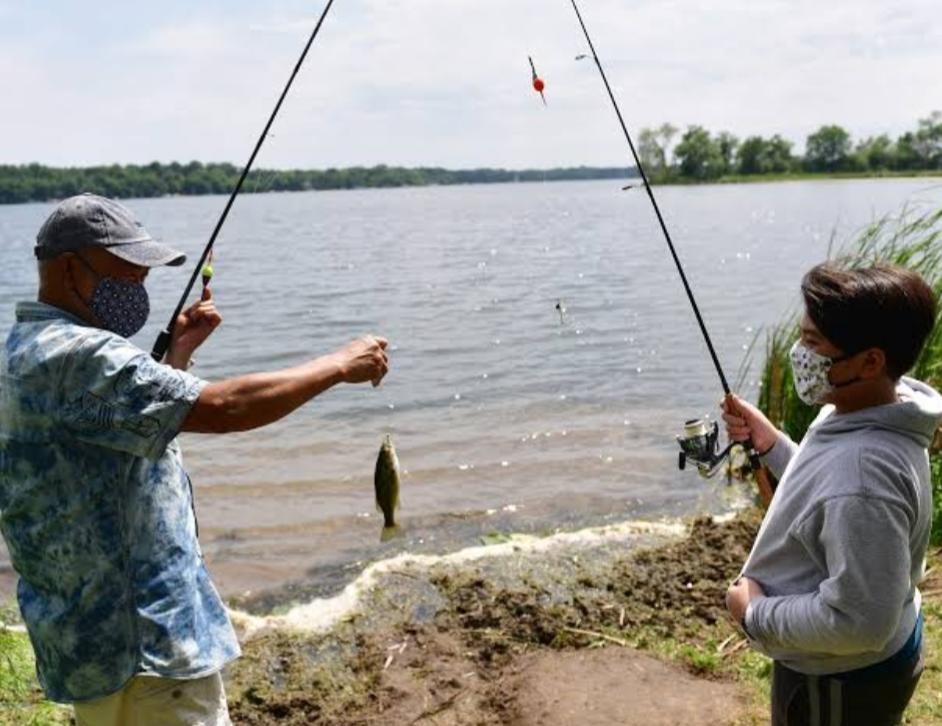
Fishing is the vast extensive human exploitative action in the marine climate. Fishing has several direct consequences on marine ecosystems because it is liable for the heightening mortality of mark and by-catch varieties; an actual physical impact on the habitat of benthic types is caused by bottom trawling. The direct effects of fishing have erratic implications for another sort as well.
“Buy Organic Products Online at best prices at http://www.getgreen.co.in “
Fishing has several direct effects on aquatic ecosystems because it is accountable for boosting the mortality of target and by-catch category competitive interchanges and conclusion in The expansion of non-target variety.
Fisheries eliminate prey that piscivorous fishes, birds, and mammals would otherwise expend, or may reduce predators that would otherwise regulate prey communities. Deductions in the density of some variety may influence competitive interactions and outcomes in the addition of non-target type. The actions of fisheries also favor scavengers. They attain more food by the removed by-catch and because a range of variables is killed but not maintained by towed loads.
Direct Effects of Fishing
- On Target Species
Fishing began at the top of most food chains by eradicating the beneficial and more easily cacheable variation, then walked down to the next most immense variety. Those above were undermined and were no longer quickly or economically grabbed. The downshift towards fish snags of lower trophic levels outcomes in ‘fishing down the diet web.’ The contrary longevity of the fish varieties caught has improved dramatically. This direction is a severe concern because variety with larger body size, longer life span, Later sexual adulthood and restrict growth are more susceptible to overfishing.
- On Benthic Organisms
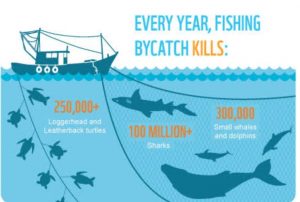
Benthic varieties and other undesirable by-catch are often removed, and a span of type is killed but not maintained by towed gears. Some by-catch species have been influenced dramatically by fishing. For example, the quantities of three dolphin communities captured by tuna boats in the eastern tropical Pacific were decreased to 20%, 35-50%, and 58-72% of pre-exploitation degrees.
- Due to physical disturbance
The direct consequences of fishing pertained to the physical disorder include the scraping, scouring, and resuspension of the substratum. The impacts vary according to the equipment used, and the environments fished. It seems adequate to indicate that the consequences of physical discomfort will be short-lived in populations modified to visit natural perturbations in contrast to those communities organize in environments exposed to fewer disruptions.
The differences correlated with physical disturbance are relatively short-lived for a small variety; longer-lived infection decolonizes more slowly. Communities overseen by long-lived suspension feeders are most likely to be renovated by a population of opportunistic deposit feeding species and mobile epifauna when subjected to large-scale and severe fishing disorder.
More dramatically, biogenic hierarchies that boost the complexity of the epibenthic habitat develop labored environmental circumstances by modifying regional hydrographic situations that motivate the growth of a technical related population.
These intense burrowing faunas are likely to be influenced by enacting trawls. However, the enthusiastic costs of recited burrow reconstruction may have long-term importance for the survivorship of people.
Sessile epibenthic variety is most likely to be vulnerable to the paragraph of lowest gears. Static ground gears are attached to the seabed and evacuated to fumble passively. The most generally used are gill, trammel, or tangle nets, which are constructed to apprehend target variety by enmeshing or twisting them.
Net and pot fishing is static. For this justification, the seabed regions affected by each gear are small, related to the extensive effects of portable fishing gears. However, the undertaking may be substantial if focused in relatively small areas with communities of long-lived fauna?
Ecological disturbance
Over-fishing can arise in the over-exploitation of aquatic ecosystem assistance. Fishing can result in various adverse physiological and psychological consequences for fish communities including:
Boosted stress degrees and bodily damages occurring from lodged fish hooks. Often, when this limit is passed over, hysteresis may happen within the environment. More precisely, some ecological disruptions examined within the Black Sea marine ecosystem occurred from a mixture of over-fishing and several other similar human activities which adversely influenced the marine atmosphere and ecosystem.
Indirect Effects of Fishing
- Due to ghost fishing
When webs or catch-pots are missed, they may proceed to fish. This manifestation is known as ‘ghost fishing.’ If nets or pots are grabbed onto rocks, carrying the net in area, or missed in relatively safe deepwater climates, they may begin again to fish indefinitely. In these trials, a natural habit of capture is examined. Over the first few days, catches decrease almost exponentially as the boosting burden of catch causes the net to fall. Then, for the next few weeks, the wrong bodies of fishes and Crustacea attract many scavenging crustaceans, many of which are essential commercial varieties and also evolve complex in the net. After that, there seems to be a continual cycle of capture, decay, and interest for as long as the net has some entrapment features.
Read Also : Almost 90 Percent Of Dolphin Population Killed Off By Overfishing
•Trophic cascading effect
Alterations in one status of a food web can also have cascading consequences on others. For example, in the Black sea, a trophic stream has behaved by fishery disposals of apex predators, which caused a declined consumer control and the key to the higher quantity of planktivorous fish. The raised consumption by planktivorous fish affects a decline in zooplankton biomass, which allowed phytoplankton to improve. This line of circumstances is thought to illustrate the explosions of phytoplankton and jellyfish.
Food-web’ competition
An app buzzard may be influenced by fisheries even, when the victim and species are grabbed, do not extend over. This has been termed ‘food-web competition.’ Food-web competition happens when there is likely an extension of the trophic streams benefiting a given faction (e.g., marine mammals) with the trophic streams helping another group (e.g., fisheries). The relationship between the number of fishery catches and the amounts of primary output expected to maintain fisheries and marine mammals indicates that the significant creation accessible to marine species may decrease as catches boost.
Fishing training pieces guide to differences in marine environments’ configuration and impact the variety, composition, biomass, and productivity of the correlated biota. The immediate consequences of fishing vary according to the gears used and the housings fished. Still, they usually encompass the scraping, scouring, and resuspension of substratum and happen against natural disorder proficiency.
The extent of natural disruption infers the comparative effect of fishing on habitat and benthic community configuration. The direct impacts of a given fishing technique on infaunal and epifaunal populations will tend to improve with depth and the stability of the substrate. In housed areas where complicated habitats formulate at least depth, such as coral reefs, the immediate impacts of fishing may be captioned and have profound implications for the habitat’s ability to sustain fish production.
Image Sources
https://images.app.goo.gl/eRR93Xn7pBjbmRg26
https://images.app.goo.gl/mDouYvtYiraP1nzj6
Tags: #angler, #bass, #bassfishing, #carp, #carpfishing, #catchandrelease, #fish, #fishing, #fishingislife, #fishinglife, #flyfishing, #getgreengetgrowing, #gngagritech, #gogreen, #greenstories, #nature, #outdoors, #pesca