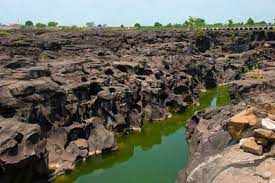
For many, potholes symbolise the deficiencies of municipal corporations and a lack of regard for human lives in urban areas—an unpleasant, manmade, and potentially dangerous situation. However, beyond urban areas, another category of potholes exists. These are more accurately described as natural, scenic, and calming. Now, associate this image with Nighoj, a small village in Maharashtra’s Ahmednagar that fits this description perfectly and claims to have the largest ‘natural’ potholes in Asia.
The village of Nighoj lies approximately 20 km from Chincholi. Also known as Nighoj Kund or Takali Haji, these naturally formed potholes, carved from black and reddish basalt rock by the Kukadi River, are considered among the largest in Asia by geologists worldwide.
The river Kukadi, which flows near the village, experienced sudden geological disturbances that resulted in the formation of a significant canyon. The river carved massive holes into the rocks with mighty force, creating potholes stretching over three kilometres with an average depth surpassing 100 feet.
_______________________________________________________________________
Read Also : Climate change could reawaken Indian Ocean El Nino
_______________________________________________________________________
Scientifically Speaking
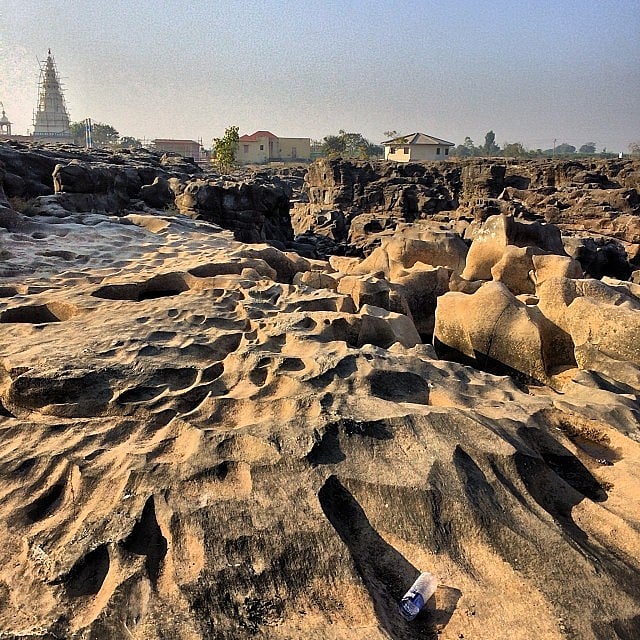
The “Potholes of Nighoj” is a geological occurrence where river-carried pebbles become wedged in cracks within the basalt rock riverbed. Due to the water current, these pebbles swirl and create pot-shaped cavities in the basalt rock. This process has unfolded over thousands of years.
The rocks primarily exhibit black or dark grey hues, and upon closer examination, one can observe layers with a hint of red.
Legends
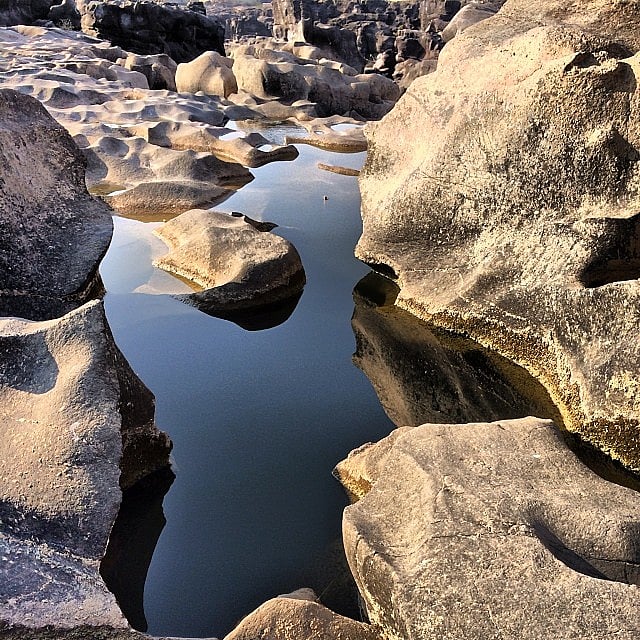
Contrary to scientific theories, villagers share different stories about the unique rock formations. They assert that the local deity, Goddess Malaganga, held significant sway over the village and the river. According to them, the Kukadi River bore the consequences of her influence and displeasure. Next to these potholes stands the temple dedicated to the local deity Malganga. The community views these formations as a manifestation of Malganga’s blessings.
How To Reach
Nighoj potholes lie 90 km from Pune and 245 km from Mumbai, offering a feasible day trip from Pune. The nearest airport and railway station are in Pune, with available transportation options like cabs or buses. However, the most practical way to reach Nighoj is by car.