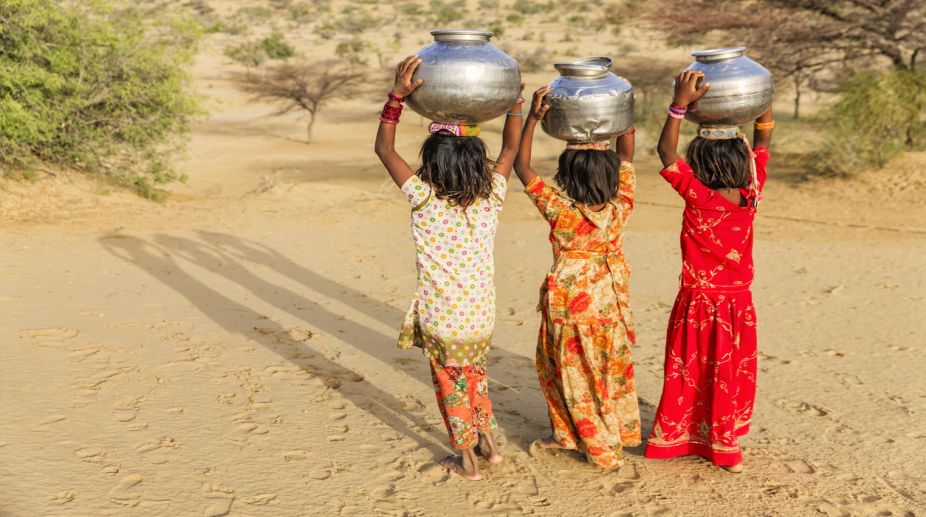
(PHOTO: Getty Images)
Even as Haryana is fighting a battle with neighbouring Punjab for getting its share of river water through the Sutlej-Yamuna Link (SYL) canal, the state has emerged as a water-scarce state with an alarming drop in groundwater level during the recent decades.
_______________________________________________________________________
Buy Organic Products Online at best prices at https://www.getgreen.co.in .
_______________________________________________________________________
The groundwater level in Haryana, a major paddy producer in the country, has dropped by more than 50% in the past four decades.
According to official information, in 1974 the groundwater was available at 9.19 metre (m) and in 2016, it has gone down to 18.66m, recording a decline up to 9.47m. In fact, this is the state’s average, as in many districts the groundwater level has gone down up to 46m.
In Mahendragarh district where groundwater level stands at 46.39m, Kurukshetra (35.30m), Gurgaon (28.87m), Rewari (26.97m), Kaithal (26.69m), Fatehabad (25.98m), Bhiwani (21.97m), Sirsa (20.48m), Panipat (18.81m), Karnal (18.75m) and Panchkula (17.15m).
_______________________________________________________________________
Read Also : Shrub encroachment on grasslands can increase groundwater recharge
________________________________________________________________________
Nearly 71 blocks in 17 districts have been reported overexploited for groundwater, 15 blocks in 11 districts fall under the critical category while seven as semi-critical.
Chief Hydrologist, Haryana Agriculture, MS Lamba told The Statesman that the trend of submersible tubewells from 1999 onwards resulted in overexploitation of groundwater in many districts, especially the ‘Paddy Belt’ comprising districts of Kurukshetra, Karnal, Kaithal, Panipat and Ambala.
According to the official data, in 1999, the groundwater level was available at 9.36m while in the past 17 years, it has gone down to 18.66m, recording a decline of 9.30m in the water level.
Data shows that paddy production in Haryana has reached 61.79 lakh metric tonne (MT) during the year 2015-16 from 36.48 lakh MT in 1998-99.
Most affected districts between 1999-2016 are Mahendragarh, recording a fluctuation up to -21.38 m; following by Fatehabad (-19.56m), Kaithal (-18.91m), Kurukshetra (-18.05m), Gurgaon (-13.65m), Rewari (-13.90m), Karnal (-11.16m), Sirsa (-11.03m) and Panipat (-10.28m).
Official figures show that in 1966 when the state of Haryana came into being, there were merely 27,957 tubewells, while in 2014-15 (latest numbers available with the department), the total number of tubewells has gone to 8,77,151 comprising 3,01,986 diesel-run tubewells and 5,75,165 electric tubewells, recording a 30-fold increase in the state.
_______________________________________________________________________
Read Also : The effect of groundwater contamination
________________________________________________________________________
Dr Sunjay Kumar, head of the department, Soil and Water Engineering, Haryana Agriculture University, Hisar, said, “Around 30-40 years ago, paddy used to be sown on hardly 10-20% of agriculture land, which multiplied over the years, leading to more extraction of groundwater.”
In many districts, especially Rohtak and Jhajjar, groundwater could not be exploited much just because the quality of the water is not good there, Lamba said.