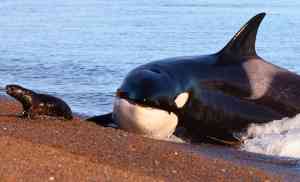
Dolphins and orcas have crossed a line in evolution they can’t step back from. A new study uncovers why these marine giants are now fully locked into ocean life.
Dolphins and orcas have undergone such extensive evolutionary changes to adapt to life in the ocean that returning to land is now impossible, according to a study published in Proceedings of the Royal Society B. These iconic marine mammals, once descended from land-dwelling ancestors, have now passed a critical evolutionary threshold, locking them into their aquatic environment forever.
Roughly 250 million years ago, some mammals made a remarkable shift back into the water, a reversal of the earlier transition that saw the first tetrapods move from aquatic to terrestrial life approximately 375 million years ago. This return to the sea happened more than once and eventually led to the evolution of today’s whales, dolphins, and orcas.
Over time, dolphins and orcas acquired a suite of specialized adaptations that made them highly efficient marine predators. They evolved larger bodies that helped them conserve heat in cold water, shifted to a carnivorous dietthat matched their high metabolic demands, and developed physical traits that enhanced swimming and diving ability. These anatomical transformations didn’t just support life in water—they fully committed these animals to it.
According to Bruna Farina, a Ph.D. student at the University of Fribourg and lead author of the study, this evolutionary journey reached a point of no return. Her research examined more than 5,600 species of mammals, classifying them into four categories ranging from fully terrestrial to fully aquatic. Her analysis revealed that once species cross from semiaquatic to fully aquatic, their evolutionary path becomes irreversible.
Illustration of a tiktaalik, an ancestor of tetrapods that is thought to have started to make the transition from sea to land 375 million years ago. (Image credit: Mark Garlick/Getty Images)
The Tipping Point in Evolution
Farina’s research highlights a “crucial tipping point” beyond which marine adaptations are no longer reversible. This concept aligns with Dollo’s law, a theory proposed by Belgian paleontologist Louis Dollo in the 19th century, which posits that evolution generally does not reverse once a complex trait has been lost.
In the case of dolphins and orcas, this means that their extensive adaptations for ocean life have closed the door on any return to land. Their entire anatomy—from their breathing and locomotion to their reproductive systems—is now dependent on a fully aquatic environment.
The study suggests that these animals are “trapped in their watery ways,” unable to evolve back toward a terrestrial lifestyle. While these changes have allowed them to thrive in the ocean, they also leave them highly vulnerable in the face of environmental disruption.
As climate change and ocean pollution continue to threaten marine ecosystems, the irreversible adaptations of dolphins and orcas raise serious concerns. Because these species can no longer return to land, their survival is tightly linked to the health of marine environments. Any degradation in ocean conditions could have severe consequences.
This vulnerability is compounded by their extreme specialization. Traits that were once evolutionary advantages—like deep-diving abilities or streamlined bodies—now limit their adaptability. If their habitat changes in ways they can’t handle, these animals have few options left.
This study adds a new dimension to conservation discussions, emphasizing how evolutionary history can limit a species’ future resilience. The more specialized an organism becomes, the less flexible it is when the environment changes.