

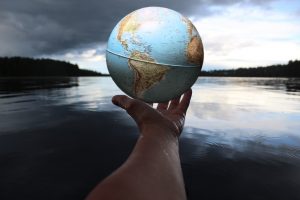
Pic Courtesy – Anne Nygård (Unsplash)
It’s a belief and a fact that humans should be the “CARETAKER” or “STEWARD” of this natural or physical world. There is also another set of people, who also believe that “leave the environment on its own, and let nature run its natural course of the process”. But human activities are not only intrinsically linked to nature, rather they are an integral part of it. From the land we live to the resources we use, the trash we throw away, and whatever we do is closely tied up with it and directly impacts the surroundings. The only question now becomes imperative, how we can shape or save the environment by maintaining our activities to have a meaningful impact on it.
________________________________________________________________________
Read Also : New species of African violets found in Mizoram
________________________________________________________________________
Earth’s environment has been in a constant state of creation and destruction. In the entire history of the planet, the continuous changes happening in the process are a regular phenomenon. The last six million years were particularly volatile and saw many different shifts in the environment. The key to human survival in these transformations was the unique ability of our ancestors to alter their behaviors according to the atmosphere around them. Our success in these times was largely due to the evolution over time. These unique number of traits our ancestors possessed, allowed us to be more adaptable to a large variety of environmental conditions. This adaptability is the greatest strength of humans.
It’s a fact that, physically, we have altered or severally damaged the planet. Greenhouse gases such as carbon dioxide, methane, nitrous oxide, caused by fossil fuel combustion and industrial processes are not only increasing, rather concentrating in the atmosphere. All these activities cause heat to get trapped in the earth’s atmosphere, resulting in the rising of global temperatures. The projected mean surface temperature increase by 2100 is between 3.7 degrees to 4.8 degrees F.
_______________________________________________________________________
Read Also : Atlantic discovery: 12 new species ‘hiding in the deep’
________________________________________________________________________
The result will be, that earth will be hotter than it has been in the last 1.4 crore years. The visible consequences will be, all the ice caps will melt, resulting in the risk of flooding in major areas we inhabit. Shrinking of forests and extinction of 20 to 40% of earth’s animal diversity. In recent times, we have started facing these effects in the environment emphatically and more clearly.
For millions of years, all humans, early and modern alike, had to find their food. In the past 12000 years, homo sapiens made the transition by producing food and by herding and domesticating the animals. It had started changing the environment. He has been so successful in it, that he has been inadvertently creating a turning point in the “HISTORY OF LIFE” on earth. Eventually, humans found that they could control the growth and breeding of certain plants and animals. This led to an increase in the activities, which transformed the Earth’s natural landscape, first locally and then globally. As humans invested more time in producing food, they settled down into villages. Gradually, villages became towns, and towns became cities. By this time, humans have learned the art of processing, storing, and trading food also. With more food available, the human population began to increase dramatically.
_______________________________________________________________________
Read Also : India discovers new plant species in Antarctica
________________________________________________________________________
Now the human had started spreading to every continent. He developed the skills for producing his food, rather than tracking it down daily. This way he had freed himself to enrich the lives in many ways. Now the human had started becoming ARTISAN, ARTIST, TEACHER, INVENTOR, POLITICIAN, and WRITER. Human has altered the world in many ways. In the process, life has become secure, comfortable, and benefitted in many more ways. But, parallelly, this transformation has augmented an unintended series of consequences. And these consequences were not limited to other species, but the whole human race started getting affected. It has triggered the creation of new challenges directly linked to the survival of not only that of the human race, rather every form of life on this planet earth.
If we look at the changes human has made, by 1995, at least 83% of Earth’s land surface had been directly affected by humans. In 2004, the International Union for Conservation of Nature (IUCN) reported that current birds, mammals, and amphibian extinction rates were at least 48 times greater than the natural process of extinction. We can say now it is 1024 times higher. As of 2005, humans had built so many dams that nearly six times water was held in storage as has been flowing freely in the rivers. Everything from damming of rivers to paving of roads to illuminating public spaces has changed the physical makeup of the planet in some respect or another. This way human has been creating a new world truly shaped by him only.
As we have seen that Earth’s environment has been in a regular process of a constant state of creation, destruction, and change. And we can never return to the environment how it was in the past. The conditions of the past have been so varied, that there can’t be any stable baseline. We can’t mark a base or draw a line, which we can call this is “THE PAST”. So, if we can’t reverse the clock, how do we can move forward in this altered world, which we have created with our imaginations and aspirations. Now the question is, whose responsibility is to make important decisions to make this planate inhabitable.
We all are trustees of posterity. We are the trustees of the earth, the environment, and the future. We owe the responsibility to work for a future, that is more just and equitable. How can we shape a GLOBAL SOCIAL PROJECT? How can we accommodate ethnic, religious, and cultural diversities, while making changes at the global level? What process and system must be adopted to make long-term plans appealing feasible and successful for individuals, societies, and countries on a short-term and long-term basis? WHAT KIND OF LIFE DO WE WANT ON THIS PLANET? What can we do as individuals, societies, organizations, and countries to create a future with purposeful institutions? Which issues are the most critical and what must be the priority to address them? And the biggest question is “HOW AND WHEN IT WILL BEGIN”
Tags: #birds, #comfortable, #environment, #food, #getgreengetgrowing, #gngagritech, #greenstories, #life, #nature, #planate, #religious, #world






Oh my goodness! a tremendous article dude. Thanks Nonetheless I am experiencing challenge with ur rss . Don’t know why Unable to subscribe to it. Is there anyone getting equivalent rss downside? Anyone who knows kindly respond. Thnkx