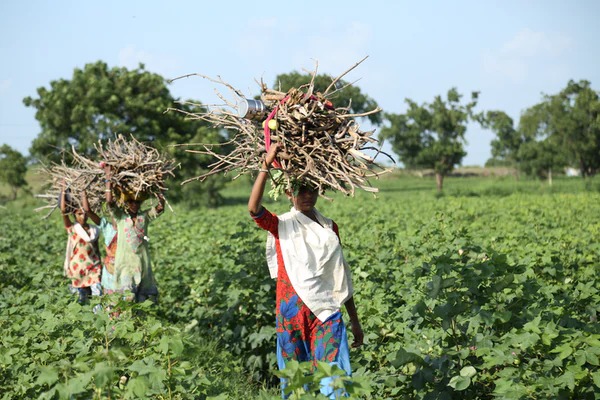

Beyond the confines of one’s private space, the geographical unit, that’s real and live
is a “VILLAGE”. A small settlement, usually found in a rural setting, generally larger
than a hamlet, but smaller than a town, we can call a village. A village is not only a
platform for social engagements, but it’s also the unit, where public policies and
programs come to fruition. We can also say, the village communities are little
REPUBLICS, having everything they want within themselves only, and almost
independent of any foreign relations. Historically, when we see, they seem to last,
where nothing else lasts. Dynasty after dynasties tumbled down, the revolution
succeeded revolution, Hindu, Mogul, Sikh, Britishers, and many others had tried to
be the masters of the societies, but the village communities remain the same.
Although Villages were remote and relatively cut off from each other, they were
never isolated. They were and still are part of the great traditions of India.
Mahatma Gandhi is often quoted as having said,”Real India lives in its villages”.
The wisdom of his version was based on the fact, that, in the early decades of the
20th century, Indian URBAN SEGMENT constituted only 11% of the total population.
It was the villages in which 89% of the population lived. The development of the
VILLAGE INDIA for Gandhi was the development of India. The chronic ills of
Illiteracy, Ignorance, Indolence, and Poverty characterized the vast and scattered population of rural India. Even being illiterate and attached to their land, the villagers
lead a simple life. That’s the reason, villages are not an important part of the
mainstream policy of India.
Let’s look at an example of public policy in this regard. Haridwar, an aspirational
district in Uttarakhand has 39% stunted children (An indicator of chronic
malnutrition), under the age of five. It has 1.3 million inhabitants across 518 villages,
where stunting prevalence is between 10% to 85% across its villages. The
prevalence of stunting among the children varies between 13% to 65% across all the
districts in India. 70% of India’s rural population resides in 6,54,856 villages. For a
district to reduce its prevalence of stunting, majorly all the villages of this district must
reduce their stunting prevalence
Read Also: https://greenstories.co.in/white-sugar-white-sugar-vs-brown-sugar-vs-jaggery-vs-honey/
Mahatma Gandhi had a vision for a holistic development of India, which is not
possible without rural development. This stands true even today. He gave two
messages about rural India. The first was “The economic independence of villages”,
and the second was “Village level governance”. Both were based on the belief of
overall preaching, frugal (economical) life, avoidance of ostentation (pretentious
display of wealth), mutual cooperation, harmony between people, and finally
nonviolence, all of which have lost value in today’s time. Aggression and power are
the key words accepted and adopted by the society in today’s value system.
He has also foreseen the four trends that have vitiated the development of ethos in
the country. The first is “unchecked population growth”, the second is ” the
systematic and progressively intensive invasion of labor displacing technology”, the
third is “the onslaught of media and communications that unleashed a consumerist
surge and urban aspirations among rural people”. And the fourth is the proliferation
of subcultural identities in Indian society that have caused splinters and divisions.
Today, Gandhi’s concerns are clearly visible in our society and the country. The
villages in densely populated Gangetic and Brahmaputra basins have become the
most corrupt places. Caste wars are common and rife here. Education and health
systems are simply non-existent in these villages. Employment is scarce. Rising
aspirations are difficult to be met locally. People are migrating to nearby towns and
distant cities in search of employment. Their needs have transformed, as they have
been converted into hapless consumers to the, not so necessary, urban products. In
return, the only sale-able product they have is, their LABOUR. They don’t want to do
farming, which what they can do and must do. And finally, they are not fit enough for
anything else to do.
On the governance front, rural India is only used for different purposes. Villages are
not an important part of the mainstream public policy or academic discourse in India.
Presently, the geographical unit that dominates the policy in India is DISTRICT. As
the resources with the states fell short of needs and often suffered from a populist
misdirection, the centre becomes the chief financier of development. The locus of
decision making thus shifted away from the villages. Only the “NEGLECTED INDIA”
now lives in the villages. We need a paradigm shift in our approach for the vision of
real development of India, and that can be achieved, only through the development
of our villages or “DEVELOPMENT OF RURAL INDIA”.
Tags: #getgreen, #gngagritech, #gogreen, #greenstories, #Historically, #india, #mahatmagandhi, #real, #villages