
California’s forests are changing in ways that are hard to ignore. Fires are no longer rare events that forests recover from over time. They now reshape entire landscapes.
In many areas, trees do not return at all. This shift raises urgent questions about what the future of these ecosystems will look like.
Forest changes after wildfires
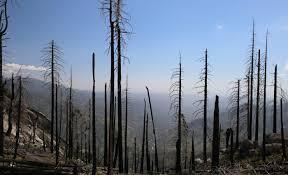
In parts of the Sierra Nevada, wildfires have led to clear changes in the landscape. Tall conifer trees that once dominated these areas are now gone.
Shrubs and hardwood species have taken their place. In some areas, new conifers are growing again. In many others, there is no regeneration.
This pattern is not random. It shows the impact of environmental stress and changes in fire behavior across California.
A global loss hotspot
North America has become a major region for fire-driven forest loss. California stands out within this trend. It carries a large share of the reforestation need in the western United States.
Several factors drive this shift. Long summer droughts, rising temperatures, and repeated dry years weaken trees. On top of this, severe wildfires, insect outbreaks, and disease increase mortality.
“Those rates are right up there with the world’s leaders in fire-driven forest loss, like Russia, Portugal, Greece, Bolivia and even Canada,” said Hugh Safford, the study’s senior author from the University of California, Davis.
Measuring regeneration chances
Researchers used the Postfire Spatial Conifer Regeneration Prediction Tool to understand what happens after fires.
This tool estimates whether conifers will return to a burned area within five years. It looks at several factors such as fire severity, rainfall after the fire, sunlight exposure, slope, and seed availability from nearby trees.
The result is a detailed map that shows where forests are likely to recover and where they are not.
The study groups forest loss into three levels. Moderate loss means at least half the tree cover is gone.
High loss means most trees are gone and regeneration is unlikely. Acute loss describes near-total destruction with very low chances of recovery.
This classification system helps show not just how much forest is lost, but how difficult recovery will be.
Forest loss from wildfires is increasing
The results show a clear trend. Forest loss is increasing quickly and shows no sign of slowing down.
Between 2021 and 2023, moderate loss reached nearly 150,000 hectares each year. High loss reached around 86,000 hectares per year.
The pace of change is striking. In some categories, the affected area doubles within a few years.
“In the case of California, the rate is also accelerating rapidly,” Safford said. “A couple more big-fire years like 2020 or 2021, and we could be looking at large-scale loss of conifer forests over wide swaths of the state.”
Impacts on mid-elevation forests
Not all forests face equal pressure. Mid-elevation forests suffer the greatest total losses. These include mixed-conifer forests and areas dominated by pine species.
Mid-elevation forests also play a key role in the timber industry. Their decline affects both ecosystems and economic systems.
A century of fire suppression has made the problem worse. Dense tree growth has increased fuel loads, leading to more intense fires.
Forest change in high-elevation zones
High-elevation forests show a different pattern. Their total loss is smaller, but the rate of increase is faster.
These areas once had natural protection due to cooler climates and snow. That protection is weakening as temperatures rise.
Recovery in these regions is slow. Short growing seasons and harsh conditions make it harder for seedlings to survive.
Ownership patterns matter
Most reforestation needs fall on private lands and land managed by the US Forest Service.
Private industrial lands often burn at higher intensity. This happens because dense plantations grow after replanting. These stands can become highly flammable.
Smaller private lands often rely on natural recovery. Many of these areas never get replanted.
Forest loss and recovery
Reforestation efforts are falling behind. On Forest Service lands, only a small percentage of burned areas are replanted within the needed timeframe.
The gap between forest loss and recovery keeps growing. This trend leads to a steady decline in overall forest cover. Hundreds of thousands of hectares now need reforestation.
Several issues limit reforestation efforts. Funding has declined over decades. Tree nurseries and seed supplies have also reduced.
At the same time, the scale of fire damage has increased. This mismatch makes recovery efforts harder to maintain.
Even long-term plans would take decades to catch up, and that assumes fire damage stops increasing.
Recent fire shocks
The 2020 and 2021 wildfire seasons stand out. These years created massive reforestation needs.
Large fires burned across multiple regions. These areas had already faced stress from drought and past fire suppression.
The scale of damage in these years pushed the system beyond its limits.
Simply planting more trees will not solve the problem. Researchers suggest a more targeted approach.
Efforts should focus on areas where conditions support growth. Planting should match natural patterns rather than follow strict grids.
Tree selection also matters. Species and genetic traits should match future climate conditions, not past ones.
The role of hardwoods
Hardwood species may play a larger role in future forests. These trees can regrow after fires more easily than conifers.
At lower elevations, conditions may favor hardwoods over traditional conifers. Accepting this shift could improve long-term resilience.
Mixed forests may offer a more realistic path forward than trying to restore past conditions.
Forests enter a new era
California’s forests are entering a new phase. Fire, climate, and human activity are reshaping them at a rapid pace.
“California has much more fire-driven forest loss than people understand,” Safford said.
“It’s high even by international standards. It’s happening more in high-elevation, climate-sensitive areas that protect our watersheds, and there’s almost nothing being done about it.
“If commensurate actions aren’t taken soon, we’re going to lose huge areas of conifer forest and the ecosystem services those forests provide.”
The tools to measure these changes are now available. The challenge lies in acting on this knowledge. The decisions made in the next decade will shape what California’s forests become.
The study is published in the journal Frontiers in Forests and Global Change.
NOTE – This article was originally published in Earth and can be viewed here