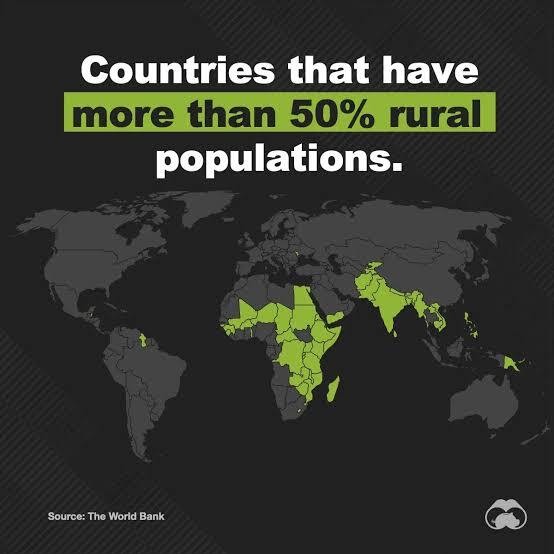

Mapped: Only 36 Countries Are Still Majority Rural
Key Takeaways:
- Only 36 countries still have more than half of their population living in rural areas.
- Nearly two-thirds of these countries are in Sub-Saharan Africa.
- The global rural population share has fallen from roughly two-thirds in 1960 to about 43% today.
Today, most people live in cities, but that wasn’t always the case. Decades of industrialization and economic development have steadily shifted populations toward urban centers, making majority-rural countries increasingly uncommon.
The map above highlights the 36 countries where more than half of the population still lives in rural areas, using the latest available World Bank data. While most are concentrated in Sub-Saharan Africa, a handful remain across South Asia, Southeast Asia, Oceania, and the Caribbean.
________________________________________________________________________
Read Also : Agricultural Technology Transfer for Rural Prosperity
________________________________________________________________________
The Most Rural Populations
Below, we show all countries sorted by rural population share:
|
Rank
|
Countries
|
Rural population (%, 2024)
|
|---|---|---|
| 1 | 🇵🇬 Papua New Guinea | 86.12 |
| 2 | 🇱🇮 Liechtenstein | 85.29 |
| 3 | 🇧🇮 Burundi | 84.84 |
| 4 | 🇳🇪 Niger | 82.77 |
| 5 | 🇼🇸 Samoa | 82.58 |
| 6 | 🇷🇼 Rwanda | 81.92 |
| 7 | 🇲🇼 Malawi | 81.40 |
| 8 | 🇱🇨 Saint Lucia | 80.69 |
| 9 | 🇱🇰 Sri Lanka | 80.58 |
| 10 | 🇳🇵 Nepal | 77.63 |
| 11 | 🇹🇴 Tonga | 76.79 |
| 12 | 🇫🇲 Micronesia | 76.44 |
| 13 | 🇪🇹 Ethiopia | 76.34 |
| 14 | 🇹🇩 Chad | 75.31 |
| 15 | 🇸🇿 Swaziland | 74.99 |
Africa dominates the ranking, with countries like Burundi, Malawi, Niger, and South Sudan among the world’s most rural. Outside Africa, Nepal, Timor-Leste, Papua New Guinea, and Cambodia also remain predominantly rural.
The World Has Become Increasingly Urban
Urbanization has been one of the defining demographic shifts of the past century. As countries develop, employment opportunities, education, healthcare, and infrastructure often become concentrated in cities, drawing millions of people away from rural communities.
According to Our World in Data, about two-thirds of the global population lived in rural areas in 1960. Today, that share has fallen to roughly 43%, with urban residents now accounting for the majority of humanity.
The transition has been particularly rapid across East Asia, Latin America, and the Middle East, where urban populations have grown dramatically over the past several decades.
Why Africa Still Has So Many Rural Countries
Sub-Saharan Africa accounts for the overwhelming majority of countries on this list. Although many African cities are among the fastest-growing in the world, agriculture remains a major employer across the continent, and a significant share of the population continues to live in villages and smaller communities.
Many of these nations also have relatively young populations and lower levels of industrialization compared to more urbanized regions, meaning rural livelihoods remain central to their economies.
________________________________________________________________________
Read Also : Agroforestry can transform rural futures
________________________________________________________________________
Many majority-rural countries also feature prominently in our ranking of the countries with the most agricultural land, reflecting the continued importance of farming and rural industries.
Will Majority-Rural Countries Become Rarer?
Current demographic projections suggest the answer is yes. Global population growth over the coming decades is expected to be concentrated in urban areas, with cities continuing to absorb most new residents.
That said, the pace of urbanization differs widely across countries. In many lower-income nations, especially across Africa, rural populations are expected to remain substantial for years to come, even as cities continue to expand.
The result is a world that is steadily becoming more urban, while rural communities continue to play a vital role in feeding populations, supporting livelihoods, and shaping national economies.
NOTE – This article was originally published in Visual Capitalist and can be viewed here