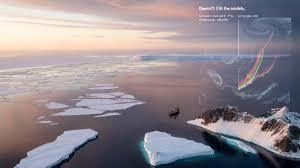

The satellite image loads slowly on the meteorologist’s screen, pixel by pixel, like a Polaroid developing in real time. At first glance, it looks almost normal: a familiar swirl of clouds over the North Pole, the white cap of sea ice, the deep blue of the surrounding ocean. Then the data layers pop up. Temperature anomalies. Sea ice thickness. Jet stream contours. The room goes quiet.(Meteorologists )
Outside, the city feels mild for the season. People walk in light jackets, coffees in hand, unaware that thousands of kilometers away, the Arctic is behaving like a planet from a slightly different universe.
The meteorologist leans in. The numbers don’t fit the models.
Something has shifted.
When the Arctic stops behaving like the Arctic
Early February used to be the heart of deep polar winter, the time when the Arctic locked itself into a hard, frozen stillness. This year, that script is slipping.
Weather stations ringing the Arctic Circle are reporting temperatures up to 10°C above seasonal norms. Pockets of warm, moist air are surging north, punching holes in the cold dome that once felt untouchable.
For specialists who track these patterns year after year, the new maps have a strange quality. They look less like winter and more like late March, like a calendar someone quietly pushed forward.
One scene keeps coming back in expert briefings. Off the coast of Svalbard, where sea ice usually stretches like a solid road, ships are still moving through open water. Fishermen film videos of dark waves under a pink polar sky and post them on social media with a mix of awe and unease.
Satellite records show sea ice extent near record lows for this time of year, with unusually thin ice in regions that used to be the Arctic’s icy backbone. The numbers are not just outside the average; they’re pressing against the edges of the known dataset.
For a field trained to trust decades of patterns, this is like watching a trusted compass slowly spin.
Meteorologists now talk about the Arctic as a “driver” rather than a distant backdrop. When the pole heats faster than the rest of the planet, the temperature contrast that powers the jet stream weakens. That high-altitude river of wind becomes wavier, more sluggish, more prone to contortions that can lock extreme weather in place.
So early February’s strange warmth up north doesn’t stay up north. It can translate into rain instead of snow in cities that built their drainage for frozen winters. It can mean prolonged cold snaps in some regions and spring-like bursts in others, all because the atmosphere’s old choreography is going off-script.
*What used to be a stable ceiling for the planet now feels like a shaky hinge.*
Reading the early warning signs like a weather diary
The way meteorologists read early February now feels almost like paging through a diary of a changing Arctic. They scan for three main clues: surface air temperatures, sea ice extent and thickness, and the behavior of the polar vortex and jet stream.
Think of it as checking the house before a storm. Is the roof still solid? Are the windows rattling? Are the foundations cracking in places no one expected? The Arctic’s “roof” is its sea ice, and in recent winters, that roof has started sagging months before spring.
By early February this year, the sag is arriving earlier, deeper, and over wider areas.
One striking detail: the Barents and Kara Seas, north of Norway and Russia, have become hotspots of warmth in recent winters. Scientists report patches of open water where thick ice used to dominate, areas that absorb sunlight instead of reflecting it back into space.
Last winter, a team monitoring a buoy in the central Arctic recorded a midwinter rain-on-snow event, the kind of thing that used to be rare this far north. Reindeer herders downstream described animals struggling to reach food trapped under an ice crust. That’s not a model projection; that’s someone’s daily life bending under a weather curve.
These early February signals are like underlined sentences in a long, unsettling book.
Behind these scenes sits a straightforward physical logic. Warmer oceans send more heat into the atmosphere. Thinner sea ice forms later and melts earlier, leaving more open water exposed to autumn and winter storms. That extra heat and moisture then disturb the polar atmosphere, making warm intrusions into the Arctic more frequent and more intense.
Meteorologists warn that we may be crossing from “extreme within the known envelope” into “conditions outside the historical envelope.” Uncharted territory is not a metaphor here; the models were built on a world that no longer exists.
Let’s be honest: nobody really updates their sense of what winter is supposed to be every single year.
What this means for our daily weather – and how to live with that uncertainty
The Arctic might feel far away, but its fingerprints show up on your commute and your local forecast app. When specialists see these odd early February patterns, they quietly adjust expectations for late winter and early spring further south.
One practical step: pay closer attention not only to the daily forecast, but to seasonal outlooks issued by national weather services. Those longer-term updates now often mention “Arctic anomalies,” “polar vortex shifts,” or “stratospheric warming events.” These phrases sound abstract, yet they often hint at real-world changes like heavier rain on thawed ground, or late freeze events hitting early blossoms.
Think of it as learning to read the subtext of the forecast, not just the headline temperature.
Many people still plan winter like it’s 20 years ago, assuming predictable snow windows, safe ice on lakes, or stable ski seasons. That mismatch between memory and reality can be dangerous. Snow turning to rain overnight on frozen ground can turn roads into invisible skating rinks. Warm spells that melt river ice early can shift flood seasons in ways local communities aren’t used to reading yet.
There’s no shame in feeling disoriented. We’ve all been there, that moment when the winter coat feels wrong in January, yet the trees say it’s not spring either. The emotional lag between what the climate is doing and what we believe “normal” should be is real.
Adjusting doesn’t mean living in fear, it means adding a new layer of attention, like checking the tide before walking along the shore.
Meteorologists themselves are starting to speak more candidly about that uneasy feeling.
“From a scientific standpoint, we’re not just seeing a warmer Arctic,” one senior forecaster told me. “We’re seeing patterns that our training never prepared us for. The models we trusted are being pushed beyond their comfort zone, and so are we.”
To navigate this, there are a few grounded steps anyone can take:
- Follow trusted national or regional meteorological services, not random social posts, for Arctic-related alerts.
- Notice language like “record-breaking,” “unprecedented,” or “exceptional” in midwinter bulletins; they usually flag real shifts, not clickbait.
- Talk to older people in your area about how winters used to behave; local memory can help highlight what has truly changed.
- Adapt routines bit by bit: flexible travel plans in late winter, better drainage checks around homes, backup plans for outdoor work or events.
- Support local efforts that focus on flood resilience, heat management, and nature-based buffers; these often start with listening to weather trends.
________________________________________________________________________
A winter that feels slightly wrong, year after year
Walk through any mid-latitude city on a soft February day now and you can almost hear the quiet confusion. Trees budding too early. Piles of unsold sleds in shop windows. Ski resorts topping up slopes with artificial snow while rain taps on metal roofs. Each scene on its own might seem like a fluke. Together, they sketch the outline of an Arctic that is slipping away from what we used to know.
Meteorologists use careful language, bound by probabilities and confidence levels, yet many now say the same thing between the lines: the early February signals coming from the pole are not just noise. They are chapters in a new climate story being written faster than expected.
How we read that story — and how honestly we talk about the unease it brings — may shape not only our policies, but our everyday sense of seasons, safety, and home.
| Key point | Detail | Value for the reader |
|---|---|---|
| Early February Arctic warmth | Temperatures up to 10°C above norms and reduced sea ice extent | Helps you understand why local winters feel “off” and less predictable |
| Jet stream and polar vortex shifts | Weakened temperature contrast alters storm tracks and extremes | Explains sudden flips between mild spells, heavy rain, and deep freezes |
| Practical adaptation mindset | Reading seasonal outlooks, adjusting routines, supporting resilience projects | Gives you concrete ways to live with a changing Arctic-driven climate |
FAQ:
- Is the Arctic really entering “uncharted territory” or is this media hype?Scientists use that phrase because current winter conditions increasingly fall outside the historical range of observations used to build climate and weather models. It doesn’t mean experts know nothing, it means the reference frame is shifting.
- How does a warmer Arctic affect my weather where I live?A faster-warming Arctic can weaken the jet stream, leading to more persistent weather patterns: longer cold snaps, stuck storm systems, or repeated warm spells, depending on your region.
- Does low Arctic sea ice in February guarantee extreme weather later?No single signal guarantees a specific event, but low sea ice and unusual warmth raise the odds of disrupted patterns that can amplify extremes in late winter and spring.
- Can we still trust weather forecasts if models struggle with these changes?Short-term forecasts (days ahead) remain very reliable; the real challenge is in seasonal and multi-week outlooks, where Arctic shifts add new layers of uncertainty that scientists are actively working to capture.
- What’s one simple habit I can adopt starting this winter?Get used to checking both the 7–10 day forecast and your national service’s seasonal update once a month, and plan travel, outdoor work, and home maintenance with that wider window in mind.
NOTE – This article was originally published in Beacon Wales and can be viewed here