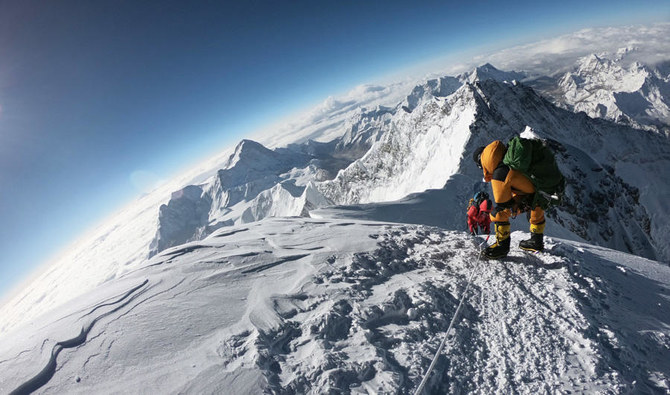
Mt. Everest stands tall in the Himalayan range with all its majesty & aura as the tallest mountain in the world. The discussion surrounding the mighty & majestic Everest usually rests upon its beauty, spiritual significance & being the pinnacle test ground of any human’s physical ability but in recent times, this discussion is gradually fading away in wake of a new topic, the death of mount Everest.
The statement is not based solely upon rhetoric but has iron-clad facts to back up its authenticity. Traditionally, the over-involvement of humankind is making Everest yet another victim of being degraded & eventually will lead to its death.
________________________________________________________________________
Read Also : Population and pollution – How they are interrelated?
________________________________________________________________________
The daunting concern arises with the influx in the amount of bio & artificial waste that is accumulated alongside a summit. In extreme weather conditions, any kind of waste can be considered as non-degradable thus adding to the already persisting problem.
The concern arises due to the present significance of Mt. Everest as it pretty much defines the way of life for thousands of people. Traditions, religion & way of life for the locals as well as that of Nepal are deeply intertwined with this daunting mountain. It acts as the major source of economy for the nation but for the locals, it is much more than money. It’s their life, religion & way they live them both.
How over-tourism is hurting Everest
In 1953 a summit was made to conquer the height of Mt. Everest & this point in history showed the pinnacle of human endurance. Alongside this, it also opened doors for a massive tourist attraction in the form of Everest thus creating a whole economy catering to mountaineering.
With the advancement in the technologies related to this sector, the angle of human endurance is becoming less relevant & is being replaced by dependency on sums of money one can rely on. As time is passing, the peak is becoming more & more human friendly which is in sharp contrast with its basic nature.
In simple words, Everest is now too full of people which is converting this proud & majestic mountain into yet another garbage dump for human waste. Owing to the increase in the number of tourists, the mountain gains 50 tons of brand new trash every year.
Complimenting that, Everest tourists annually leave behind around 26,000 pounds of human excrete as waste & due to high altitude & extremely toe temperature & pressure, human excrete take way longer time to disintegrate & decompose.
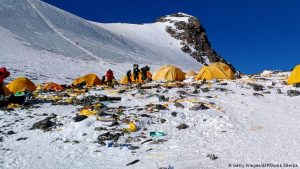
The problem of human excrete waste has also contributed to making the locals life miserable. Pollution of water bodies via human waste results in frequent poisoning incidents of humans & animals alike & natural degradation comes as an added sidekick.
Also, around 50 tons of garbage is said to be littered around Everest base camps. It also presents a huge challenge as retrieval & disposal of this much trash require a huge amount of capital, something, a small country like Nepal finds difficult to accomplish.
________________________________________________________________________
Read Also : The Mystical Himalayas – Where Yogis and Sages Live – Part 1
________________________________________________________________________
World’s highest cemetery?

As of 2018, a total of 5294 people have completed the heavy task of completing the summit 9,159 times. Out of this figure, 300 people have lost their lives while completing the summit. Owing to this, it has become the 10th deadliest mountain of the Himalayan range & keep in mind that the mountainside is completely unpopulated.
Around 1 in every 10 climbers suffers this gruesome fate but what happens to their remains is also a matter of huge concern. Owing to the frigid temperatures, the decomposition of said bodies is practically impossible. Sadly, this also adds to the amount of trash already present upon the mountain.
As the removal of these bodies will cost tens of thousands of dollars along with the possibility of losing even more human lives, most of them are left on the spot of their deaths & in a very creepy fashion, the said dead bodies act as a sort of landmark upon the mountain.
The said problem has in turn converted Mount Everest into the world’s highest cemetery.
Restoring Everest’s sacred glory
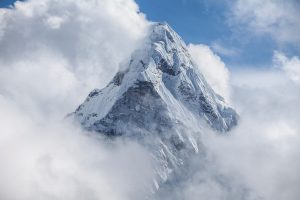
As Everest tourism has become a major industry that supports the economy of Nepal, the government finds itself economically bounded when it comes to regulating the number of tourists & doing a decisive overall keeping the health of the mountain in check.
________________________________________________________________________
Also Read : Immune System and its link with Eating Healthy and Organic Food
________________________________________________________________________
Some of the various steps that we can do to save the Everest can be-
- Employing more localities in a summit that can help in bringing down the waste & garbage.
- Incentivizing garbage & waste retrieval process to encourage locals.
- Setting a strict limit on the minimum amount of garbage a climber has to bring back.
- Starting the process of removal of dead bodies from the mountain.
- Urging global community to help in clean-up efforts of the mountain.
- Maintaining a pre-ready force which can help in cleaning efforts after a season ends.
These are some of the very basics on how we can at least start caring about the majestic crown of Himalaya.
Along with this general awareness among the incoming tourists is highly required so that we can keep Mount Everest sacred & pious, the way it’s meant to be since its inception.
Reference links:
- https://www.cbc.ca/news/world/mount-everest-warming-pollution-deaths-dangerous-1.5162691
- https://mteverestbiogasproject.org/the-problem/#:~:text=With%20decades%20of%20continued%20use,risks%20to%20clean%20water%20sources.
- https://ourworld.unu.edu/en/vanity-pollution-and-death-on-mt-everest
- https://www.tibettravel.org/tibet-everest-base-camp-tour/everest-environmental-issues.html
- https://www.dailymail.co.uk/sciencetech/article-5852843/Mount-Everest-high-altitude-rubbish-dump.html
- https://daily.jstor.org/mountain-trash-everests-environmental-disaster/
image links
- https://www.cbc.ca/news/world/mount-everest-warming-pollution-deaths-dangerous-1.5162691
- https://www.redbull.com/za-en/everest-deaths-dangers-avalanches
- https://en.wikipedia.org/wiki/List_of_people_who_died_climbing_Mount_Everest
- https://www.tibettravel.org/tibet-everest-base-camp-tour/everest-environmental-issues.html
Tags: #adventure, #everest, #everestbasecamp, #getgreengetgrowing, #gngagritech, #greenstories, #himalaya, #himalayas, #mountaineering, #mountains, #mounteverest, #nepal, #travel, #trekking, #visitnepal