
When you purchase through links on our site, we may earn an affiliate commission. Here’s how it works.
Rivers often feel timeless, carved into the landscape as if they’ve always been there. Yet, like many natural features, they have life cycles. Some gradually expand and shape the land for millions of years before eventually drying up. Others disappear much sooner. This raises an intriguing question: which river on Earth is the oldest still known today?
________________________________________________________________________
The surprising winner is far older than the dinosaurs. The Finke River, known as Larapinta in the Indigenous Arrernte language, is estimated to be between 300 and 400 million years old.
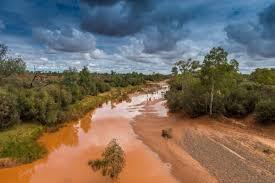
Stretching more than 400 miles across Australia’s Northern Territory and South Australia, this ancient river system flows through one of the most arid parts of the continent. Because of the dry climate, the river does not run continuously throughout the year. Instead, it often appears as a chain of scattered waterholes connected by channels that only flow after rainfall.
Despite these intermittent flows, scientists have been able to estimate the river’s remarkable age using a combination of geological evidence. By studying surrounding rock formations, weathering patterns, and radioactive isotopes in nearby sediments, researchers traced the origins of the system back to either the Devonian period (around 419 to 359 million years ago) or the Carboniferous period (359 to 299 million years ago).
One particularly striking clue lies in an unusual geological feature known as cross axial drainage.
A river that cuts through mountains

Normally, rivers follow the easiest route downhill. They tend to run alongside tough rock formations rather than directly through them. Yet the Finke River does something different.
As it travels through the MacDonnell Ranges in central Australia, the river slices straight across hard quartzite rock structures instead of flowing parallel to them. At first glance, this seems counterintuitive. Why would water carve its way through such resistant rock instead of taking an easier path?
________________________________________________________________________
According to geomorphologist Victor Baker from the University of Arizona, this strange pattern reveals something important about the river’s history.
Scientists believe the river existed before the mountain range itself fully formed. As tectonic forces slowly pushed the land upward during the Alice Springs Orogeny, the river maintained its course. While the mountains were rising, the flowing water gradually cut downward through the rock.
This process, called antecedence, explains how the river could end up crossing such tough geological structures.
The MacDonnell Ranges, known locally as Tjoritja in the Arrernte language, formed between 300 and 400 million years ago during this tectonic event. Since the river cuts directly through them, researchers conclude that the Finke River must be at least as old as the mountains themselves.
Clues hidden in rocks and sediments
Additional evidence comes from the chemical fingerprints left behind by erosion and weathering.
Over millions of years, rocks interact with air, water, and the surrounding environment. These interactions leave specific chemical patterns that scientists can analyze. By examining these patterns, researchers can reconstruct how landscapes evolved over time.
Another key method involves studying radioactive isotopes in the surrounding rock. Because these isotopes decay at predictable rates, scientists can estimate when the rock formed by measuring the ratio of different isotopes present today.
Taken together, these techniques help build a detailed timeline of the river’s development and long history.
Why has the Finke River survived so long?

Rivers are dynamic systems. Some grow larger over time, while others vanish completely due to environmental changes.
According to geologist Ellen Wohl from Colorado State University, rivers can disappear when massive amounts of sediment bury their channels or when dramatic shifts in the landscape redirect water flow. Events such as volcanic eruptions, glacial movement, or major tectonic changes can dramatically reshape river networks.
Climate and human activity can also play a role. In many regions, rivers stop flowing because of drought, changing weather patterns, or heavy water consumption.
However, the Australian Plate has remained unusually stable for hundreds of millions of years. Sitting in the middle of this tectonic plate, central Australia has experienced very little geological upheaval compared to other parts of the world.
This stability allowed the Finke River system to evolve slowly and continuously without being drastically altered by tectonic shifts or glaciation.
What about the future?
Predicting the future of such an ancient river is difficult.
Some long lasting rivers continue flowing for millions of years, while others eventually fade away due to environmental changes. Increasing global water consumption and rising temperatures could put pressure on rivers in dry regions like central Australia.
If the Finke River were ever to disappear, scientists believe another contender could claim the title of the world’s oldest river. One likely candidate is the New River, which flows through Virginia, West Virginia, and North Carolina and is estimated to be around 300 million years old.
Still, for now, the Finke River holds a remarkable distinction: a river so ancient that it began flowing long before the first dinosaurs ever walked the Earth.
NOTE – This article was originally published in FUTURA Sciences and can be viewed here