

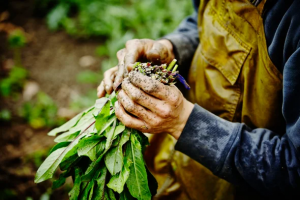
It is a testament to human creativity that even as the number of farms has decreased, the mechanics of agriculture have managed to keep pace with ever-expanding demand. Farm machinery has become larger, more productive and more powerful.(Organic farming)
New crop varieties have been produced that are resistant to common pests and diseases while producing higher yields. Chemical fertilisers and pesticides have become increasingly effective, enabling farmers, without the need for additional human labour, to produce larger crops.
Today’s large-scale food farmers continue to benefit from this. As well as customers also see supermarket shelves filled with farm goods, there is a growing toll on the hidden costs of our reliance on agro-business. Farmlands have become increasingly dependent on chemical fertilisers that over time, have short-term advantages but lead to soil degradation. In non-organic farmlands, water retention is reduced, which lead to degradation of topsoil and chemical residues entering watersheds. These improvements in farming practises have been embraced quietly by us consumers as the cost of feeding a growing country, and because there seem to be no realistic alternatives.
In the past twenty years, there has been an emphasis on the food that we consume and how it is produced. Many people ask questions about the inputs that are added to their food and the effect it could have on both the environment and their bodies.
So a very common question arrives, “organic vs conventional farming – what’s exactly the difference?”
To answer this question, we need to go through a little history first, we won’t be able to understand the difference without history and why the world depends so heavily on the traditional approach to agriculture.
A brief history of agriculture
With the first domestication of food crops happening over 10,000 years ago, agriculture has been one of the greatest developments in human history. This domestication of food made it possible for communities to develop themselves in one place, to grow, tend and harvest food to support larger populations. For the first 8,000 years, plain, manual agriculture dominated – concentrating on the sowing and harvesting of grain crops, animal husbandry, and the planting of nut and fruit tree orchards. The next 2,000 years brought major changes in technology that changed from mainly manual labour (both human and animal labour) to the development of farming implements that required less labour to be farmed in larger areas.
This again improved the potential of humans to farm and feed larger populations with agriculture, coupled with the exchange of food crops around the world. What began as a basic understanding of plant biology (i.e. planting a seed to grow a replica) developed into the world’s largest and most important industry, as well as the fuel for rapid population growth. With what was naturally available, food was grown, and if modern standards were applied to ancient agriculture, it would most likely be ORGANIC!
Now let’s take a look at the difference between organic and conventional farming.
Organic vs conventional farming: –
The differences between conventional and organic farming derive directly from the farming methods used during food processing. Some of the differences between the two practises are unknown to many individuals. Agriculture has a direct impact on our climate, so it’s necessary to understand what goes into our agriculture.
Organic farming

At the sight of what they could do, the incorporation of chemicals into agriculture had many delusions. Exploded Yields. The soil was safe at the outset. Any harm caused by chemical fertilisers was barely visible. Resistance to the chemicals was not developed by pests. Technology spread throughout the world as it was called the agricultural revolution.
Flash forward to today, and again many individuals wonder at organic farming. This is after discovering that traditional methods of farming have a host of issues, including health-related diseases such as cancer, pollution, soil and water depletion, and the effects on domestic animals.
Organic farming is a strategy that requires the natural growing of plants and the rearing of animals. This approach includes the use of biological materials to prevent synthetic substances from preserving soil fertility and ecological balance, thereby reducing emissions and waste. In other words, organic farming is a method of farming which involves growing and nurturing crops without the use of fertilisers and pesticides based on synthetics. Also, no genetically modified organisms are allowed in the process.
Key point: –
- In order to boost soil quality, composition and fertility, natural fertilisers, crop rotation, and cover crops
- Rotation of crops, mulch, and hand or mechanical weeding to suppress weeds
- Beneficial insects to treat insects, trap seeds, and crop rotation
- Cover crops to control disease and crop rotation
Read Also : Organic Farming : Why We Don`t Have More Organic Farms
Conventional farming

The dominant agricultural system, variously referred to as “conventional agriculture,” “modern agriculture,” or “industrial agriculture,” has brought enormous productivity and efficiency gains. Over the past 50 years, food production has increased worldwide; the World Bank reports that between 70 percent and 90 percent of recent food production rises are the result of traditional agriculture rather than higher acreage.
Conventional farming systems differ from one farm to another and from one country to another. They share many features, however, such as rapid technological advancement, major capital investments in machinery and technology, large-scale farms, single crops (monocultures), standardised high-yielding hybrid crops, agribusiness reliance, mechanisation of agricultural work, and widespread use of pesticides, fertilisers, and herbicides. Most of the production in the case of livestock comes from systems where animals are highly concentrated and confined. The bounty associated with industrial farming has brought both positive and negative effects.
Key points
- Chemical fertiliser use
- Chemical pesticide use
- Utilization of chemical weed killers
- Usage of genetically engineered organisms that can yield consistent crops
- Output per growing season or year of only one or two crops in the same field
Tags: #agriculturejobs, #agristudent, #bhfyp, #bhiwani, #bhu, #bihar, #bjp, #chandigarh, #getgreengetgrowing, #gngagritech, #greenstories, #gurugram, #horticulture, #inc, #indianfarmer, #jaijawanjaikisan, #kaithal, #karnal, #khpetter, #kisandiwas, #kishan, #modi, #panipat, #rajesthan, #rohtak, #Tractor






Trackbacks/Pingbacks