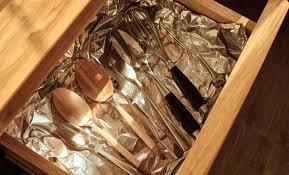
You already own the secret to cleaner kitchen drawers and cabinets that stay dry and spotless. It costs nothing extra and takes seconds to install.

Placing a sheet of aluminum foil at the bottom of a kitchen drawer has become a common habit, and the reasoning behind it is purely practical. The method involves lining the drawer’s interior with standard household foil, then swapping it out whenever grime or moisture builds up. Recent coverage from home improvement publications outlines why this low-effort trick has gained traction.
The main draw is a disposable shield against dampness, drips, and crumbs. For anyone with wooden cabinets, that matters. Wood absorbs steam and ambient humidity from cooking, and over time, that exposure can cause swelling, warping, or even fungal growth. A layer of foil offers a simple waterproof partition between the contents of the drawer and the wood itself.

When the foil gets dirty, cleanup takes seconds. Instead of emptying the drawer and scrubbing the surface, you lift out the old sheet and lay down a fresh one. In spaces like the cutlery drawer or the spice cabinet, where spills and debris are routine, this cuts maintenance down to a single step.
House Digest flagged another upside in its June 2025 review of cabinet liners: the foil’s metallic sheen reflects light. Whether the shiny or matte side faces up, the surface bounces ambient glow back into the drawer. Small items, measuring spoons, tea bags, stray twist ties, become easier to spot at a glance.
How to Line a Drawer in Under Five Minutes
Installation requires no adhesive and very little time. First, clear the drawer completely and wipe the floor dry. Cut a length of foil a bit larger than the interior footprint. Center it, then press a rigid card, a library card or old gift card works well, from the middle outward. That action pushes the foil into the corners and flattens any air pockets.
If the drawer is deeper than the foil’s width, House Digest suggests using two overlapping sheets. The piece closest to the drawer front should sit on top. That way, when you sweep debris forward, nothing catches the seam. The weight of the contents keeps the protective liner from sliding around.

The same approach works inside the refrigerator crisper. A sheet of foil catches stray spinach leaves, berry juice, and bits of vegetable debris. When the foil looks wet or speckled with food, it gets tossed, and the bin itself stays clean.
How Often to Replace the Foil Liner
There is no set schedule. In a drawer that holds party napkins or holiday serving pieces, the liner might stay clean for half a year. In the silverware drawer, where metal utensils scrape the surface daily, the foil will likely tear or stain within a few weeks. The visual cue is straightforward: if the foil appears moist, ripped, or spotted with residue, pull it out and cut a new piece.
House Digest notes a subtle benefit of using foil over other materials. Since aluminum foil already lives in most kitchens, you will not run out of liner unexpectedly. You are repurposing something you already buy, rather than tracking down a specialty product.
This kitchen organization technique does not solve every storage problem. Yet as a no-cost way to shield wood surfaces and make drawer cleaning less of a chore, it has a clear purpose. The practice spreads not because of any viral gimmick, but because it works and asks almost nothing in return.
NOTE – This article was originally published in Indian Defence Review and can be viewed here
Tags: #adhesive, #aluminumfoil, #foil, #getgreengetgrowing, #gngagritech, #greenstories, #huminity, #kitchen, #moisture, #refrigerators, #utensil, #woodencabinets