Water security is quickly becoming an existential threat for most nations on Earth, including parts of the U.S. A comprehensive global analysis warns that many regions are approaching “Day Zero Drought” – a moment when taps could run dry not for days, but for months or even years.
A new study projects a sharp rise in multiyear shortages that push demand beyond supply, placing both cities and rural communities at risk much sooner than expected.
The study was led by Vecchia Ravinandrasana of the IBS Center for Climate Physics at Pusan National University.
The research shows that these crisis points could first emerge within the next decade, if not sooner – well inside current planning cycles.
For present-day evidence of this, look no further than the western U.S. where several states are currently experiencing “Extreme Drought” (D3 on the U.S. Drought Monitor scale) and even “Exceptional Drought” (D4 – the worst classification level).
Defining “Day Zero Drought”
Researchers define Day Zero Drought as a compound, multi-year shortage in which regional water demand outstrips supply from rainfall, rivers, and stored water.
It is not a dry afternoon or a temporary pressure dip – it’s a sustained deficit that forces severe restrictions and emergency allocations.
A compound event combines several stressors at once, such as prolonged low rainfall, reduced river flow, and high use.
An assessment by the Intergovernmental Panel on Climate Change (IPCC) notes that compound extremes are rising in a warming world and that they raise risks beyond any single driver alone.
The hydrological cycle links evaporation, clouds, rain, runoff, lakes, and aquifers in constant motion.
Evapotranspiration describes the water that leaves soils and plants for the air, which climbs as temperatures rise and can deepen drought even when rain totals change only a little.
Global hotspots of water scarcity
Current Day Zero Drought modeling points to cities across the Mediterranean, southern Africa, and parts of North America where these acute water shortages first become attributable to human-caused warming.
In nearly one-third of vulnerable areas, first emergence occurs between 2020 and 2030, a window that overlaps with current planning cycles.
About 14 percent of large reservoirs evaluated could run dry during their first crisis episode because inflows and stored water cannot cover use through a long dry spell.
That is a system stress test no manager wants to fail, because it can take years to refill after a prolonged deficit.
By century’s end, about 753 million people could face these water conditions at the moment they first emerge, including 467 million city residents and 286 million rural residents.
The Mediterranean region is projected to carry the largest urban exposure, while northern and southern Africa and parts of Asia face heavier rural impacts.
Cities collapse faster under drought
Cities concentrate people, pipes, and power that all need reliable supply every hour of every day. Small mismatches between inflow and demand can snowball when a dry year arrives just as consumption rises.
Cape Town’s 2015 to 2018 crisis showed how fast a modern metro can approach a shutoff date when a run of low rain years hits surface water systems.
A paper documents how the Western Cape drought collided with inequality and governance choices, forcing emergency restrictions and reshaping daily life.
Chennai’s reservoirs dropped to exposed lakebed in June 2019 after delayed monsoon rains and runoff mismanagement. A study finds the city had enough seasonal runoff on paper to meet months of water demand, but capturing and storing it proved to be the weak link.
“The length of time between successive DZD events is shorter than the duration of DZD,” said Ravinandrasana.
The new projections underline a similar urban pattern in future decades, with dense areas crossing stress thresholds earlier than the surrounding countryside.
Human fingerprints on Day Zero Droughts
The researchers used two climate model suites to estimate when the human fingerprint on compound drought scarcity first becomes clear.
They tested results under Shared Socioeconomic Pathways (SSP) scenarios that include both higher and moderate future emissions.
To attribute the first emergence to human influence, the team applied the Fraction of Attributable Risk (FAR), a standard event attribution metric that compares how likely an event is in today’s climate versus a pre-industrial baseline.
Using this method, the researchers flagged the first decade in which the anthropogenic signal exceeds a very high threshold of confidence. That choice sets a clear line for planners who need to know when attribution is no longer in doubt.
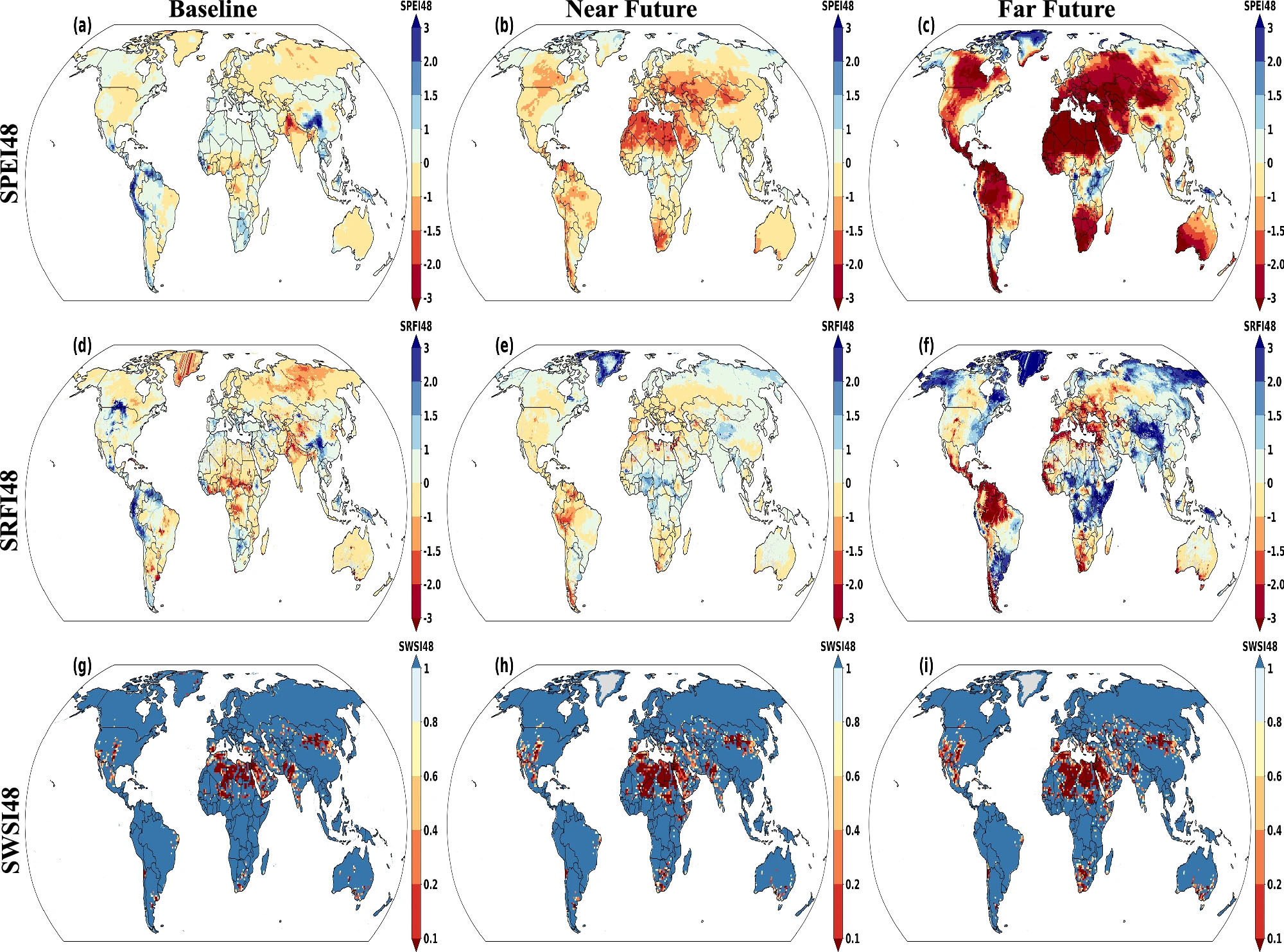
Four key drought indicators
The models track four indicators together, long term atmospheric dryness, diminished river flow, rising demand, and how long a reservoir can supply water during drought before it empties.
The fourth piece matters because storage can mask stress for a while, then fail abruptly when inflows stay low for years.
Where demand rises quickly, timing shifts earlier even if rainfall does not collapse. In parts of Asia and the Americas, consumption growth alone was enough to pull the first emergence forward relative to other drivers.
In Mediterranean settings, longer reservoir drawdown times can delay the first emergence by a decade or so. But when drawdown finally arrives, recovery can lag because refill seasons may not be wet enough to rebuild storage for several years.
Water tables built on shaky ground
Water managers often work with risk tables built on 20th-century climate and past consumption. That is a shaky foundation when dry spells now last longer and return sooner than the systems were built to handle.
A practical path blends efficiency, diversified sources, and equity, starting well before a warning siren sounds.
The “Water” chapter in the IPCC impacts report points to measures such as leakage control, smart pricing, reuse, rain- and city stormwater capture, and updated reservoir rules that share scarcity across sectors.
Agriculture needs attention because irrigation can dominate demand exactly when rivers run low. Cities need backup that does not rely on a single pipeline, plant, or lake, and rules that protect low-income households during restrictions.
Day Zero Drought and Humanity’s future
Even though climate models aren’t perfect, they all keep flagging the same trouble spots: the Mediterranean, southern Africa, and parts of North America.
Cities are especially at risk once global temperatures climb 1.5°C above pre-industrial levels, because dense populations burn through water supplies fast.
To make things worse, extreme droughts are hitting more often than communities can bounce back from.
The gap between one drought and the next is shorter than the drought itself, so the water supply never fully recovers before the next crisis rolls in. It’s like trying to refill a pool with a garden hose while someone keeps draining it.
The takeaway here is pretty straightforward – governments and water managers need to start planning now, not later, because waiting until the tap runs dry means the damage is already done.
The study is published in the journal Nature Communications.
NOTE – This article was originally published in Earth and can be viewed here