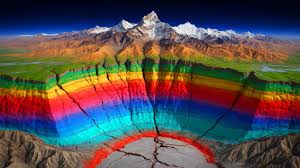
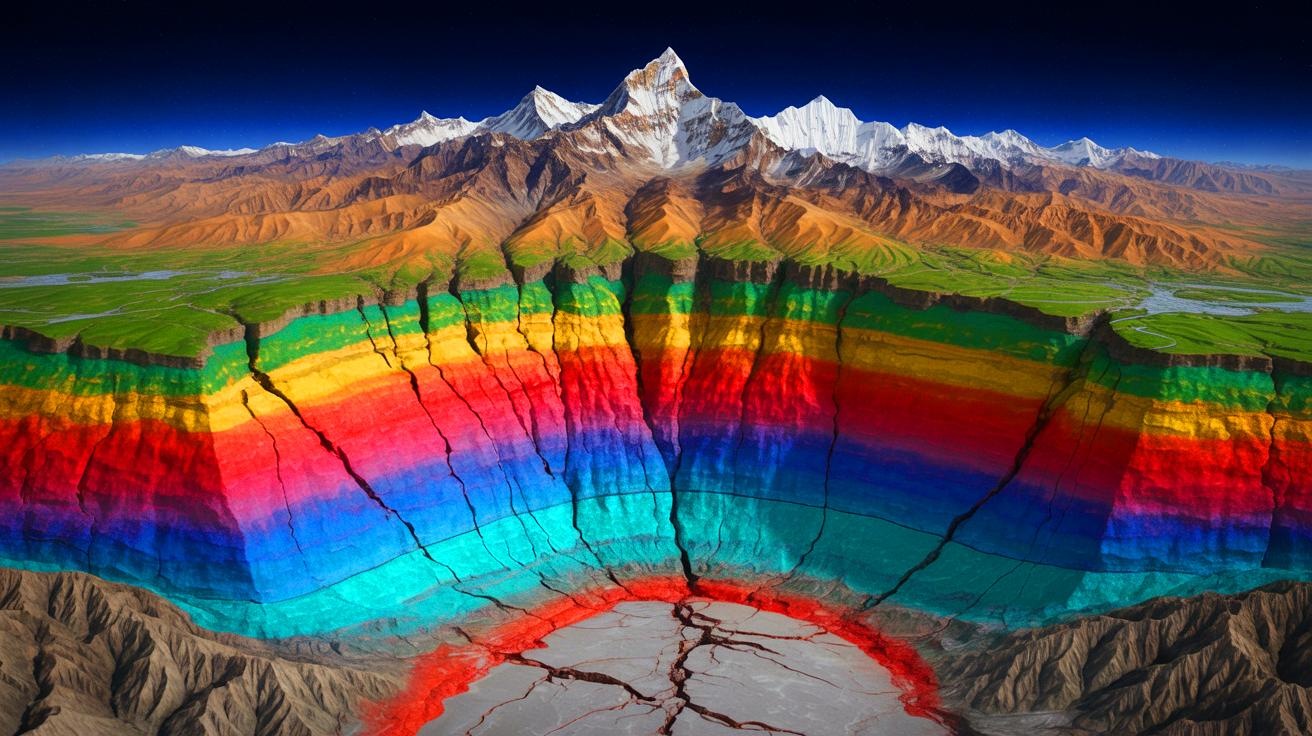
In a groundbreaking study that challenges century-old geological theories, scientists have discovered that the Earth’s mantle, rather than just the thickened crust, plays a crucial role in supporting the majestic Himalayas, potentially altering our understanding of mountain formation worldwide.
Share
| IN A NUTSHELL |
|
bd268
The Traditional View: Crustal Support
For decades, the scientific community largely agreed that the immense height and mass of the Himalayas were supported by a thickened crust. This idea was first proposed by Swiss geologist Émile Argand in 1924. He suggested that the collision of the Indian and Asian tectonic plates caused the Earth’s crust to thicken, forming a strong base that extended 45 to 50 miles deep. This thickened crust was thought to provide the necessary support for the mountain range’s weight.
However, this theory has significant limitations. As the crust descends, the increasing temperatures cause rocks to become molten, transforming them into a ductile material at depths of around 25 miles. As Pietro Sternai, a geophysicist leading the new study, pointed out, “You can’t build a mountain on top of yogurt,” referring to the viscous nature of the molten crust. This analogy highlights the challenge of relying solely on the crust to support the Himalayas.
________________________________________________________________________
Read Also : The Mystical Himalayas – Where Yogis and Sages Live – Part 1
________________________________________________________________________
Unveiling the Mantle’s Role
Pietro Sternai and his team have introduced a paradigm shift in the understanding of the Himalayas’ structural support. Their research proposes that the mantle, a layer situated beneath the Earth’s crust, also plays a pivotal role. According to their findings, when the Indian plate slid beneath the Eurasian plate, some mantle material did not flow away as previously thought. Instead, it rose and was trapped between the two crusts, providing additional support.
This mantle material does not liquefy as easily as the crust, which adds strength and buoyancy to the region, sustaining the Himalayas and the Tibetan Plateau. The new model aligns with seismic data and direct geological observations, offering a more comprehensive understanding of the region’s geology. Sternai’s colleague, Simone Pilia, noted that with this new model, “Things actually start to make sense now,” as previously enigmatic observations can now be explained.
________________________________________________________________________
Read Also : Thin ice: Editorial on the growing ecological vulnerability of the Himalayas
________________________________________________________________________
Implications for Global Tectonic Studies
This new understanding of the Himalayas has far-reaching implications for tectonic studies worldwide. Traditionally, any new geological data from the region had been interpreted through the lens of the double-thickened crust theory. However, with the inclusion of the mantle layer, scientists are now urged to reconsider their interpretations.
Could other mountain ranges possess similar structural compositions involving mantle support? This raises important questions about the formation and sustainability of mountain ranges across the globe. By examining the possible presence of mantle material beneath other tectonic boundaries, researchers may unlock new insights into the forces driving mountain uplift.
The Future of Himalayan Research
As researchers delve deeper into the complexities of the Himalayas’ geological structure, the focus is shifting towards understanding the broader implications of these findings. The presence of mantle material between crustal layers invites a reevaluation of existing tectonic and geological models. It challenges researchers to explore new methodologies and perspectives in mountain formation studies.
The new insights gained from this research may lead to more accurate predictions of seismic activity in the region, potentially enhancing our ability to mitigate natural disasters. Moreover, understanding the role of the mantle in mountain formation could have implications for resource exploration and environmental conservation efforts in mountainous regions.
The recent discoveries about the Himalayas invite us to reconsider long-held geological theories and highlight the importance of continuous scientific inquiry. As we explore the depths of our planet’s structure, we are reminded of the vastness of what remains to be understood. What other geological secrets might be hidden beneath the Earth’s surface, waiting to reshape our understanding of the world?