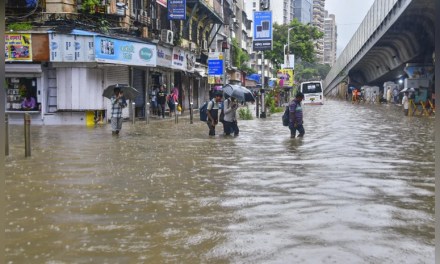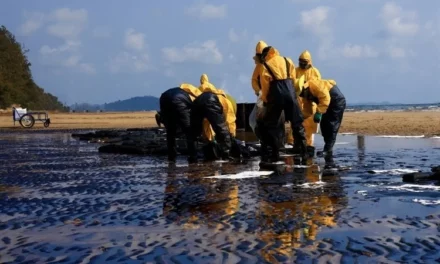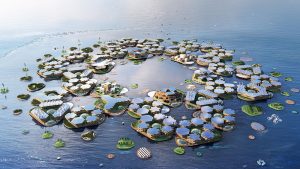
Rising sea levels are an undeniable danger to coastal living. Now, an innovative new project in South Korea intends to solve the climatic phenomena by constructing a sustainable metropolis that will be untouched by rising seas since it would float on top of them.
_______________________________________________________________________
Read Also : Too many choices making decision making difficult for Indian farmers, says a scientist
________________________________________________________________________
South Korea will soon have the world’s first floating metropolis to deal with flooding caused by increasing sea levels.
The UN Human Settlement Programme (UN-Habit) and OCEANIX collaborated on the floating city project. The city will be built off the coast of Busan, South Korea, and is expected to be finished by 2025.
IMPORTANT HIGHLIGHTS
- Off the coast of Busan, the metropolis will be created.
- The floating city’s primary goal is to address increasing sea levels.
- The city will be capable to produce its own electricity as well as food and water.
In relation to the city:
Busan, located just on Korean peninsula’s southeastern point, has secured a deal with UN-Habitat and Oceanix to develop the world’s first floating metropolis. The project, which may be finished as soon as 2025, would serve as a model for coastal communities seeking to battle climate change.
To avoid the possibility of flooding, the floating metropolis will contain ‘flood-proof infrastructure’ and multiple man-made islands. The self-sufficient metropolis will be built to survive natural calamities such as tsunamis, floods, and Category 5 hurricanes.
According to Oceanix’s news release, 40 percent of the global total and 90 % of its “megacities”—typically everyone with populations in excess of 10 million people—are now located within 62 miles of a large coast. As a result, those cities are vulnerable to increasing sea levels, which may uproot millions of people and wreak billions of dollars in global real estate destruction in the coming decades.
Busan, with a population of 3.4 million, is hardly a megacity, but it is Currently The largest port city and the world’s sixth largest. However, the city is not just vulnerable to floods levels; it has also been hit by typhoons and storms in recent years, making it a perfect location for the critical experiment.
_______________________________________________________________________
Read Also : Why a new potato variety could be a game-changed for farmers in East Africa
________________________________________________________________________
“It simply occurred that Busan is the greatest site for us to launch this prototype,” said Oceanix co-founder Itai Madamombe earlier this month. “However, we think that this will be valuable to all coastal cities across the world, as well as all coastal communities confronting the issue of sea-level rise.”
About the city
https://currentaffairs.adda247.com/south-korea-to-get-worlds-first-floating-city-by-2025/
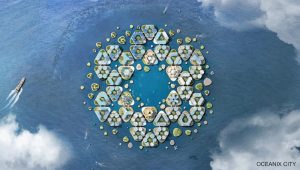
The concept for the metropolis off the coast of Busan was proposed in 2019 during the United Nations’ inaugural workshop on sustainable floating cities. It was created by the Bjarke Ingels Group and is made up of a series of modular hexagonal structures that float on water. It will initially be able to house 10,000 people and will produce its own food (such as scallops and kelp), electricity, and fresh water owing to a fully integrated closed-loop system that produces no waste. The modular architecture will also aid the city’s resilience in the face of natural calamities like as tsunamis, storms, and flooding.
_______________________________________________________________________
Read Also : East Africa’s banana farmers welcome new varieties that resist disease and drought
________________________________________________________________________
UN-Habitat will gather and analyse data from the floating city, and the findings will be used to guide future developments. It may sound far-fetched, but Oceanix is claimed to be in discussions with ten other countries about similar initiatives, a number that might expand if the Busan prototype is successful.
When finished, the city will be able to house 10,000 people in a ‘full-proof infrastructure’ made up of multiple man-made islands.
Tags: #climate, #climatechange, #climatecrisis, #climatic, #environment, #flood-proof, #flooding, #floods, #getgreengetgrowing, #gngagritech, #greenstories, #nature, #sustainable, #world