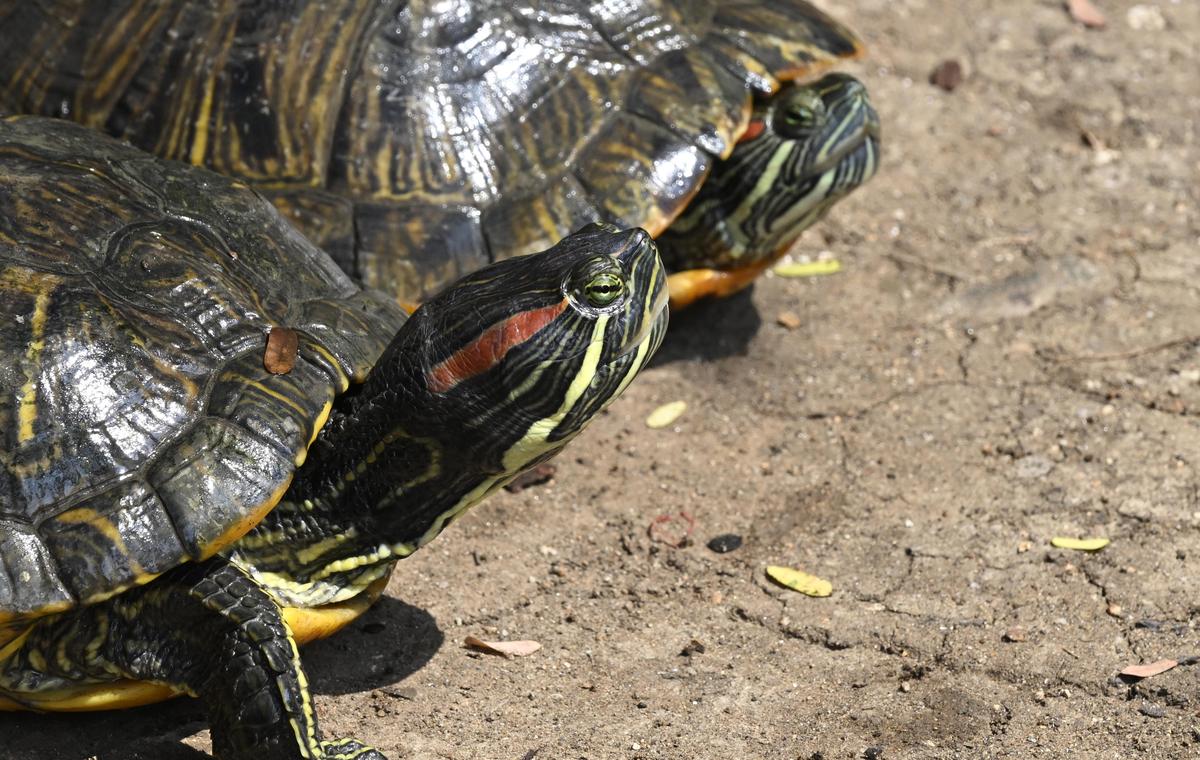
Two red-eared slider turtles sheltered at the avian recuperation centre of the Forest Department in Coimbatore. | Photo Credit: The Hindu
After water hyacinths, another invasive species is posing a threat to tanks and other wetlands in Coimbatore. Red-eared slider turtle, an invasive turtle species that got circulated across countries through pet trade, is the new entrant as two reptiles were accidentally captured by fishermen from a tank in the city recently. The turtles were later handed over to the Forest Department.
The incident has renewed attention on the ecological risks associated with the release of exotic pets like the red-eared slider turtle into natural water bodies.
Native to the United States, red-eared slider is considered one of the world’s most widely introduced freshwater turtles, which now has an established distribution across all continents except Antarctica, posing a threat to native biodiversity, according to experts.
Biologist P. Prasanth said the exotic turtles enters India through exotic pet imports and are commonly sold when they measure less than four inches.
“Many people buy them as ornamental pets, but they grow rapidly and become difficult to maintain. Owners eventually abandon them in lakes, ponds or park water bodies,” he said.
Once released, red-eared sliders breed quickly and expand unchecked due to the absence of natural predators. The species competes directly with India’s native turtles for basking sites, nesting grounds and food. Their aggressive behaviour and higher consumption patterns also affect fish population, disturbing freshwater ecosystems, he added.
________________________________________________________________________
“Weak monitoring and restrictions allow exotic species to enter the country,” said Mr. Prasanth, stressing the need for awareness among students, pet owners, traders, local residents and fishermen about the ecological risks of releasing such pets. Early reporting of sightings, he said, can help remove the turtles before they spread, he added.
“The red-eared slider is highly adaptable and can survive under sub-optimal temperature conditions. Its flexibility allows it to thrive in non-native environments,” said A. Abinesh, a wildlife biologist.
He added that the species exhibits aggressive hunting behaviour during certain periods. “One such phase is during pregnancy, when the turtle requires excess food and easily preys on native aquatic species. They also attack or outcompete other species to assert dominance and maintain hierarchy,” he noted.
In its native habitat, the red-eared slider is predominantly aquatic, becoming terrestrial only when expanding its range. However, in invaded regions, it adopts more terrestrial traits, enabling it to spread across varied landscapes, he added.
District Forest Officer N. Jayaraj said the Forest Department conducts periodical checks at pet shops to check trade of exotic species.
The Forest Department has instructed fishermen to inform upon sighting red-eared slider turtles in tanks in the city and handover, if they are accidentally caught during fishing.
NOTE – This article was originally published in The Hindu and can be viewed here